Most corporate wellness programs fail quietly. Leadership announces a step challenge, 40% of employees sign up in the first week, and by month two, participation drops to single digits. The program technically exists. Nobody uses it. Research on organizational-level participation confirms the pattern — most workplace wellness programs struggle to sustain engagement beyond an initial burst.
The problem isn’t that employees don’t care about their health. It’s that a night-shift warehouse worker, a remote software developer, and a new parent in customer support have wildly different needs — and they’re all getting the same program.
We are consumers inside and outside of work, and we have come to expect a level of personalization and choice in the workplace that we are provided with outside our work life. By understanding and catering to motivations at the individual level, we can unleash the potential of each person.
— Jennifer Hornery, SVP Global People & Culture at Cochlear, via Deloitte Global Human Capital Trends 2025
In our work at Vantage Fit with organizations across industries, we’ve seen a consistent pattern: generic programs plateau at the low end of that range, while personalized wellness programs that adapt to individual needs regularly maintain 60%+ engagement over 12 months. The difference isn’t budget. It’s design.
Key Takeaways
- RAND found only one-fifth to two-fifths of employees use the wellness programs they qualify for, and median participation is 20% with no incentive, 40% with a reward.
- Effective personalization spans 5 layers — most programs only address 1-2.
- A health risk assessment is the right starting point: individual baselines in, personalized recommendations out.
- A composite wellness score gives employees one number to beat and HR one metric to report.
- 20+ activity types sustain engagement far better than step-only programs.
What Personalization Actually Means (And What It Doesn’t)
A personalized wellness program is a health initiative tailored to each individual’s unique needs, goals, and lifestyle rather than offering a one-size-fits-all approach. For HR leaders, personalization shifts the design question from “what activities do we offer?” to “what does each employee actually need?”
There are three distinct levels, and most companies stop at the first two:
- Segmentation divides employees into groups and offers different options per group. Better than nothing, but still a blunt instrument.
- Customization lets employees pick from a menu — yoga or running, meditation or journaling. This feels personal, but the menu itself is still generic.
- True personalization adapts to the individual based on their behavior, preferences, and context — without requiring them to configure everything manually.
Most companies that claim personalization are actually doing customization. The jump to true personalization is where measurable outcomes change.
Why Does Personalization Drive Higher Engagement?
The business case is clear. The RAND Workplace Wellness Study found only one-fifth to two-fifths of employees take part each year in the components they are eligible for, with median participation at 20% where no incentive is attached. Programs that personalize across the dimensions below consistently perform 2-3x better.
The RAND Workplace Wellness Study found that targeted, personalized interventions generated significantly higher savings than generic lifestyle-only programs. SHRM research makes a similar case: personalized benefits signal authentic care for employees as individuals, strengthening their identification with the organization and driving retention and loyalty.
The difference is not the budget. It’s whether employees feel the program was built for them.
| Outcome | Generic Program | Personalized Program |
|---|---|---|
| Sustained participation | 20-40% of eligible employees (RAND) | 50-70% across Vantage Fit programs |
| Program design | Same activities for all employees | HRA-driven, multi-activity, individual goals |
| Employee feedback | "Not relevant to me" | "Feels like it was built for me" |
| Progress tracking | Steps counted, attendance logged | Composite wellness score against personal baseline |
| ROI reporting | Attendance rate only | Wellness trends + department segmentation + biometrics |
The 5-Layer Personalization Framework
Effective personalization operates across five distinct layers. A holistic wellness program addresses all five. Miss any one, and the program feels incomplete.
Layer 1: Health Profile
Understand each person’s starting point: biometric data, chronic conditions, fitness baseline, and health literacy. A health risk assessment captures these inputs through a brief self-assessment, feeding personalized program recommendations without exposing individual data to HR.
The key principle: never assume. A 25-year-old might have a chronic condition. A 55-year-old might run ultramarathons. Profiles must come from actual data, not demographics.
Layer 2: Behavioral Patterns
People engage with wellness differently. Some thrive on competition (leaderboards, team challenges). Others prefer solo, self-paced progress. Forcing introverts into public leaderboards actively drives disengagement.
Capture motivation style, habit patterns, and readiness to change. The Stages of Change model provides a useful framework for matching program intensity to individual readiness.

Layer 3: Life Context
Night-shift workers can’t attend noon yoga. Remote employees don’t benefit from on-site gym access. A single parent’s available time looks nothing like a college graduate’s.
Programs designed for the actual environment employees work in — not the ideal one — get higher participation. Consider work schedules, family situations, financial constraints, and physical environment.
Layer 4: Cultural & Social Dimensions
Meal plans must respect religious dietary requirements and cultural food traditions. Content should be available in employees’ preferred languages. Some cultures view public health discussions as private; others thrive on communal wellness activities.
For global workforces, cultural personalization is the difference between a program that translates and one that doesn’t.
Layer 5: Digital & Communication Preferences
The “last mile” of personalization — how you actually reach people. Channel preference (email, SMS, app, Slack), content format (video, articles, quizzes), and notification frequency all matter. Platforms like Vantage Fit offer 20+ activity types — steps, meals, sleep, meditation, education — so employees can engage through formats that fit their life.
Let employees set their own communication cadence. What feels helpful to one person feels annoying to another.
How to Implement Personalization: Step by Step
Step 1: Start With a Health Risk Assessment
Personalization starts with a baseline. A health risk assessment captures BMI, activity level, blood pressure, and fitness goals through a brief self-assessment. That data feeds personalized program recommendations — structured multi-week programs that adapt to individual fitness levels identified in the HRA.
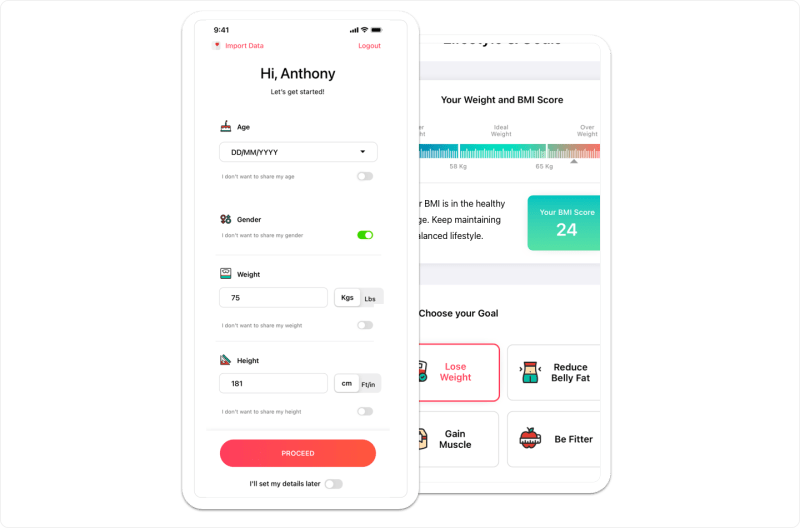
Privacy is non-negotiable: individual data stays private. HR sees only aggregate insights, not individual scores. If employees don’t trust the program with their data, they won’t share it, and personalization fails at the first step.
Step 2: Offer Real Choices Across Wellness Dimensions
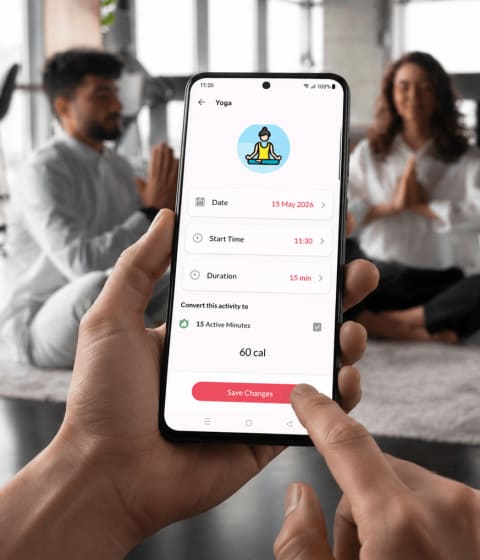
Don’t force everyone into the same activity. Programs with 20+ activity types — steps, meals, sleep, meditation, financial wellness, education — let employees choose what fits their life. Physical, mental, and nutritional wellness in one program, not three separate initiatives.
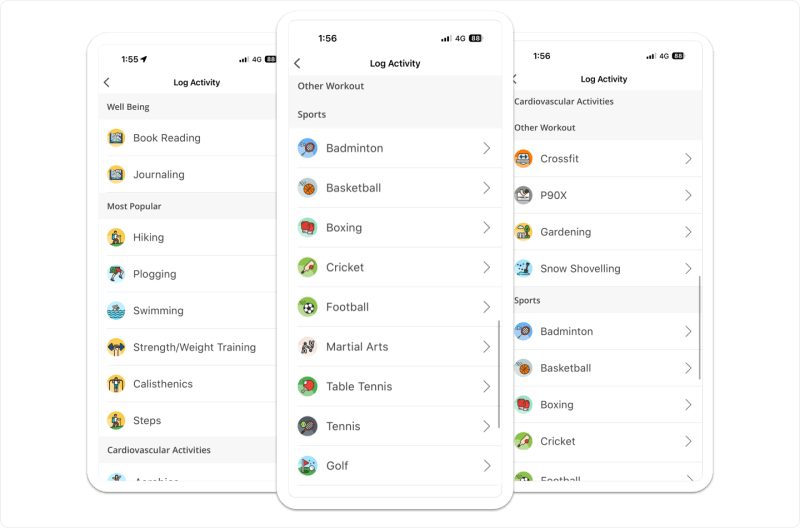
When employees feel ownership over their wellness journey, participation sustains. Build 4-6 tracks with three intensity levels each so the same track serves beginners and experienced participants.
Step 3: Use Data to Adapt, Not Surveil
Data personalization only works if employees trust the program. The distinction: aggregate health insights inform program design and help HR identify which groups need targeted support, while individual data remains private.
Design your program so employees can see their own data clearly, but HR sees only team-level trends. Collect data through voluntary opt-in only. When someone disengages, reduce frequency rather than increasing notifications — respecting boundaries is itself a form of personalization.
Step 4: Track Progress With a Wellness Score
One of the biggest gaps in most wellness programs is the feedback loop — employees don’t know if they’re improving. A composite wellness score combines clinical health data (from the HRA) with behavioral engagement into a single number.
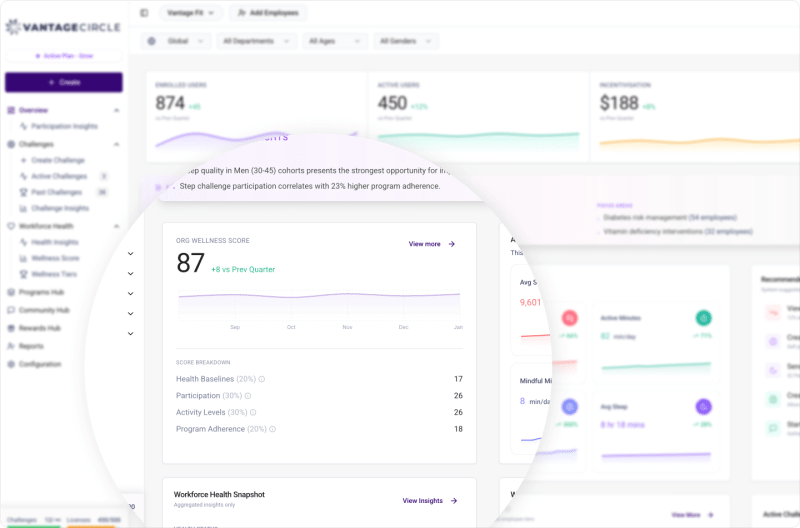
The key design principle: self-referenced, not peer-referenced. Employees are measured against their own history, not the rest of the company. That makes the score motivating, not demoralizing. For HR, it provides a single metric to track wellness trends and report ROI to leadership.
Step 5: Measure, Iterate, and Report ROI
Track participation rate by department, wellness score trends over time, challenge completion rates, and biometric improvements where collected. The most important metric in the first 6 months is sustained participation — behavior change precedes health change.
Build a quarterly review cycle: analyze engagement data, collect short pulse surveys, adjust what doesn’t work, and communicate changes back to employees. Programs that evolve based on employee input maintain engagement 3x longer than static programs. For a deeper look at measurement, see our guide on the ROI of wellness programs.
Frequently Asked Questions
What does a personalized wellness program look like in practice?
Employees complete a health risk assessment that captures their baseline. The platform recommends programs, activity types, and goals matched to their fitness level and preferences. Progress is tracked against personal history rather than company averages.
Is personalization too expensive for smaller companies?
No. Mobile-first platforms make personalization workable for companies with as few as 100 employees. Start with a needs survey, two or three flexible tracks, and a wellness champion per team. Pricing usually scales with headcount.
How do you measure personalized wellness program ROI?
Three measurable outputs: participation rate, wellness score trend, and biometric improvement. Track department-level engagement over time and compare against your pre-personalization baseline. The data is there — if your platform collects and reports it.
How does gamification enhance personalized wellness?
Leaderboards and challenges create friendly competition around personally chosen activities, not just step counts. Real rewards such as gift cards close the motivation loop. Gamification on top of personalized goals sustains engagement better than either alone.