A wellness program for hourly workers is one built around shift patterns, shared devices and short breaks rather than desks and calendars. Make it mobile-first, keep participation to minutes rather than hours, and fund only what a worker can reach while on shift. Hourly staff are not a minority to design around later: 80.5 million people, or 55.7% of all US wage and salary workers, are paid by the hour (Bureau of Labor Statistics, 2023).
Hourly workers are the backbone of our economy, powering essential industries like retail, healthcare, logistics, and hospitality. They work long hours across unpredictable shifts and rotating schedules.
Despite forming the majority of the workforce in many companies, hourly workers often find themselves overlooked when it comes to employee wellbeing.
Most corporate wellness programs are designed with office workers in mind: fixed schedules, long breaks, easy access to emails, and quiet spaces for workshops. For hourly employees, however, this is far from the reality. Their days are unpredictable, time is limited, and work locations constantly shift. Many even juggle multiple jobs.
This creates a significant gap: what companies offer versus what workers can actually access. Gym memberships, virtual wellness talks, and app-based challenges may seem appealing, but for frontline workers, these benefits often feel distant or out of reach. The downstream effect shows up in employee engagement and, eventually, in turnover.
This blog will explore why traditional wellness programs fail hourly workers, what they truly value, and how to design wellness initiatives that align with their unique needs and realities.
Rethinking wellness programs for hourly workers is no longer optional. For the well-being of frontline workers and improved employee retention, companies must design wellness programs that are accessible and tailored to how hourly workers live and work, not to the needs of office teams.
Key Takeaways
- Hourly workers face structural barriers (shift patterns, no desk access, limited break time) that make standard wellness programs ineffective.
- The annual turnover cost for a single hourly employee averages $15,000 to $25,000. Effective wellness programs are one of the most cost-efficient retention tools available.
- Four priorities define what hourly workers actually value: flexibility, accessibility, simplicity, and relevance to day-to-day health challenges.
- Mobile-first, gamified platforms like Vantage Fit are purpose-built for distributed and shift-based workforces, with clients reporting up to 88% participation rates.
- Removing participation barriers matters more than adding more benefits. Inclusive design, not benefit quantity, drives results.
Who Are Hourly Workers?
To design effective wellness programs, HR teams must first understand who hourly workers are. Companies pay these employees by the hour. They work across retail, manufacturing, logistics, healthcare, hospitality, construction, food services, and customer support.
In many industries, they make up the most significant part of the workforce. For some companies, they represent more than half of all employees. They are the essential force driving day-to-day operations.
Their workdays follow no single pattern. Some start before sunrise. Others finish late at night. Many rotate between shifts each week. Work locations change. Break times shift. Schedules are updated with little notice. Many also work more than one job to support their families. Free time stays limited.
Their roles require physical stamina and constant focus. They stand for hours, manage customers, and meet tight targets. Unlike office workers, they rarely get quiet moments during the day.
Reading a message or joining a wellness activity can be challenging during a busy shift. This everyday reality shapes how they experience stress, fatigue, and overall health. When wellness programs ignore these conditions, they lose relevance.
To improve frontline workers’ well-being and support hourly employee retention, companies must start here: by understanding how hourly workers live and work.
Industry context: The average annual turnover rate for hourly workers sits between 20% and 30% in most industries, compared to 13% for salaried employees. Replacing a single hourly employee costs between $15,000 and $25,000 when accounting for recruitment, onboarding, and lost productivity. Wellness programs that reduce burnout and absenteeism are among the most cost-effective retention levers HR teams have.
Where Traditional Wellness Programs Fall Short
Most wellness programs look good on paper. They offer gym discounts. They run mental health webinars. They share long emails about healthy habits. Some provide fitness apps or step challenges. These ideas work for office teams. They fail hourly workers.
Timing creates the first barrier. Sessions often happen during fixed hours. Shift workers cannot attend them.
Location causes the next problem. Many benefits require workers to be on-site or near a partner gym. Frontline teams work across sites and cities.
Technology access adds another layer. Not every worker checks emails daily. Not everyone feels comfortable using apps during work hours.
Communication also breaks down. HR teams send updates through internal portals or long emails. Many hourly workers never see them. Even when they do, the message often feels unclear or rushed.
Most programs also assume workers have spare time and steady routines. Hourly employees do not. They move between shifts. They manage tight schedules. They choose to rest rather than take on extra tasks.
Shift patterns are a health variable in their own right, not only a scheduling problem. NIOSH’s training on shift work and long work hours documents sleep loss linked to insulin resistance, raised evening cortisol and hormone changes that increase hunger, with impaired glucose tolerance measurable after six nights of four-hour sleep. That is the physiology a wellness program for shift-based staff is working against, so accessibility is the whole design problem.
Hourly workers do care about their health. They want support. They cannot access what companies offer today. When wellness feels hard to reach, it stops being wellness.
Erayna Sargent, Founder of Hooky Wellness and a burnout relief specialist who has worked with teams at Microsoft, Google, and Deloitte, captures this gap precisely:
"If you make it available, ensure people are actually using it. People don't believe their organisations or their leaders — so they don't use the benefits that are available."
— Erayna Sargent, Founder, Hooky Wellness | Listen to the full episode
What Do Hourly Workers Really Value?
When asked, hourly workers are clear about their priorities. While pay is important, they also value support, health, and stress management in their daily lives. Four key needs consistently stand out:
| Priority | What workers need | Why it matters |
|---|---|---|
| Flexibility | Options that fit shifting schedules, not fixed timeslots | Fixed-hour sessions exclude most shift workers by design |
| Accessibility | Works on basic phones, across locations, with minimal steps to join | Many hourly workers lack desk or laptop access during shifts |
| Simplicity | Short actions, clear messages, low barrier to start | Complex enrollment or long sessions lead to immediate drop-off |
| Relevance | Support for fatigue, body pain, sleep, stress, and job pressures | Generic wellness content misses the physical demands of frontline roles |
When wellness programs align with these priorities, participation increases, trust builds, and health outcomes improve. Retention follows naturally. Hourly workers know what they need. Companies just need to listen and design accordingly.
Read more on: 10 Proven Benefits of Employee Wellness Programs
How Vantage Fit Makes Wellness Accessible for Hourly Workers
Vantage Fit designs wellness programs that cater to real work lives. Not idealized ones.
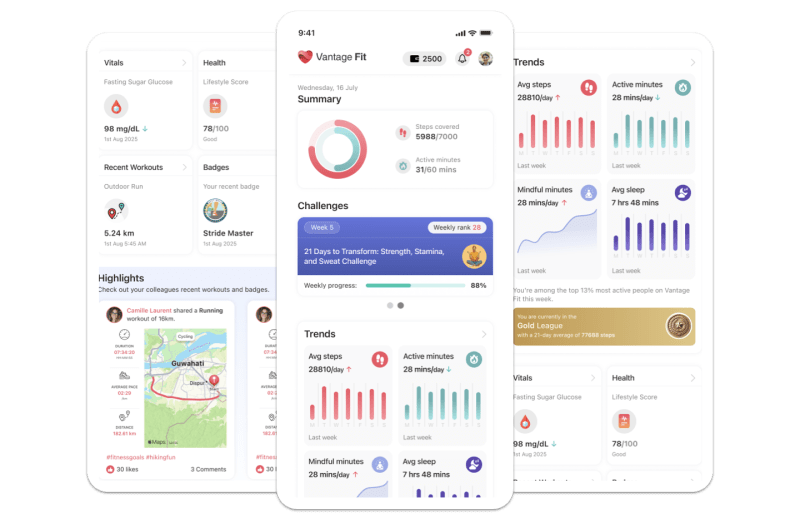
The platform is built mobile-first, so employees can participate during breaks, between shifts, or after work without needing a desk, laptop, or company email. No complex setup. No steep learning curve.
Here is what makes Vantage Fit specifically suited to hourly and frontline workforces:
Flexible, anytime participation. The platform supports various shifts, locations, and job roles. Employees can log activities, join challenges, and track health at any time during their day. Even a five-minute walk counts.
Gamification and Vantage Points. Short fitness challenges, step competitions, and wellness leagues create friendly rivalry between teams and departments. Employees earn Vantage Points for completing activities, which they can redeem for rewards. This keeps participation intrinsically motivated rather than mandatory.
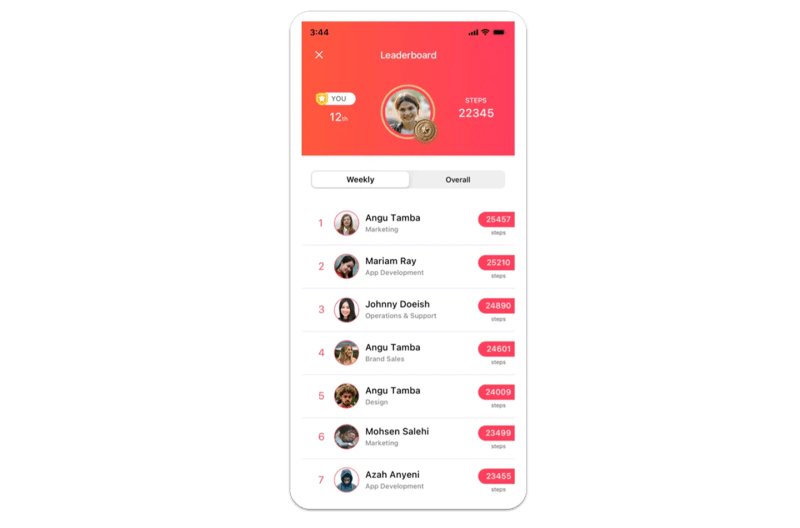
Leaderboards that drive friendly competition. Real-time individual and team leaderboards give workers visibility into how they rank, without requiring manager follow-up or manual tracking.
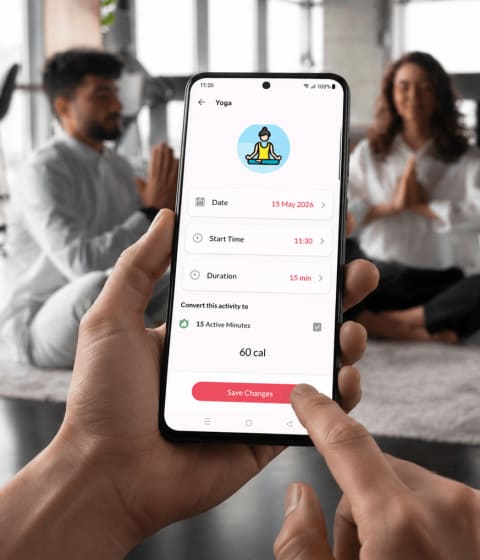
Multi-activity challenge templates. The platform supports running, walking, cycling, yoga, strength training, hydration tracking, and more. Hourly workers with physically demanding jobs can log work-related movement, not just gym visits.
Wearable and app integration. Vantage Fit syncs with Apple Health, Google Fit, Garmin, and Fitbit. Workers who already track movement on a personal device can connect it directly, removing any manual data entry.
Admin dashboard for HR visibility. HR teams get real-time participation data, engagement rates, and health trends by department or location without chasing manual reports.
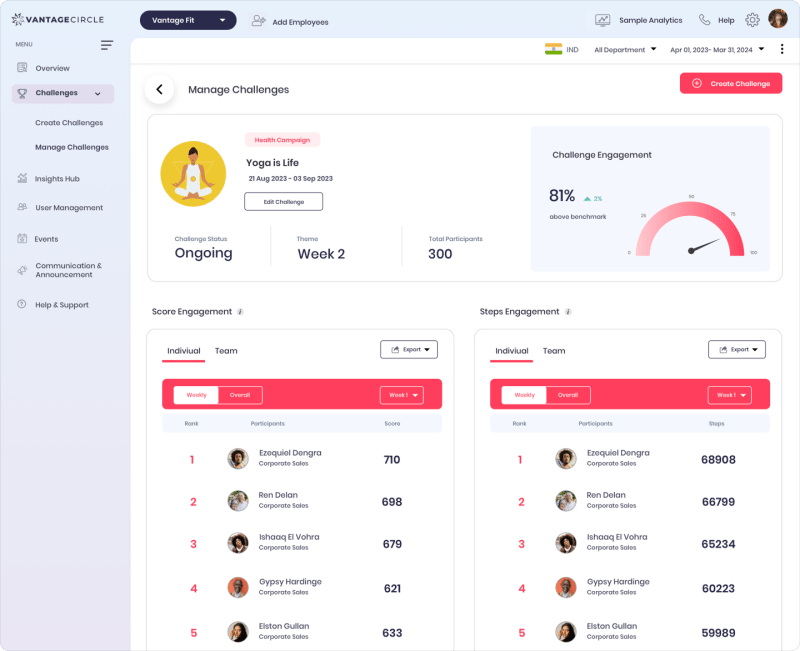
The results are measurable. IBS Software’s 28-day March to Fitness challenge hit 88% employee engagement, with 500+ active participants tracking steps, heart health, and daily mood simultaneously. Tata Motors’ six-month Step & Stride Challenge achieved 59% engagement across 1,248 participants, with employees averaging 6,246 steps per day and logging over 7,200 meals.
Landmark Leisure, a hospitality group whose workforce is almost entirely shift-based and frontline, saw similar outcomes after introducing Vantage Fit across their teams. Tarun Rangwani, Business Head at Citymax Hotels (Landmark Leisure), noted:
"Employees became more consistent, more present in meetings, more cheerful and active."
— Tarun Rangwani, Business Head, Citymax Hotels (Landmark Leisure)
Tip for HR teams: When launching wellness for hourly workers, start with a 21-day step challenge instead of a full program rollout. Short, clear, low-barrier challenges consistently outperform comprehensive programs in first-month adoption rates. Vantage Fit includes ready-to-launch challenge templates you can activate in under an hour.
This enables companies to offer real benefits to hourly workers, supports frontline well-being at scale, and makes inclusive employee wellness not just a goal, but a practical reality.
Read more on: Best Corporate Wellness Companies: A Complete List
Building an Inclusive Wellness Strategy for Hourly Workers
Reaching hourly workers with wellness is not about spending more. It is about removing barriers and designing for their reality. Here is a practical framework HR teams can apply:
1. Audit access first. Before choosing any tool, map where and how your hourly workforce connects to company information. If most employees check a shared tablet during breaks, your wellness program needs to work on that device in under 60 seconds.
2. Start with physical health. Fatigue, back pain, and sleep disruption are the most reported health issues among hourly workers. Programs that address these immediately earn trust. Generic stress management content can come later.
3. Use short, recurring challenges. A 10,000 steps-per-day challenge that runs for 30 days outperforms a quarterly wellness month that no one remembers by week two. Recurring short programs build habits.
4. Involve team leads early. Frontline supervisors have more daily influence over hourly workers than HR does. When managers participate visibly, participation rates increase significantly. Across Wipro’s 2025 global wellness challenges, active participation grew 3X, from 163 to 550 users, as program visibility among team leads expanded challenge by challenge.
5. Measure and share outcomes. Participation data, average step counts, and challenge completion rates belong in your monthly HR dashboard, not a quarterly report no one reads. Visibility keeps leadership committed and workers engaged.
Final Thoughts
Wellness programs should support the people who keep businesses running every day.
Hourly workers face strict limits on time, access, and energy. When programs overlook these realities, even the best ideas fall flat. But when companies design for real work conditions, participation increases, trust builds, health outcomes improve, and retention becomes easier.
Inclusive employee wellness is not about adding more benefits. It is about making them usable for everyone, especially your hourly workers.
For HR leaders, this shift is crucial. Accessible wellness programs not only help teams feel seen and supported but also strengthen frontline well-being, turning wellness from a policy into a real business advantage.
Frequently Asked Questions
What are examples of employee wellness programs for hourly workers?
Effective wellness programs for hourly workers include mobile-accessible step challenges, short fitness activities that fit into break times, hydration and sleep tracking, stress management micro-sessions, and gamified team competitions with point-based rewards.
The key distinction from standard programs is that these initiatives require no fixed schedule, no desk or laptop, and no long sessions. Examples include a 21-day walking challenge, a monthly hydration goal, or a shift-friendly posture and stretch routine that employees can complete in five minutes.
How much does a wellness program cost per employee?
Costs vary widely depending on program scope and vendor. Basic digital wellness platforms typically range from $2 to $10 per employee per month. Comprehensive enterprise programs with wearable integration, rewards, and dedicated support can run higher, but the ROI case is strong.
Companies using platforms like Vantage Fit report average savings of $250 per employee annually through reduced absenteeism and lower healthcare utilization. When you factor in that replacing one hourly employee costs $15,000 to $25,000, a wellness investment that improves retention by even a few percentage points pays for itself quickly.
How do you create a wellness program for shift workers?
Start by mapping how your hourly workforce actually accesses information: shared tablets, personal phones, or break room screens. Then choose a platform that works within those constraints, ideally one that is mobile-first and requires no company email to sign up.
Build the program around asynchronous participation, so employees on night shifts or rotating schedules can join the same challenge as day workers. Short daily or weekly goals work better than month-long programs. Always pilot with one department or location first, gather participation data, and then scale what works.
What wellness activities work best for hourly and frontline employees?
The most effective activities are ones that acknowledge the physical nature of frontline work rather than ignoring it. Step challenges, hydration reminders, posture and stretch breaks, sleep tracking goals, and short breathing exercises all work well because they address the health issues hourly workers actually experience: fatigue, body pain, sleep disruption, and stress.
Gamified formats, such as team leaderboards, point rewards, and completion badges, consistently outperform generic wellness content because they create a social dimension that motivates ongoing participation without requiring extra time.