
Most corporate wellness programs see sustained participation rates of just 20–30% past the first month. Adding a charitable cause to a step challenge at work addresses that problem directly. When every step an employee takes translates into real donations for a cause they care about, participation becomes personal.
A step challenge for charity gives HR leaders a rare opportunity to address two strategic priorities with one program. The wellness side produces measurable physical activity data, participation rates, and engagement metrics. On the CSR front, you get charitable impact numbers, employee sentiment data, and ESG-ready reporting. It is one of the few workplace initiatives that can credibly claim both outcomes from a single rollout.
This guide covers the full process of planning and running a charity step challenge at your workplace. You will find donation models with budget calculations, step goal benchmarks drawn from real corporate data, eight themed challenge ideas with charity pairings, and a platform comparison framework for tracking it all.
Key Takeaways
- A charity step challenge delivers dual ROI for HR teams: wellness engagement metrics and CSR impact data from one initiative.
- Per-step donation models (at $0.01–$0.05 per step) give employees a tangible reason to stay active, while tiered milestone models offer more budget predictability.
- Set daily step goals at 6,000–8,000 steps for inclusive participation. The 10,000-step target excludes a large share of sedentary employees.
- Corporate wellness platforms outperform consumer charity apps for organizations with 500+ employees because they offer admin dashboards, team management, and exportable reporting.
Why Run a Charity Step Challenge at Work

Purpose-driven challenges consistently outperform reward-only programs in sustained participation. When employees know their daily steps fund meals for families, school supplies for children, or medical research, they engage more consistently and stay active longer. The motivation shifts from personal fitness tracking to collective impact.
Standard corporate step challenges typically see sustained participation rates of 20–30%. Charity-linked step challenges regularly exceed this baseline because they add an emotional layer that personal reward systems cannot replicate. Tata Motors saw 59% engagement in their multi-activity challenge. Adding a charitable donation component to a similar initiative amplifies that effect by giving employees a reason to participate that extends beyond their own health goals.
For HR leaders evaluating a corporate step challenge solution, the dual-benefit framework is the strongest business case. A single charity step challenge produces two distinct sets of leadership-ready metrics.
| Wellness Outcomes | CSR Outcomes |
|---|---|
| Steps tracked across the workforce | Total funds raised for charity |
| Participation rate (%) by department | Charity impact delivered (meals, supplies, etc.) |
| Average daily steps per employee | Employee sentiment and satisfaction |
| Health outcomes (weight, activity levels) | ESG report contribution |
| Engagement vs. previous wellness programs | Employer brand and media mentions |
The result is a program that satisfies both the wellness committee and the CSR team. Instead of running separate initiatives and competing for budget, HR can present one program with two measurable outcomes to leadership.
How to Set Up a Step Challenge Fundraiser
A successful charity step challenge requires more planning than a standard wellness challenge. Each decision in the setup process affects participation, budget, and charitable impact. Wipro saw a 3X participation increase across three structured challenges, which underscores how planning directly influences outcomes. Here is a six-step process for HR admins.
1. Define dual goals (wellness + fundraising target). Set a specific wellness target (e.g., 80% participation rate) alongside a fundraising target (e.g., raise $3,000 for a local food bank). Having both goals stated upfront frames the challenge as more than a fitness program.
2. Choose a charity partner. Select a nonprofit that aligns with your company's values and resonates with employees. More detail on this in the section below.
3. Set duration and step goals. A 4–6 week challenge window works best for sustained engagement without fatigue. Daily step goals should be inclusive, not aspirational. See the goals section below for specific benchmarks.
4. Choose a tracking platform. Decide between consumer charity apps and corporate wellness platforms based on your organization's size and reporting needs.
5. Set the donation structure. Choose from per-step pledges, flat donations, tiered milestones, or employee matching. Each model has different budget implications covered in the donations section below.
6. Launch and promote. Announce the challenge at least two weeks before the start date. Share the charity story, explain how donations work, and make sign-up effortless. Use email, Slack, intranet, and team meetings to build early momentum.
| Company Size | Recommended Duration | Rationale |
|---|---|---|
| Under 200 employees | 2–3 weeks | Smaller teams build momentum quickly. Shorter timelines maintain urgency. |
| 200–1,000 employees | 4 weeks | Enough time for cross-department engagement without fatigue. |
| 1,000+ employees | 5–6 weeks | Large organizations need ramp-up time. Longer windows allow for staggered onboarding. |
Choosing a Charity Partner
The charity you select directly affects employee buy-in. Three criteria help HR teams make the right choice. First, look for alignment with your company's industry or values. A healthcare company partnering with a disease-research charity feels authentic. A tech company funding STEM education makes natural sense.
Second, verify transparency. Charities with strong Charity Navigator ratings or equivalent third-party audits give employees confidence their steps are making a real difference.
Third, consider letting employees vote. Presenting three shortlisted charities and inviting the workforce to choose increases personal investment in the outcome. When employees select the cause, they feel ownership over the challenge from day one.
Setting Step Goals and Duration
Set daily step goals at 6,000–8,000 steps for inclusive participation. The popular 10,000-step target puts off a significant share of sedentary employees and reduces sign-ups before the challenge even starts. Tata Motors achieved 7,600 average daily steps across their workforce, which demonstrates that a mid-range step goal drives broad adoption without alienating less active participants.
For duration, 4–6 weeks is the sweet spot. Shorter challenges (under two weeks) do not give slower adopters enough time to build the habit. Longer challenges (over six weeks) risk fatigue. Setting a clear step goal and timeline upfront helps employees plan their routines around the challenge.
Choosing a Tracking Platform

HR teams choosing a challenge app for a charity step challenge face two categories of tools: consumer charity apps and corporate wellness platforms. Consumer apps like Charity Miles and Charity Footprints are designed for individuals and small groups. They handle donation tracking natively but lack the admin controls large organizations need.
Corporate wellness platforms let HR admins launch step challenges quickly with pre-built templates, real-time leaderboards, and wearable sync. These platforms are built for organizations with 500+ employees and offer the reporting depth HR leaders need for post-challenge analysis.
For organizations running a virtual step challenge across multiple offices or countries, corporate platforms offer the infrastructure to manage teams, sync devices, and generate unified reports. For smaller teams under 100 employees, consumer apps may be sufficient. For a deeper comparison of available tools, see this guide on step challenge apps.
| Feature | Consumer Charity Apps | Corporate Wellness Platforms |
|---|---|---|
| Best for | Individuals and teams under 100 | Organizations with 500+ employees |
| Donation tracking | Native | Via finance team integration |
| Admin dashboard | None or limited | Full admin controls |
| Team management | Basic | Multi-department, multi-region |
| Wearable sync | Select devices | Broad device and app support |
| Exportable reports | No | Yes (ESG and HR reporting) |
| Examples | Charity Miles, Charity Footprints | Vantage Fit, corporate wellness suites |
How Charity Step Challenge Donations Work

The donation model you choose determines both the budget impact and the employee experience. Four models work well for corporate charity step challenges.
1. Per-step pledge. The company donates a fixed amount for every step employees take. Common rates range from $0.01 to $0.05 per step. This model creates the strongest engagement because every step literally counts toward the charity goal.
2. Flat corporate donation. The company commits a fixed donation amount (e.g., $3,000) contingent on the team reaching a collective step goal. This offers complete budget predictability but less individual motivation.
3. Tiered milestones. Donation amounts increase at predefined collective step thresholds. For example: 50 million steps unlocks $1,000, 75 million unlocks $2,000, and 100 million unlocks $3,000. This creates natural momentum as teams chase the next tier.
4. Employee matching. The company matches employee pledges or personal donations. This doubles the charitable impact and signals leadership buy-in. It also gives employees a direct financial stake in the outcome.
| Donation Model | 500 Employees x 30 Days | Estimated Cost |
|---|---|---|
| Per-step ($0.01/step) | 500 x 7,000 steps x 30 = 105M steps | $1,050 |
| Per-step ($0.025/step) | Same calculation | $2,625 |
| Flat donation | Goal: 50M collective steps | $3,000 (fixed) |
| Tiered milestone | 50M = $1K, 75M = $2K, 100M = $3K | $1,000–$3,000 |
The per-step model works best for engagement because employees see a direct connection between their daily activity and the charity outcome. Tiered milestones offer more budget control while still creating collective momentum.
For budget planning, the per-step model at $0.01 per step is the most affordable option for most organizations. At an average of 7,000 daily steps per employee, a 500-person company would invest roughly $1,050 over 30 days. That is under $2.10 per employee for a full month of wellness engagement and charitable impact.
8 Charity Step Challenge Ideas for the Workplace
The best step challenges pair a compelling theme with a matching charity cause. Here are eight ideas designed for corporate teams, each with a suggested charity type. For more wellness challenge ideas, see our full roundup.
1. Steps Around the World
Set a collective step goal equivalent to a real-world distance (e.g., New York to London = ~5,570 km or ~7.3 million steps). Track the team's virtual journey on a map. Partner with a global health charity like Doctors Without Borders or UNICEF.
2. Department vs. Department
Teams compete by department, and the winning department selects the next charity partner. This format drives inter-team rivalry and gives winners a meaningful reward beyond a trophy.
3. Walk-a-Thon Week
A concentrated five-day sprint with per-step pledges. The short timeline creates urgency. Partner with a local charity to keep the impact visible and tangible for employees.
4. 10K Steps for Cancer
Align the challenge with an awareness month (October for Breast Cancer, November for Movember). Employees aim for 10,000 daily steps during the awareness period. Partner with disease-specific charities like the American Cancer Society or Movember Foundation.
5. Steps for Schools
Partner with an education charity. Set milestone-based goals where every million collective steps funds a specific deliverable (100 backpacks, 500 books, or 50 laptops). The tangible outcome keeps employees motivated.
6. Million Step March
A company-wide collective goal of one million steps. Celebrate milestones at 250K, 500K, 750K, and 1M with announcements and progress updates. As the Landmark Group walkathon case study shows, large-scale collective goals drive significant activity.
7. Walk and Talk
Combine walking meetings with step tracking. Donate per meeting-step logged. Tie the challenge to a mental health charity to reinforce the connection between movement, mental wellbeing, and social impact.
8. Holiday Giving Challenge
A December challenge where steps convert to toy or food donations. Partner with local food banks or toy drives. The holiday season naturally amplifies generosity and participation.
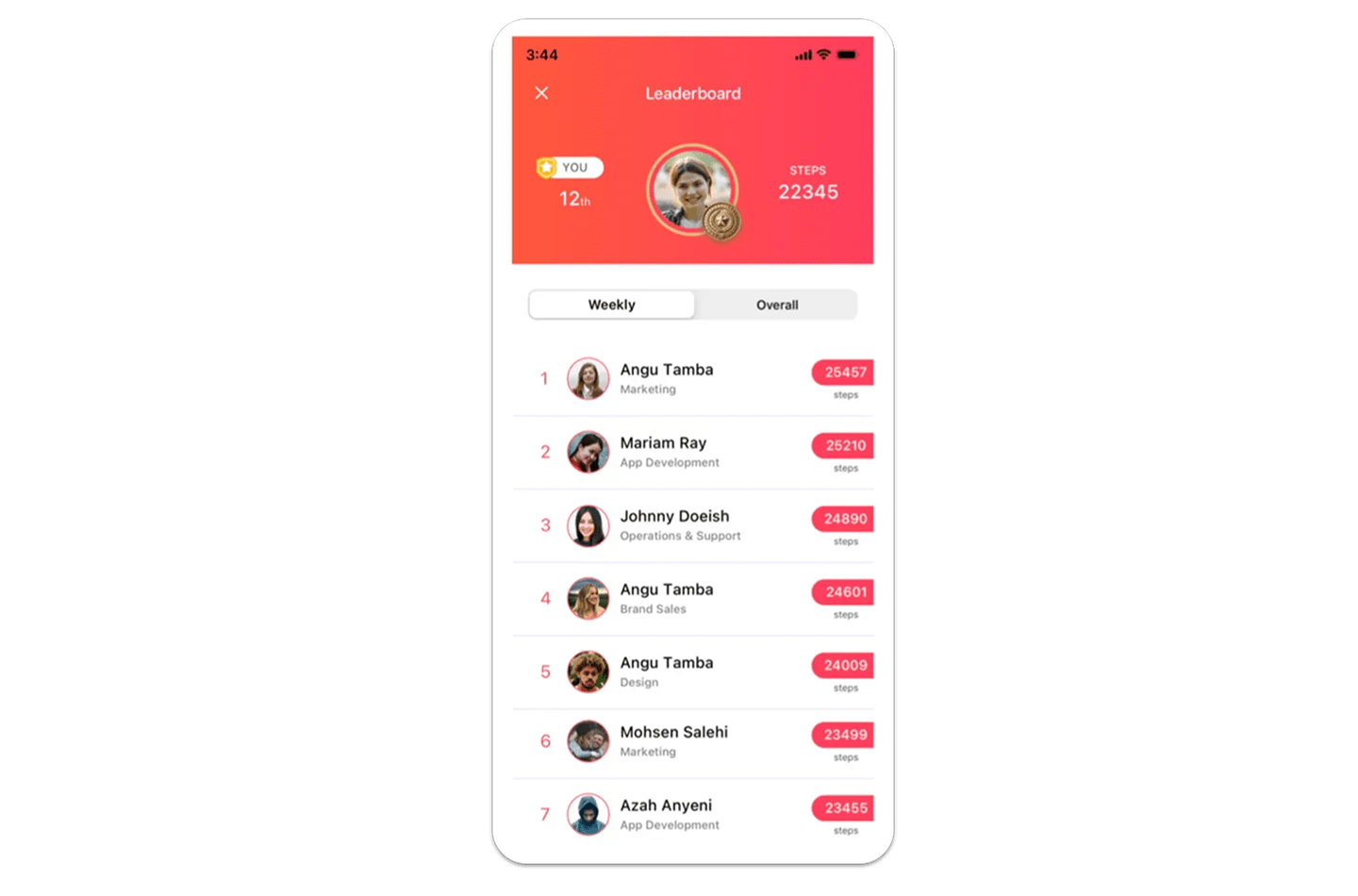
Real-time leaderboards keep the competition visible across all these formats. Platforms like Vantage Fit display individual and team rankings, turning each step into a public commitment to the charity cause.
Launch your next corporate step challenge with built-in leaderboards and team tracking.
Frequently Asked Questions
1. What is a good step goal for a charity challenge?
6,000 to 8,000 steps per day. This range is achievable for most employees and drives broad participation. Avoid 10,000 steps — it discourages less active staff from signing up.
2. How do you track steps for a charity challenge?
Small teams (under 100) can use consumer apps like Charity Miles or Charity Footprints. Organizations with 500+ employees should use a corporate wellness platform for admin dashboards, team management, and exportable reporting.
3. How much should a company donate per step?
$0.01–$0.05 per step is the standard range. At $0.01 per step, a 500-person company investing over 30 days spends approximately $1,050. Use tiered milestones if you need a firm budget cap.
4. Can a step challenge count toward CSR reporting?
Yes. Track total funds raised, charity deliverables funded, and employee participation rate. These metrics slot directly into ESG and CSR annual reports.
Turn every employee step into measurable wellness engagement and charitable impact. See how a corporate step challenge platform works.