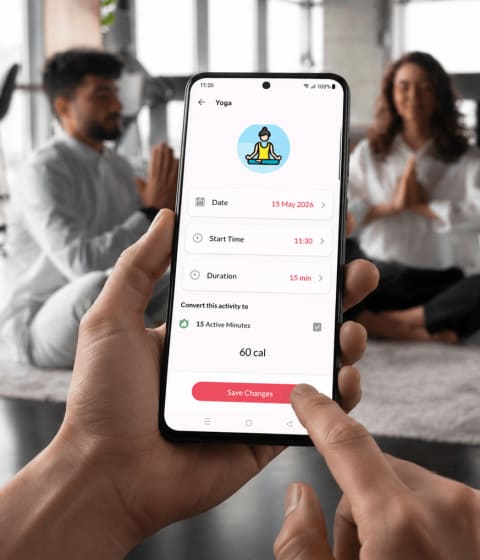
A wellness platform is the single app or portal where your employees track their health, join challenges, and claim rewards. Choosing one comes down to eight things: feature breadth, user experience, gamification, integrations, data privacy, analytics, scalability, and pricing. Adoption decides the rest.
Adoption is also where the money sits. Turnover costs employers around $15,000 per worker, and well-run workplace wellness programs return $3.27 in reduced medical costs for every dollar spent, supported by a wider body of wellness ROI research. A platform nobody opens returns none of it.
Vantage Fit is a corporate wellness platform built for companies running exactly that kind of program, on native mobile apps, gamified challenges, and real rewards. It sits below as one option among several, held to the same eight criteria as the rest.
Let’s start with the eight criteria.
Key Takeaways
- Choosing a wellness platform is a retention decision. Surveys show around two-thirds of employees would switch jobs for better benefits.
- Prioritize adoption over features. The best corporate wellness platform is the one your team actually uses. Test UX and mobile access first.
- Run a pilot before committing. A 4–8 week trial with diverse employees uncovers real engagement levels no demo reveals.
- Verify data privacy upfront. Demand HIPAA, SOC 2 Type II, and clear data ownership before shortlisting vendors.
- Insist on outcome proof. Request engagement benchmarks and client results, not feature checklists.
- Calculate cost per active user, not sticker price. A cheap tool that few employees open costs more per person reached than a pricier one they use.
How to Evaluate a Corporate Wellness Platform: 8 Key Criteria
Selecting a platform requires looking beyond the surface level of flashy interfaces. You are building a digital home for your company’s health culture. These specific factors determine whether your program will flourish or fade into the background.
| Evaluation Criterion | What to Look For | Red Flag |
|---|---|---|
| Feature Breadth | Physical + mental + nutritional wellness in one platform | Steps-only or single-dimension tools |
| User Experience | Native mobile apps, intuitive navigation, consumer-grade UX | Browser-only, clunky interface, steep learning curve |
| Gamification | Leaderboards, challenges, streaks, real rewards | No social or motivational mechanics |
| Integrations | Wearable sync (Apple Watch, Fitbit, Garmin), HRIS integration | Manual entry required |
| Data Privacy | HIPAA compliance, SOC 2 Type II, data ownership clarity | Vague security claims, no audit documentation |
| Analytics & ROI | Real-time aggregate dashboards, engagement benchmarks | No reporting or only login-based metrics |
| Scalability | Modular features, multi-region support, flexible licensing | Rigid bundles, single-market only |
| Pricing | Per-user pricing, predictable TCO, no hidden fees | Multi-year lock-in with unclear add-on costs |
A Holistic and All-Inclusive Feature Set
Modern employees require support that spans multiple dimensions of their lives. An effective platform should act as a centralized hub for physical, mental, financial, and social well-being, the four pillars of a holistic employee wellness strategy.
When evaluating UX, ask vendors for real participation data. Wellness platforms with intuitive, native mobile apps consistently outperform browser-based tools.
For instance, Tata Motors saw 59% engagement and IBS Software hit 88% engagement. Both results came from programs where the platform was mobile-first with gamification and real rewards.
Providing a single point of entry for these various services simplifies the user experience and encourages broader participation.
A Consumer-Grade User Experience (UX)
Your employees use seamless, high-quality apps in their personal lives and expect the same level of polish at work. If a platform is difficult to navigate or requires a steep learning curve, adoption will naturally suffer.
Prioritize an intuitive, mobile-optimized interface that makes logging an activity or joining a challenge feel like a natural part of the workday.
Behavioral Science and Gamification
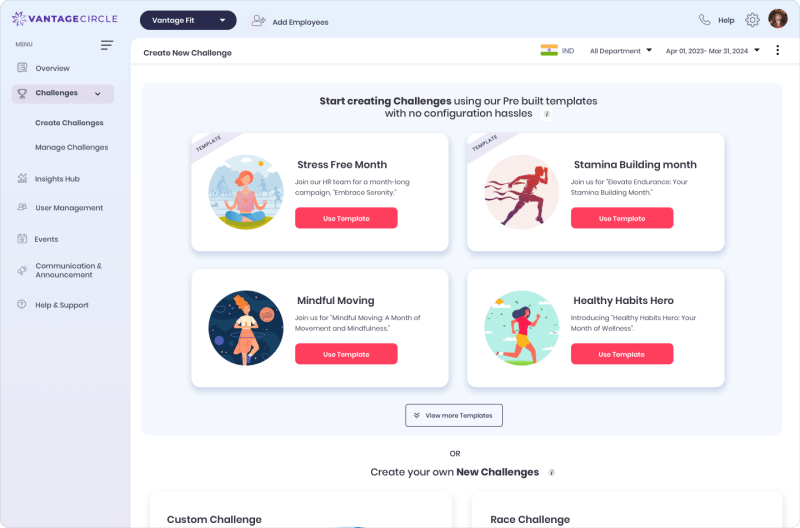
True engagement requires more than just high-quality content; it requires motivation. The best wellness platforms utilize gamification strategies like leaderboards, team challenges, and social streaks to make healthy habits feel rewarding.
These social elements foster a sense of community and friendly competition, which are powerful drivers for building lasting healthy habits.
Deep Integration and Technical Flexibility
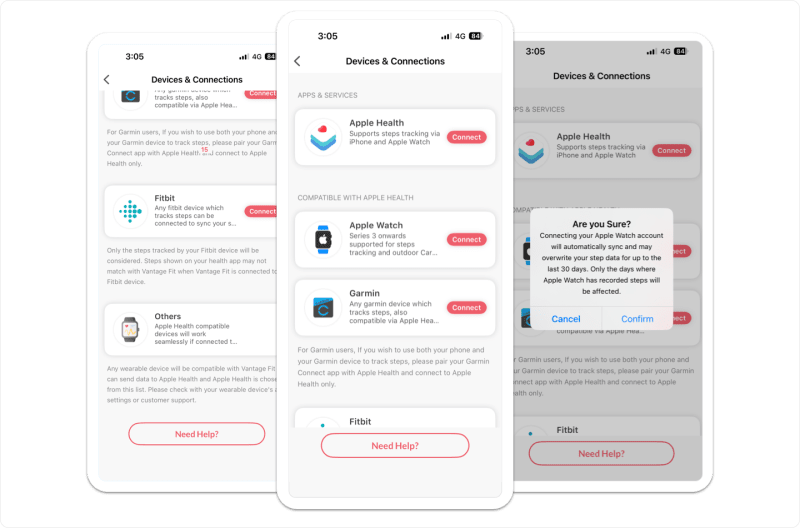
A corporate wellness platform should enhance your existing ecosystem rather than create a new silo of data. Ensure the vendor can integrate with your HRIS, payroll systems, and a wide array of wearable devices and biometric tools like Fitbit or Apple Health.
This connectivity allows for automated data tracking, which removes the burden of manual entry from your employees and provides administrators with a more accurate view of population health.
Program Scalability and Customization
Your organization’s needs will likely change as you grow.
A modular platform allows you to start with core features. Then expand into more complex offerings like financial wellness coaching as your budget and goals evolve.
Vantage Fit works this way. Health Insights and Wellness Score are admin dashboard modules available to annual clients, and lab report upload is switched on separately through your account manager. Each gives HR a different read on workforce health: biomarker trends, an org-level score, and extracted lab values.
Additionally, the ability to white-label the portal with your company’s branding helps build trust and ensures the program feels like an internal initiative rather than a third-party add-on.
Ironclad Data Privacy and Compliance
Handling sensitive health information (PHI) brings significant legal and ethical responsibilities. Your vendor must comply with HIPAA, ADA, and GINA. Ask for documentation upfront. If they hesitate, that tells you something. For global teams, also verify GDPR compliance, a non-negotiable for any EU workforce.
Be diligent in requesting SOC audits, their encryption standards, and their disaster recovery plans to ensure they can handle data securely and transparently. Vantage Fit’s employee health risk assessment shows how this works in practice: each employee sees a private score, and HR sees only aggregate counts.
Real-Time Analytics and ROI Measurement
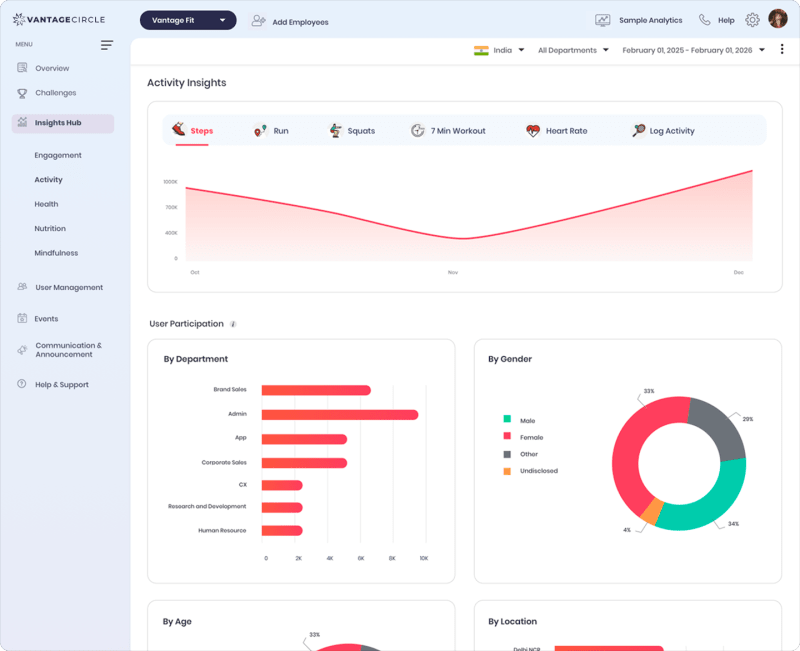
To justify your investment to executive leadership, you need access to real-time aggregate reporting. Look for dashboards that track not only participation rates but also sentiment indicators and health outcomes. Having access to this data-driven wellbeing view allows you to prove the program’s value and make informed adjustments to your strategy over time.
Transparent Pricing and Long-Term Value
Transparent pricing models with predictable total costs of ownership are vital for budget planning. While cost is always a factor, a cheaper solution with low participation ultimately provides less value than a more robust platform that employees actually use.
Seek flexible licensing tiers such as per-user or per-subgroup pricing to ensure the platform scales efficiently with your workforce.
Types of Employee Wellness Platforms: Which Category Fits Your Needs?
The market is fragmented, with different vendors specializing in various aspects of health. Understanding these categories helps you narrow your search based on your primary objectives.
Agnostic Wellness Portals
These platforms act as an open “one-stop-shop” that integrates specialized third-party applications and services. Choosing an agnostic provider allows you to retain control over your wellness ecosystem, meaning you can swap individual services or vendors without needing to replace the entire platform.
All-Inclusive or Holistic Platforms
These are comprehensive solutions that provide a start-to-finish experience within a single site or app. They typically house everything from health coaching and trackers to education and social challenges under one login, which is ideal for companies seeking a unified, turnkey experience.
Mental Health Focused Platforms
Some platforms prioritize emotional well-being, offering specialized tools like one-on-one video therapy, stress-reduction resources, and confidential support groups. These are particularly effective for organizations looking to address high levels of burnout or stress-related absenteeism. For a deeper look, see our guide on corporate mental health programs.
Fitness and Activity-Only Apps
These niche solutions focus primarily on physical movement, often through gym stipends, step tracking, and athletic challenges. While they are excellent for promoting physical activity, they may lack the breadth needed to address more complex health issues like chronic condition management or financial stress.
Step-by-Step Process to Evaluate and Select the Right Wellness Platform
Selecting the right partner is a strategic project that benefits from a structured approach. Following these steps helps ensure that you arrive at a decision supported by data and stakeholder buy-in.
Step 1: Define Requirements and Prepare an RFP
Begin by identifying the specific challenges you wish to solve, such as rising healthcare premiums, low morale, or high turnover. Conduct an employee interest survey to understand which resources your staff actually wants, as their input is vital for long-term engagement.
Multiple surveys now link wellbeing benefits directly to retention, with roughly half of employees saying benefits are a deciding factor in whether they stay with their current employer.
Once you have identified your “must-have” features, draft a Request for Proposal (RFP) that outlines your user count, compliance needs, and technical requirements. This formal document forces vendors to be specific about how their solution meets your unique needs.
Step 2: Shortlist Vendors and Conduct Demos
Research the market and narrow your options to a shortlist of three to five candidates. When you arrange for product demos, invite representatives from IT and legal to evaluate technical security, and include a few employee representatives to provide an end-user perspective.
During the demo, pay close attention to the visual appeal and intuitiveness of the navigation. Ask difficult questions about uptime reliability and data export options to see how the vendor handles technical transparency.
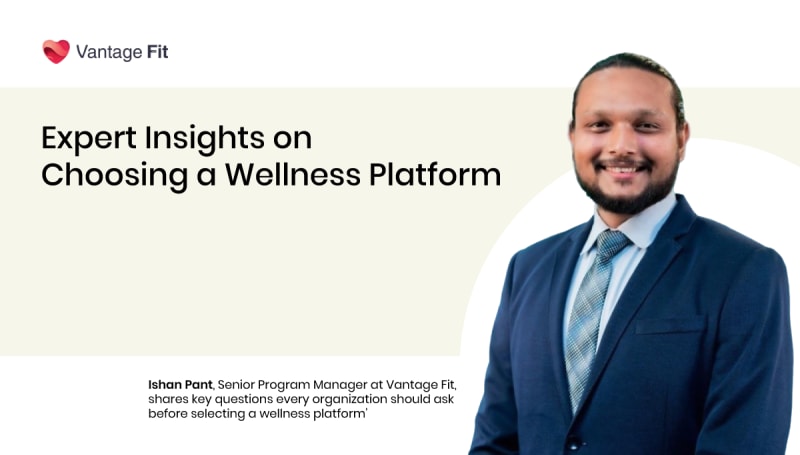
Ishan Pant, Senior Program Manager at Vantage Fit, emphasizes that while many vendors articulate their capabilities well, few can truly demonstrate real outcomes and the capacity to support a workforce at scale.
Below are a few questions to keep in mind during your demos and evaluations to ensure you find the best fit for your organizational culture:
- How do you measure authentic engagement versus passive participation, and what are your benchmarks for success?
It is common for vendors to report high numbers based on simple logins, but true value comes from deep, consistent interaction. You should ask for clarity on how they define an “active” user and what benchmarks they use to prove outcomes for companies similar to your own.
- What specific strategies do you use to re-engage employees who have dropped off from wellness activities?
Maintaining momentum is one of the greatest challenges in any wellness program. You want a vendor that uses sophisticated engagement strategies to tailor incentives and challenges for different motivation styles rather than a one-size-fits-all approach.
- How do you handle data discrepancies and syncing reliability when employees use multiple personal tracking devices?
Technical transparency is vital when employees use various tools like Fitbit, Apple Health, or Google Fit simultaneously. Inquire about how the platform ensures tracking accuracy and what data variance thresholds they guarantee to prevent frustration among your users.
- What specific health and productivity metrics do you track to demonstrate ROI beyond simple participation rates?
To justify your investment, you need data that connects program usage to business outcomes. Ask about their ability to provide predictive analytics and customizable reports that identify at-risk employees or predict program success for your leadership team.
- Can you provide a detailed implementation timeline and explain how you support cultural adoption beyond basic communication templates?
A platform is only successful if it becomes part of the daily work life. You should understand their tech refresh cycle and what specific training programs they offer for administrators and employee champions to ensure the platform remains stable and relevant as you grow.
To know more about the specific inquiries that reveal a provider’s true operational reality, you can check our dedicated blog on over forty essential RFP questions.
Step 3: Run a Pilot Program
A polished sales demo shows you the product at its best, so committing to a full-scale rollout on that alone involves significant risk. A pilot program lasting four to eight weeks with a small, diverse group of employees reveals real-world engagement levels and technical hitches.
Monitor the data closely to see which features are popular and which cause confusion. Gathering qualitative feedback during this phase allows you to address issues like “annoying notifications” before the platform is launched to the entire company.
Tip: Start your pilot with a cross-functional group. Include remote employees, field workers, and office staff to test adoption across work styles.
Step 4: Evaluate Results and Finalize the Contract
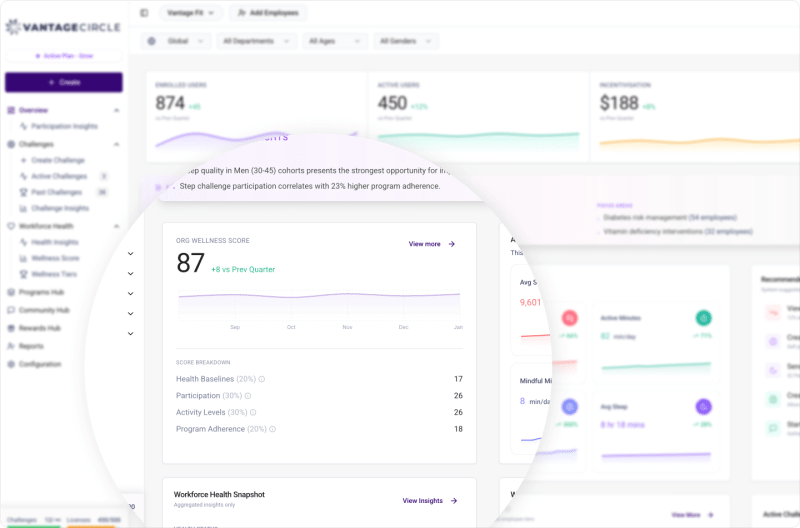
Use the data from your pilot to build a final business case for executive buy-in. When you move to the contract stage, pay careful attention to the Service Level Agreements (SLAs), data ownership clauses, and renewal terms.
Ensure that the pricing structure is predictable and matches your previous discussions to avoid surprises later. Once the legal and procurement teams have reviewed the terms, you can confidently sign the agreement and begin your rollout.
Common Mistakes to Avoid When Choosing a Wellness Platform
Even experienced leaders can fall into traps that derail a program before it truly begins. Recognizing these pitfalls is the first step toward avoiding them.
Signing Long-Term Contracts Too Early
Be cautious of vendors that insist on multi-year commitments from the start. It is often wiser to seek an initial one-year agreement, or a month-to-month plan that scales with engagement. A vendor should earn your loyalty through consistent results and usability.
Prioritizing Cost Over Value
The cheapest option often lacks the reporting depth, integration, or engagement tools necessary for success. Investing in a high-quality solution with a slightly higher price point often yields a much better return on investment. See the benefits of employee wellness programs and real cost comparisons in our corporate wellness programs cost breakdown.
Ignoring the Voice of the Employee
Selecting a corporate wellness software based only on what HR likes is a common mistake that leads to low participation. A program that misses what employees actually want, whether that is cash incentives or mental health resources, fails to gain traction.
Choosing a Rigid, One-Size-Fits-All Approach
Every workforce has unique demographics and health needs. A rigid, cookie-cutter program rarely scales effectively as your company evolves. Look for a flexible, modular partner that can adapt its offerings to suit different groups within your organization.
Conclusion
Selecting a wellness platform is far more than a simple administrative task; it is a strategic investment in the future of your workforce. The ideal platform aligns with your business objectives, respects employee privacy, and fosters a culture of health through engaging, data-driven experiences.
By following a structured selection process (defining clear goals, testing through pilots, and prioritizing user experience) you move from merely offering a benefit to building a lasting engine for organizational success.
Frequently Asked Questions
How long does it take to implement a wellness platform?
Implementation time depends on how employee data reaches the platform. A steps-only launch using an admin CSV upload goes live fast: Vantage Fit does it in one to two days. HRIS integration or single sign-on extends that, and the timeline then depends on your own IT team as much as on the vendor.
What are the top employee wellness platforms?
The market includes platforms like CoreHealth, Wellable, Personify Health (formerly Virgin Pulse), and Vantage Fit. Each takes a different approach. When evaluating, focus on native mobile experience, gamification depth, reward flexibility, and real engagement data from similar-sized organizations.
Should we build a custom wellness platform or pick an off-the-shelf one?
Building a custom platform is often expensive and technically demanding to maintain. Choosing an agnostic, off-the-shelf portal often provides a superior balance of control and ease, allowing you to integrate best-in-class vendors while the platform provider handles technical updates and maintenance.
How much does a wellness platform cost?
Pricing typically varies based on your organization's size and the specific modules you select. Most vendors offer flexible pricing tiers, such as per-user or per-subgroup models.
It is important to evaluate the total cost of ownership against the potential for significant ROI through reduced healthcare costs and increased productivity.
How do wellness platforms encourage employee engagement?
Engagement is driven through a combination of gamification and behavioral science. Effective platforms utilize social challenges, leaderboards, and immediate rewards (cash, gift cards, or premium offsets) to keep health goals top-of-mind and make participation enjoyable.
What’s a good employee participation rate for a wellness program?
RAND’s Workplace Wellness Programs Study (2013) found median participation of around 40 percent in programs that offered incentives, and around 20 percent in those that did not.
Platforms with native mobile apps and real rewards run higher. IBS Software reached 88% on a 28-day challenge, and Tata Motors reached 59% across a six-month multi-activity program.