Biometric screening gives HR a baseline of workforce health: blood pressure, cholesterol, blood glucose, and body mass index, measured in a short exam.
Choosing the company that runs it is mostly a logistics and privacy decision. Getting value from the results depends on follow-through, and that is where a wellness platform such as Vantage Fit comes in.
This guide is written for HR and benefits leaders. It covers how to choose a biometric screening company, what screening costs in 2026, how to set up a program step by step, and 12 vendors worth shortlisting.
If you need the basics first, read what a biometric test is and why employers offer them.
KEY TAKEAWAYS
- According to the KFF 2025 Employer Health Benefits Survey, 22% of small firms and 43% of larger firms that offer health benefits also offer biometric screening, and 61% of firms with a screening program let employees complete it remotely.
- One vendor's published 2026 price list puts onsite screening at $50 to $99 per participant, depending on the test panel and group size.
- Screening in a wellness program must be voluntary under the ADA, and employers should only ever receive aggregate, de-identified results.
- Two large randomized trials found that workplace wellness programs raised screening participation but did not significantly change medical spending within two years, and the one that measured clinical markers found no significant change in them.
- Vantage Fit does not run screenings. It turns screening and assessment results into goals, challenges, and habit tracking, while HR sees only aggregate trends.
How to Choose a Biometric Screening Company

Biometric screening is increasingly a commodity. Hundreds of vendors and thousands of labs can measure the same core panel. What separates them is how well they fit your workforce, protect your data, and hand results back in a form employees will act on. Use these six criteria to compare vendors.
-
Delivery options that match where your people work. Most national vendors now offer four ways to screen: onsite events, vouchers for a lab patient service center, at-home fingerstick kits, and physician results forms. A distributed or shift-based workforce needs more than onsite events alone.
-
The test panel. Confirm what the standard panel includes (typically blood pressure, height, weight, BMI, cholesterol, and glucose) and what add-ons such as HbA1c or waist circumference cost. Ask whether blood is drawn by fingerstick or venipuncture, since that affects which markers can be tested.
-
Lab credentials and data security. Ask for CLIA certification for the lab doing the testing, and for evidence of security controls such as SOC 2 or HITRUST. Ask who can see individual results and how long the vendor retains them.
-
Reporting that protects privacy. You should receive an aggregate population report, never individual results. Check the minimum group size before the vendor will report a breakdown, so that small teams cannot be identified.
-
Results and follow-up for employees. Look at how employees receive results: a portal, a printed report, a nurse review, or a coaching call. Results without follow-up rarely change anything.
-
Pricing structure and references. Get an all-in written quote, including minimum participation commitments, travel fees for onsite events, and voucher charges. Then speak with two or three current clients of a similar size.
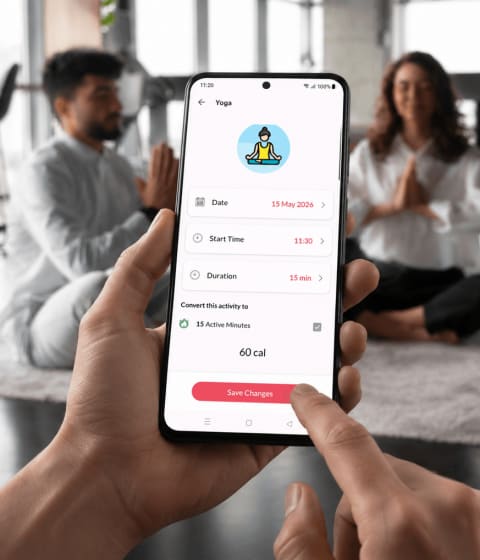
Biometric data holds real value only when it drives meaningful follow-through. Vantage Fit helps turn screening insights into everyday habits. Instead of conducting screenings, the platform enables employees to use their existing reports to set goals, join structured wellness challenges, and track steps and nutrition in a consistent way.
The Health Risk Assessment deepens that impact. Employees answer a few everyday health questions in the app and get a private fitness score, while HR sees aggregate counts to plan programs around.
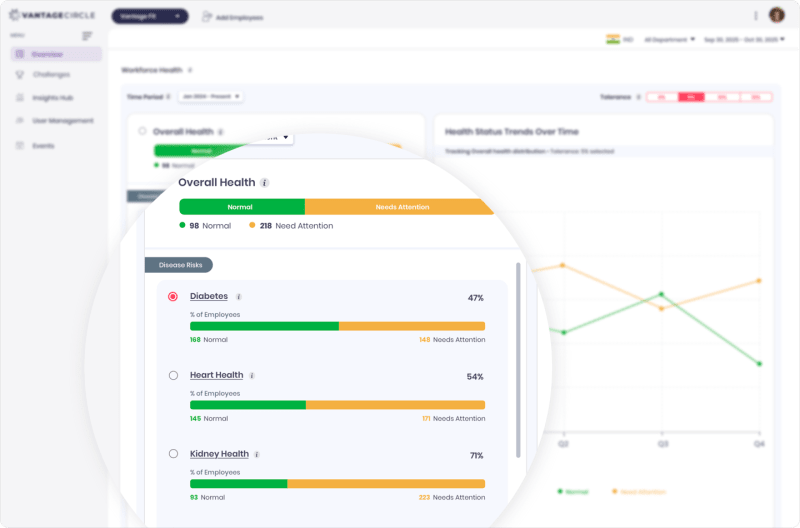
For companies that want to use the screening results themselves, the health data upload add-on reads an employee’s lab report into a private health plan. HR sees only how common each risk is across the company, with no names and no raw values, creating a strong foundation for targeted and effective wellness programs.
How Much Does Biometric Screening Cost?
There is no independent survey of what employers pay per screening, so vendor price lists are the most reliable guide.
One vendor’s published 2026 price list puts onsite screening at $50 to $54 per participant for its basic panel and $95 to $99 for its fullest panel with HbA1c, with the price falling as group size rises.
Four things move the price:
- Panel size. Adding markers such as HbA1c adds cost per person.
- Headcount. Per-person prices often fall as participation rises, and some vendors bill against a committed minimum. Under the same price list, you pay for at least 90% of your estimated participant count, even if fewer people show up.
- Delivery mode. Onsite events carry staffing and travel costs. Lab vouchers and home kits are priced per use.
- Follow-up. Nurse result reviews and health coaching are usually priced separately.
For budgeting the wider program around screening, see our guide to planning a wellness program budget.
How to Set Up a Biometric Screening Program: A Step-by-Step Guide for HR
Step 1: Set the goal and the baseline
Decide what the screening is for before you pick a vendor. A first-year program usually aims for a baseline: what share of employees have elevated blood pressure, cholesterol, or glucose.
That baseline then shapes which wellness programs you fund. A health risk assessment alongside screening adds lifestyle context that lab values alone do not give you.
Step 2: Decide who runs it and how data flows
Whether the program sits inside your group health plan or is run directly by the employer changes which privacy rules apply.
According to the US Department of Health and Human Services, health information collected through a wellness program offered as part of a group health plan is protected by HIPAA, while information collected by an employer-run program is not, although other federal and state laws may apply.
Either way, write down in your vendor contract who receives individual results (the employee, and the vendor’s clinicians) and who receives only aggregate reports (HR).
Step 3: Keep participation voluntary and incentives defensible
Under the ADA, medical exams in an employee health program must be voluntary and reasonably designed to promote health, and employers may only receive the results in aggregate.
A federal court vacated the EEOC’s incentive limits for wellness programs, and the EEOC removed them effective January 1, 2019. No replacement rule has been issued since, so there is currently no federal figure for how large an incentive can be before participation stops being voluntary.
For programs offered through a group health plan, HIPAA nondiscrimination rules cap rewards for health-contingent programs, such as those that reward hitting a target result, at 30% of the total cost of employee-only coverage, or 50% for programs designed to reduce tobacco use.
A reward for simply completing the screening is a participatory program and is not capped this way.
GINA adds a separate rule for spouses: an employer may not deny an employee an incentive because the spouse’s blood pressure, cholesterol, or blood glucose is higher than the employer would like. Review your incentive design with benefits counsel, and see our overview of workplace wellness program regulations.
Step 4: Make it easy to take part
Offer more than one way to screen. Onsite events work for central offices, while lab vouchers and home kits reach remote, field, and shift workers.
Remote options are now the norm: the KFF 2025 Employer Health Benefits Survey found that 22% of small firms and 43% of larger firms offering health benefits run biometric screening, and 61% of firms with a screening program let employees complete it remotely.
Schedule onsite slots across shifts, publish a short privacy explainer before launch, and keep any reward simple. Our list of wellness incentive ideas has options that do not depend on screening results.
Step 5: Return results quickly and plan the follow-through
Employees should get their own results within days, with a clear next step for anything out of range, such as a nurse call or a visit to their doctor.
HR’s aggregate report then tells you which programs to run next. The section below on turning biometric data into health improvements explains why this step matters most.
Top 12 Biometric Screening Companies for Employers in 2026
Each vendor below offers employer biometric screening today. Delivery options and credentials are taken from each company’s own website as of October 2026.
| Company | Delivery options | Worth noting |
|---|---|---|
| Circle Health | Onsite, lab draw, home kit, physician form | Formerly Circle Wellness; screening plus a wellness platform |
| TotalWellness | Onsite, Labcorp voucher, MinuteClinic, home kit, physician form | Specializes in onsite screenings and flu shots in all 50 states |
| The Wellness Company | Onsite fingerstick | Regional New England provider for groups from 15 employees |
| Labcorp | Onsite, lab service centers, home kit, physician form | Nearly 2,000 patient service centers |
| eHealthScreenings | Onsite, offsite lab, home kit, physician form, at-home concierge | A Premise Health company; SOC 2 audited |
| Star Wellness | Onsite | Certified Women's Business Enterprise; also offers vascular ultrasounds |
| Quest Diagnostics | Onsite, lab service centers, self-collection kit, physician form | Over 3.5 million biometric screenings a year |
| US Wellness | Onsite, Labcorp voucher, home kit, physician form | CLIA-licensed lab; no minimum participation |
| Onsite Health Diagnostics | Onsite, lab, pharmacy, home kit, physician form | CLIA-certified lab; one pricing option has no site minimums |
| Health Advocate | Onsite, lab voucher, home kit, physician form | Screening sits alongside healthcare navigation services |
| Catapult Health | Home kit or onsite collection, plus video visit | A Teladoc Health company; HITRUST CSF certified |
| Sterling Wellness Solutions | Onsite, lab voucher, physician form | In-house screening team, no third-party vendors |
1. Circle Health (formerly Circle Wellness)

Circle Wellness and Circle Health Partners are now one brand, Circle Health, which launched in 2005 and has more than 20 years of experience.
It acts as a partner for companies seeking to improve employee wellbeing, combining screening with its own wellness platform and private results consultations as part of a whole-person corporate wellness approach.
Employees can be screened onsite by nurses and phlebotomists, at a local lab, with a take-home fingerstick kit, or through a physician form. Companies that want outside help shaping the wider program can also look at a corporate wellness consultant.
2. TotalWellness

TotalWellness, based in Omaha, Nebraska, specializes in flu shots, COVID-19 vaccines, and biometric screenings. Founder Alan Kohll started the company in 1998, and it works through a network of more than 12,000 health professionals across all 50 states.
Its standard onsite panel covers blood pressure, height, weight, BMI, cholesterol, glucose, and waist circumference.
For screening employees who cannot attend an event, it offers four remote options: a physician form, a Labcorp lab voucher, a MinuteClinic visit, or an at-home kit.
Screening at the workplace keeps time away from work to a minimum, a practical point when absenteeism and employee productivity are concerns.
3. The Wellness Company

The Wellness Company was founded in Rhode Island in 2000 and is best known for flu vaccination programs, including a school vaccination program run with the Rhode Island Department of Health.
Its WellSolutions division runs fingerstick biometric screenings with fasting and non-fasting panels for groups with as few as 15 employees, mainly in New England. It suits smaller regional employers better than national ones.
4. Labcorp

Labcorp is one of the largest clinical laboratory networks in the United States, and it offers onsite, offsite, and at-home biometric screening for employers.
Its services include:
-
Onsite screening events covering a blood draw for a health panel, plus height, weight, blood pressure, waist circumference, and BMI.
-
Offsite screening at nearly 2,000 Labcorp patient service centers or retail partners, or results submitted by the employee’s own doctor.
-
At-home kits for a lipid panel and HbA1c through Labcorp OnDemand, with results in the WellConnect Plus participant portal.
5. eHealthScreenings

eHealthScreenings was founded in 2007 and has been part of Premise Health since 2017. It works with more than 3,000 certified technicians across all 50 states and over 2,200 offsite lab locations.
It offers five ways to screen: onsite events, offsite labs, physician forms, at-home kits, and an at-home concierge visit. It holds SOC 2 certification and completes an annual third-party HIPAA assessment, which helps when your security team reviews vendors.
6. Star Wellness

Star Wellness, based in Euless, Texas, has more than 20 years of experience in onsite biometric screening, vaccinations, and vascular ultrasounds, and is a certified Women’s Business Enterprise.
Every screening package covers all five metabolic syndrome risk factors, which gives a corporate wellness program a consistent baseline to build on.
7. Quest Diagnostics

Quest Diagnostics is a national diagnostic lab company. Its employer population health team has more than 20 years of experience working with employers and screens over 3.5 million people a year for more than 4,400 employer clients.
Employees can be screened onsite, at one of 2,250 patient service centers, with a self-collection fingerstick kit, or through a physician results form.
8. US Wellness

US Wellness is a women-owned company based in Gaithersburg, Maryland, operating a CLIA-licensed laboratory with licensed coverage across all 50 states.
It offers onsite screening, Labcorp lab vouchers at more than 1,200 service centers, home kits, and physician forms, with no minimum participation. Beyond screening, it offers multi-cancer early detection testing.
9. Onsite Health Diagnostics

Onsite Health Diagnostics, based in Plano, Texas, serves employers, health plans, wellness companies, and brokers. It runs its own CLIA-certified laboratory and screens by fingerstick, venipuncture, or home kit.
Employees can be screened onsite, at a lab or pharmacy, through a physician, or at home, and one of its pricing options has no site minimums. Results come with online aggregate reporting and incentive management tools.
10. Health Advocate

Founded in 2001 and owned by Teleperformance since 2021, Health Advocate is best known for helping people navigate the healthcare system. Biometric screening is one of the services it adds on top of that core offer.
Its health screening service offers onsite events, lab vouchers, home test kits, and physician forms, and flu shots can be added to an onsite event.
11. Catapult Health

Catapult Health has been a Teladoc Health company since February 2025. It is HITRUST CSF certified, which signifies that it meets industry standards for data security and privacy.
Its VirtualCheckup is a preventive checkup billed as a preventive care claim. It includes:
-
A home kit, including a blood pressure monitor the employee keeps, or sample collection at the worksite
-
Lab work from the collected samples
-
A live video visit with a licensed healthcare provider
12. Sterling Wellness Solutions

Sterling Wellness Solutions has more than 20 years of experience creating and running employee wellness programs, with health coaching and a wellness portal alongside screening.
It uses its own in-house screening team rather than third-party vendors. Employees can be screened onsite by venipuncture or fingerstick, through offsite lab vouchers, or with a physician form.
Bridging the Gap Between Biometric Data and Meaningful Health Improvements

Biometric screening programs can provide valuable employee health data, but their effectiveness depends on their ability to encourage sustainable lifestyle changes. The research shows how hard that is.
In a randomized trial at the University of Illinois, a wellness program persistently increased health screening rates but showed no significant effect on medical spending, other health behaviors, or productivity after more than two years.
A randomized trial across 160 BJ’s Wholesale worksites found improvements in self-reported exercise and weight management, but no significant change in 10 clinical markers, including cholesterol, blood pressure, and BMI, after 18 months.
The real challenge lies in applying the biometric results. Employees may receive their screening data, meet with a nurse or health coach, and even be encouraged to see their primary care provider. Employees, however, often need ongoing habit-change support to implement these recommendations.
Elevated health risks such as high cholesterol or high blood pressure often result from lifestyle factors. The aim is to help employees adopt and maintain healthier habits through evidence-based habit-change strategies, with clear health goals and lifestyle adjustments that last.
Targeted programs, challenges, coaching, and other resources can improve nutrition, physical fitness, and other lifestyle behaviors. An effective employee wellness program revolves around this principle.
ISKL, which ran a Vantage Fit challenge to support its employee wellness goals, saw a similar long-term shift:
"The program helped our employees develop good fitness habits that will last beyond the time frame of the challenge."
– ISKL
Wellness programs that focus on lasting healthy habits can bridge the gap between biometric data collection and meaningful, long-term health improvements.
Summing It Up
Choosing a biometric screening company comes down to fit: delivery options that reach your whole workforce, a lab with the right credentials, aggregate-only reporting, and a price you can confirm in writing. Setting up the program well means keeping it voluntary, keeping individual results private, and returning results quickly.
The screening itself is only the starting point. It shows where the risks are, but changing them takes sustained habit change, which is why the follow-through program deserves as much attention as the vendor you choose.
Frequently Asked Questions
How much does biometric screening cost?
One vendor's published 2026 price list puts onsite biometric screening at $50 to $99 per participant. The price depends on the number of people screened (per-person cost often falls as headcount rises), the tests in the panel, the delivery mode, and any follow-up such as nurse result reviews.
Can employers see individual biometric screening results?
Generally, no. Under the ADA, employers may only receive information from an employee health program in aggregate terms that do not identify any employee. Individual results go to the employee and the screening vendor's clinicians. HR should receive a population-level report only.
Can an employer make biometric screening mandatory?
Biometric screening in a wellness program must be voluntary under the ADA. Since the EEOC's incentive limits were removed effective 2019, there is no federal rule on how large an incentive can be, so review incentive design with benefits counsel. For programs inside a group health plan, HIPAA caps rewards for health-contingent programs at 30% of the total cost of employee-only coverage, or 50% for programs designed to reduce tobacco use.
Should we choose onsite screening or at-home kits?
Most employers use both. Onsite events suit central offices, while lab vouchers and at-home kits reach remote, field, and shift workers. KFF's 2025 survey found that 61% of firms with a biometric screening program let employees complete it remotely.
Why might some employees be hesitant to participate in biometric screening?
Some reasons employees might hesitate to participate in biometric screening include negative perceptions of their organization's wellness programs, poor incentives, inconvenient times or locations, and worry about who will see their results.
Will biometric screenings reveal all potential health risks?
No single screening can identify every potential health issue. Partnering with a biometric screening company can help in assessing specific health metrics such as blood pressure, cholesterol levels, glucose levels, body mass index (BMI), and more. However, it's essential to understand that they may not uncover every potential health risk or condition. Some health issues may require specialized tests or examinations that go beyond the scope of standard biometric screenings.
Why should you consider using a biometric screening company?
Biometric screens are quick and accurately give you a snapshot of your health. More importantly, they can detect potential health risks early. They can also baseline your wellness initiatives and track changes over time.