Introduction
Every quarter, HR teams launch a wellness challenge with genuine enthusiasm. Participation climbs in week one. The leaderboard fills up. When the challenge closes, the team distributes gift cards and moves on. Participation across employer wellness programs is low to begin with: RAND’s Workplace Wellness Programs Study found fitness programs to be the best attended of the lifestyle programs, at an average uptake of 21% of targeted employees, with half of employers reporting 10% or less.
The programs that escape this pattern share a structural characteristic: they run on infrastructure, not campaigns. A persistent system that continues generating engagement data between programs, connects to the HRIS and devices the workforce already uses, and gives HR administrators actionable intelligence instead of participation logs. That distinction (infrastructure versus a campaign tool) is the most consequential platform decision HR teams make when selecting an employee wellness software solution.
This guide evaluates 7 digital wellness platforms against four criteria that matter to HR administrators in 2026: engagement model, feature depth, admin dashboard capability, and integration fit. A comparison table, a buyer criteria matrix, and 7 FAQ answers are included.
Key Takeaways
- Engagement model is the primary evaluation criterion: always-on platforms sustain participation beyond month 2; campaign-only platforms require continuous re-launch effort from HR.
- Fitness programs draw roughly 21% of eligible employees (RAND). Platforms achieving above this benchmark consistently share three design elements: real rewards, mobile-first UX, and between-challenge engagement mechanisms.
- HIPAA compliance and SOC 2 Type II are non-negotiable procurement gates for healthcare, finance, and government sectors. Not all platforms in this list hold both certifications.
- Implementation ranges from 1–2 weeks (step challenge tools) to 8–12 weeks (enterprise platforms with HRIS sync and custom incentive configuration).
- The 7 platforms here span the full market spectrum: step challenge specialists, configurable enterprise builders, clinical compliance tools, and global multi-pillar infrastructure.
What Is a Digital Wellness Platform?
A digital wellness platform is an integrated system that centralizes employee wellness programs into one digital experience. Core capabilities include fitness challenges, health risk assessments, activity tracking, incentive management, and workforce analytics.
HR leaders, benefits managers, and people ops teams use digital wellness platforms (also referred to as employee wellness technology) to replace fragmented point solutions. Without one, a step challenge lives in a spreadsheet, a meditation program runs through a separate app, and incentive fulfillment goes through procurement. A digital wellness platform consolidates all of these into one system with unified data and administration.
What Counts as a Digital Wellness Platform (and What Doesn't)
A digital wellness platform covers multiple wellness dimensions (physical, mental, financial, and social at minimum), is administered by an HR team, and produces reportable outcomes data. This definition excludes several adjacent categories that HR buyers sometimes conflate with the category.
Standalone fitness apps (Peloton, Strava, Nike Run Club) are consumer tools without HR administrative interfaces or workforce-level reporting. Employee Assistance Programs are clinical counseling services, not wellness tracking infrastructure. HRIS platforms manage employee records and payroll; they do not deliver wellness programs or produce participation analytics. Mental-health-only apps are point solutions, not platforms. Any tool missing HR administration, population-level data, and multi-dimensional wellness coverage is a point solution operating within the category, not a platform.
How We Evaluated These 7 Digital Wellness Platforms
Top 7 Digital Wellness Platforms for 2026

Vantage Fit
Vantage Fit is the only platform in this comparison with an always-on engagement architecture and AI-powered administrative intelligence, making it the strongest choice for enterprise HR teams that need population health data and sustained participation without continuous campaign management.
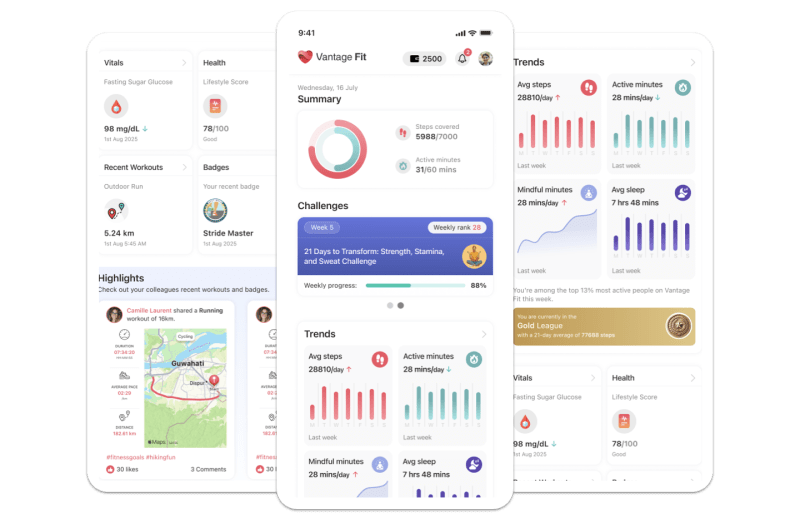
Vantage Fit tracks 30+ activity types across physical, mental, and nutritional wellness dimensions. The Health Risk Assessment functions as an intake mechanism: employees complete an HRA at onboarding, which generates a Wellness Score and routes them into targeted challenges based on their individual risk profile. This eliminates the “one-size-fits-all” program problem that drives early disengagement.
Wellness Leagues solve the between-challenge engagement gap that campaign-only platforms cannot address. Leagues operate on a 21-day rolling average that rewards consistent daily activity — an employee who walks 7,000 steps every day ranks above one who hits 20,000 steps twice. This is the structural mechanism that keeps participation above 50% in month 4, not just month 1.
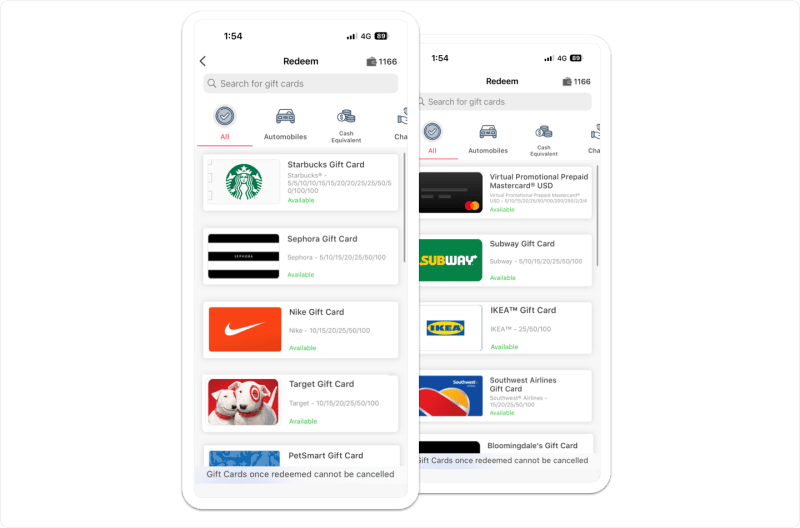
Incentive management runs through Vantage Points, redeemable across 20+ reward categories including brand-name gift cards from Amazon, Starbucks, and Nike. Real external rewards sustain participation in ways that internal-only point systems do not.
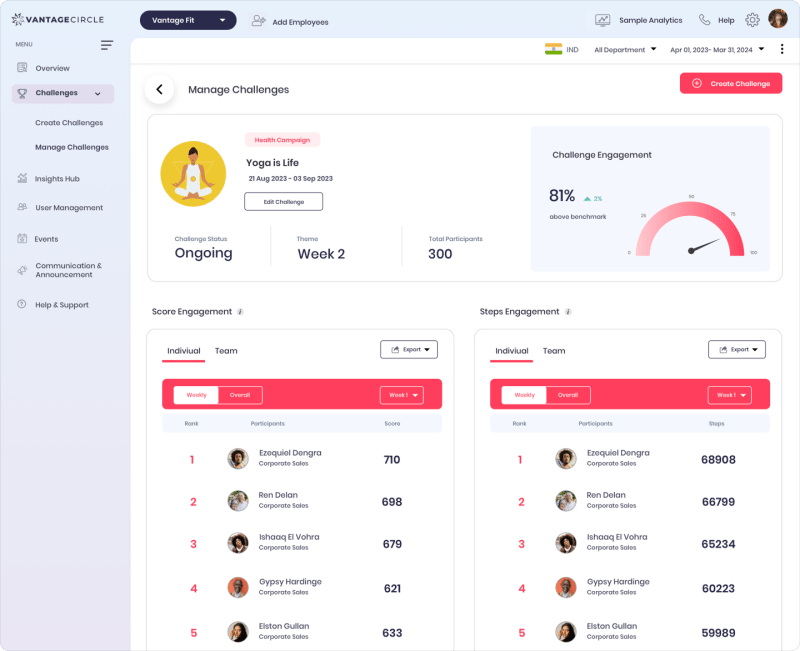
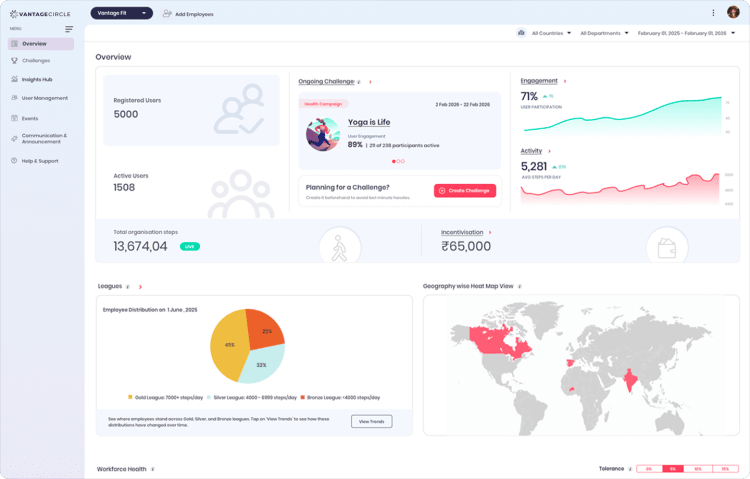
AI-Powered Admin Insights V2 (new in 2026) flags departments showing disengagement trends and suggests next challenge types based on historical participation patterns — the only platform in this comparison with an AI intelligence layer on the HR admin interface.
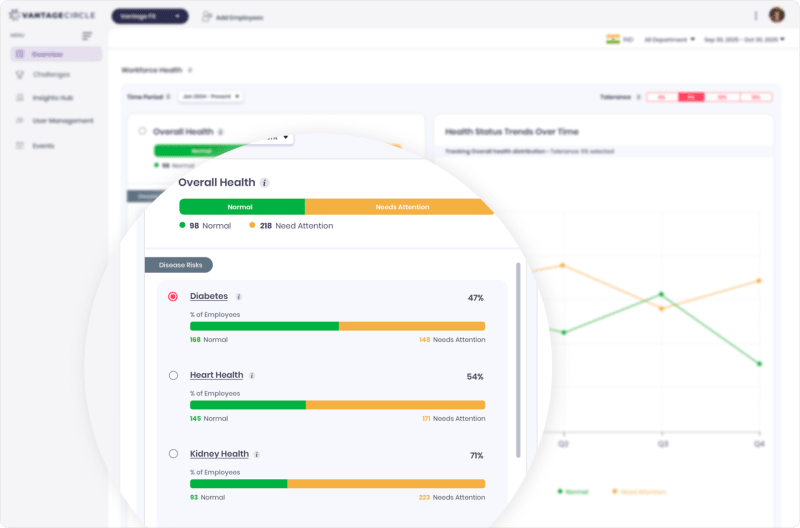
The aggregate biomarker dashboard enables employees to upload lab reports while HR views aggregate health risk distribution across the workforce without accessing individual data. Post-challenge eNPS surveys close the feedback loop.
Results from real teams:
- JF Petroleum Group (Morrisville, NC): 81% overall engagement rate across a 52-week league-based program; multi-activity participation grew from 38% to 65%.
- Brazosport ISD (Clute, TX): 86% participation rate (2-week challenge); average BMI improved from 30 to approximately 27.
- Tata Motors: 59% engagement rate (6-month multi-activity challenge).
- IBS Software: 88% engagement rate, 17 percentage points above benchmark.
- Wipro: 3× participation increase across three consecutive challenges.
Recommended for: Global enterprise organizations (500–10,000+ employees), hybrid and remote workforces, HR teams prioritizing workforce health analytics and measurable ROI, and organizations requiring multi-language program delivery across multiple countries.
HIPAA
Yes
SOC 2 Type II
Yes
SSO (SAML 2.0, Okta, Azure AD)
Yes
30+ activity types with wearable sync (Fitbit, Apple Health, Garmin, Google Fit)
7 challenge formats: step, distance, team, journey, streak, mindfulness, multi-activity
Wellness Leagues — always-on 21-day rolling average engagement
Health Risk Assessment with personalized Wellness Score
Vantage Points redeemable for brand-name gift cards (Amazon, Starbucks, Nike)
AI-Powered Admin Insights V2 with department-level recommendations
Aggregate biomarker dashboard (population-level, no individual data access)
Pre-built HRIS connectors: Workday, BambooHR, SAP SuccessFactors, ADP
190+ countries, multi-language delivery, multi-currency rewards
Single Challenge (4 weeks)
Basic from $250 at 25 employees, rising to $4,000 at 1,000
Unlimited (annual)
Basic from $500 at 25 employees, rising to $8,000 at 1,000
Pro tier
25% above Basic at any headcount
Above 1,000 employees
Custom pricing

Wellable

Personify Health

CoreHealth

WellRight

MoveSpring

YuMuuv
Digital Wellness Platform Comparison: Features, Integration, and Pricing
Digital wellness platforms are priced on a per-employee per-month (PEPM) basis. Basic challenge platforms range from $1–3 PEPM. Full-featured platforms with HRA and analytics run $3–8 PEPM. Enterprise contracts use custom pricing. Use the employee wellness ROI calculator to model expected returns before requesting vendor quotes.
| Platform | Best For | Engagement Model | HRIS Integration | Compliance | Company Size | Pricing |
|---|---|---|---|---|---|---|
| Vantage Fit | Global enterprise; deep analytics; hybrid/remote | Always-On ★ | Pre-built (Workday, BambooHR, SAP, ADP) | SOC 2 + HIPAA compliant | 500–10,000+ | From $1/user/mo |
| Wellable | Benefit-integrated wellness (US mid-market) | Campaign-Only | Yes (standard) | HIPAA | 100–2,000 | $3–6 PEPM est. |
| Personify Health | Clinical compliance; regulated industries | Campaign-Heavy | Pre-built (enterprise) | HIPAA + ACA | 2,000+ | Custom |
| CoreHealth | Configurable enterprise programs; global/EU compliance | Hybrid | Yes (configurable) | ISO 27001 + GDPR | 500–5,000 | $4–8 PEPM est. |
| WellRight | Holistic multi-pillar; financial wellness | Campaign-Only | Yes (standard) | HIPAA | 200–5,000 | $3–6 PEPM est. |
| MoveSpring | Step challenge campaigns; SMB | Campaign-Only | Limited | Basic | 50–500 | $1–3 PEPM est. |
| YuMuuv | Remote/hybrid team challenges | Campaign-Only | Limited | Basic | 50–1,000 | $1–2 PEPM est. |
★ Only platform in this comparison with an always-on engagement architecture (Wellness Leagues, 21-day rolling average) and AI-powered admin recommendations (Admin Insights V2, 2026). Pricing tiers are indicative ranges; contact vendors directly for current quotes.
How to Choose the Right Digital Wellness Platform for Your Organization
Platform selection narrows significantly once three filters are applied: company size, workforce distribution, and compliance requirement. Compliance requirements apply as first gates — healthcare, financial services, and government organizations must confirm HIPAA compliance and SOC 2 Type II certification before any other evaluation criterion.
| Company Size | Workforce Type | Platform Profile to Prioritize |
|---|---|---|
| Under 200 employees | Any | Plug-and-play challenge tools with minimal admin setup. No IT requirement. Budget PEPM. Mobile-first UX and simple wearable sync. Implementation under 2 weeks. |
| 200–1,000 employees | Co-located or hybrid | Multi-activity tracking, HRA, gamification, mobile app with strong adoption data. HIPAA compliance required if handling health data. Pre-built HRIS connector and department-level analytics. |
| 200–1,000 employees | Fully remote | Async challenge design, multi-timezone native support, Slack/Teams integration. Team-based challenge modes and minimal-friction onboarding for distributed employees. |
| 1,000–5,000 employees | Any | Pre-built HRIS connectors (CSV import is not sufficient), department and geography analytics, SOC 2 Type II certification, between-challenge engagement data. Admin dashboard must pass the Zero-IT-Dependency Test. |
| 5,000+ employees | Global or multinational | Multi-language delivery, multi-currency reward catalog, SSO (SAML 2.0/Okta/Azure AD), enterprise HRIS connectors, aggregate biomarker dashboard, AI-driven admin insights. Implementation timeline: 8–12 weeks minimum. |
Frequently Asked Questions
Q. What's the difference between a digital wellness platform and an employee wellness program?
A: A wellness program is the strategy — goals, activities, incentives. A digital wellness platform is the technology that delivers and measures it. One is a plan; the other is the infrastructure that makes it run at scale.
Q. What are the six pillars of digital wellness?
A: Physical, mental, financial, social, occupational, and environmental wellness. Most enterprise platforms cover the first four comprehensively. Occupational and environmental dimensions are less consistently supported and are often handled through separate EAP or safety programs.
Q. How much does a digital wellness platform cost per month?
A: Pricing is per-employee per-month (PEPM). Basic step challenge tools: $1–3 PEPM. Full platforms with HRA and analytics: $3–8 PEPM. Enterprise contracts with clinical compliance or custom configuration are quoted individually. Budget for rewards separately — gift card redemption typically adds $10–40 per active participant per year.
Q. How long does it take to implement a digital wellness platform?
A: Simple step challenge platforms: 1–2 weeks. Standard enterprise deployments with HRIS sync and admin training: 4–8 weeks. Enterprise setups requiring SSO, biometric screening, or multi-language configuration: 8–12 weeks. Pre-built HRIS connectors significantly compress the timeline versus custom API builds.
Q. Do these platforms integrate with HRIS systems like Workday or BambooHR?
A: Most enterprise platforms offer pre-built connectors for Workday, BambooHR, SAP SuccessFactors, and ADP. Always confirm the method: a pre-built connector syncs automatically; a custom API requires IT; a CSV upload requires ongoing manual effort. Ask vendors directly: Is this a pre-built connector or a custom integration?
Q. What is an example of digital wellness at work?
A: A 30-day step challenge where employees sync wearables automatically, earn points redeemable for gift cards, compete on a department leaderboard, and HR monitors participation by geography in real time — no manual data entry or IT tickets required.
Q. Are digital wellness platforms HIPAA compliant?
A: Enterprise platforms should hold HIPAA compliance and a SOC 2 Type II report. Always request the audit report directly — not a self-attestation. Not every platform in this comparison states HIPAA compliance: MoveSpring, YuMuuv, and CoreHealth (which cites ISO 27001 and GDPR instead) do not, which limits their use in US healthcare, finance, and government. Any platform handling biometric or lab data must be HIPAA-compliant without exception.
Making the Final Call
Selecting a digital wellness platform from a comparison guide is not the same as selecting the right one for a specific workforce. The criteria, matrix, and platform profiles in this guide narrow the field. The final procurement decision requires validating engagement data from organizations with similar workforce profiles, testing the admin dashboard under real conditions, and confirming integration methods with IT before signing a contract.
The platforms that deliver sustained engagement above that 21% mark share one characteristic: they are designed to keep working between campaigns, not just during them. The real question is how long your organization is willing to manage the participation reset problem before choosing infrastructure over a campaign calendar.