
Most organizations start their wellness program the same way: a company-wide email, a step challenge spreadsheet, a Slack channel that stays active for three weeks. But the companies that sustain engagement rates above 59% year over year are not running better email campaigns. They are running their programs through a different kind of system. A digital wellness platform brings challenge design, health risk assessment, engagement tracking, incentive distribution, and administrative reporting into one integrated experience.
This guide covers what a digital wellness platform actually is. It explains how the term differs from "corporate wellness" and "employee wellness." It breaks down the features that separate strong platforms from weak ones. And it gives you a structured evaluation framework you can use in your next vendor demo.
Key Takeaways
- A digital wellness platform is a technology layer, not a strategy. It is the system that delivers a corporate wellness strategy to employees.
- The biggest information gap in vendor evaluation is integration depth. SSO-only is not the same as bidirectional API integration.
- Use the 7-dimension evaluation rubric in this guide to score vendors during demos. Print it and bring it to your next meeting.
- Organizations using multi-format challenge platforms report engagement rates of 59-88% and participation rates up to 99%, compared to the industry average of 20-30%.
- Most cloud-based platforms follow a 3-month onboarding rollout: setup, expansion, then optimization. Implementation anxiety should not stall your purchase decision.
What Is a Digital Wellness Platform?
A digital wellness platform is an integrated system that centralizes employee wellness programs into one digital experience. Core capabilities include fitness challenges, health risk assessments, activity tracking, incentive management, and workforce analytics.
HR leaders, benefits managers, and people ops teams use digital wellness platforms (also referred to as employee wellness technology) to replace fragmented point solutions. Without one, a step challenge lives in a spreadsheet, a meditation program runs through a separate app, and incentive fulfillment goes through procurement. A digital wellness platform consolidates all of these into one system with unified data and administration.
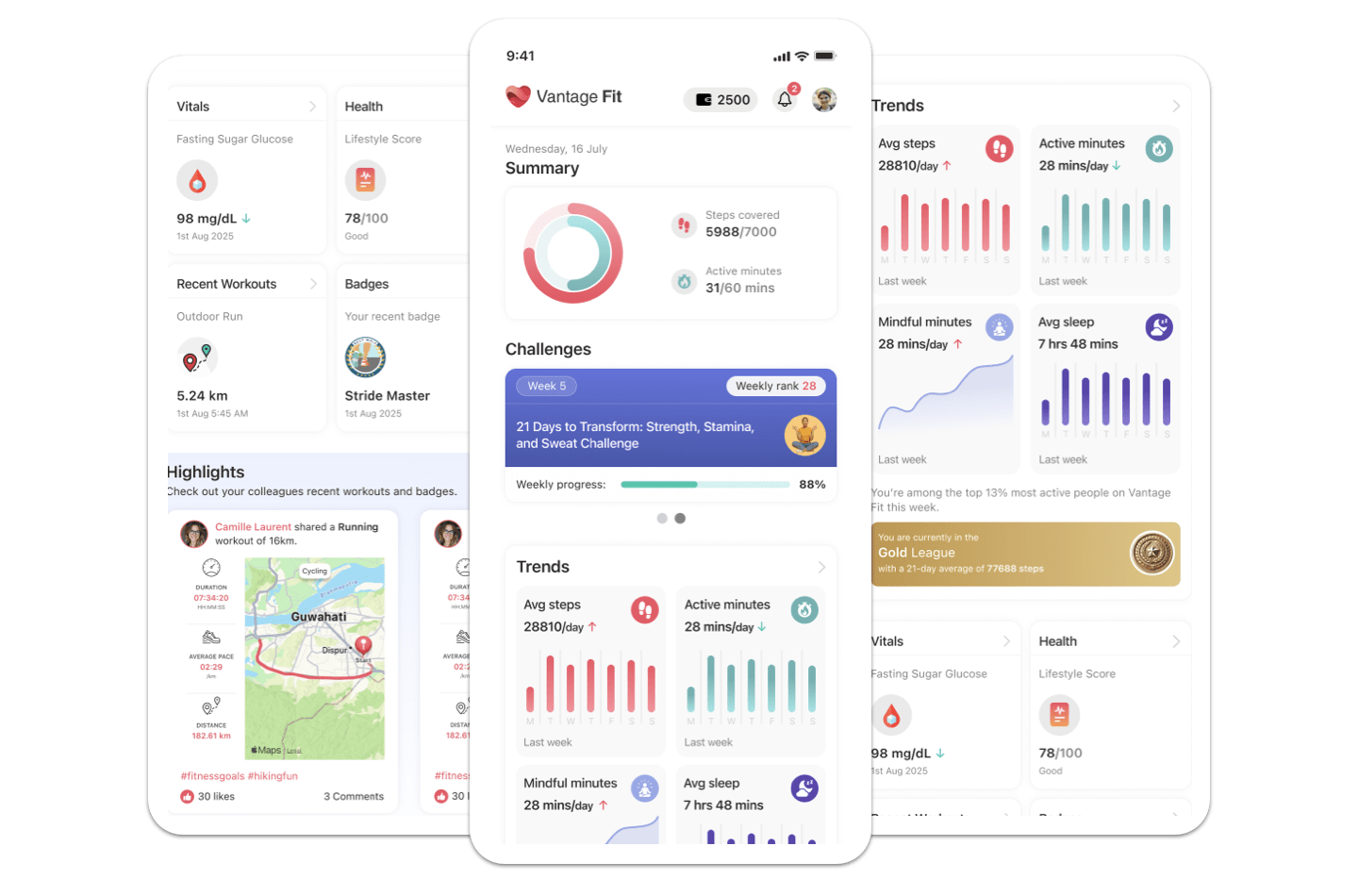
Fragmented tools create fragmented data. Challenge participation lives in one system. Health outcomes live in another. HR cannot draw a line between program activity and workforce health improvement. A single platform closes that loop.
How Digital Wellness Differs from Corporate and Employee Wellness Programs
Three terms dominate this space: digital wellness, corporate wellness, and employee wellness. Vendor marketing uses them interchangeably. They are not the same thing.
| Dimension | Digital Wellness | Corporate Wellness | Employee Wellness |
|---|---|---|---|
| Definition | The technology platform that delivers wellness programs | The organizational strategy behind wellness initiatives | The target population frame: programs designed for employees |
| Scope | Campaigns, tracking, communications, incentives, analytics | Budget allocation, program selection, culture alignment | Health outcomes, participation, satisfaction |
| Delivery | Digital tools: apps, web portals, wearable integrations | Organizational policy and leadership commitment | Through whatever channels the organization chooses |
| Who Owns It | HR + IT (vendor relationship) | CHRO / VP of HR (strategic ownership) | HR + employees (shared accountability) |
| Success Metric | Adoption rate, feature utilization, data completeness | ROI, healthcare cost reduction, retention impact | Participation rate, health outcomes, engagement scores |
A digital wellness platform is the technology that executes a corporate wellness strategy for employees. Digital wellness examples include mobile-based step challenges with automated leaderboards, virtual mindfulness sessions, and gamified health risk assessments. Some platforms align their assessment modules to the CDC Workplace Health Model. Others benchmark activity targets against the WHO's 150-minute weekly activity guideline. The strategy determines what programs to run. The population determines who to serve. The platform determines how it all gets delivered and measured.
This taxonomy matters during vendor evaluation because some platforms cover one layer well but not the others. A strong holistic wellness program requires alignment across all three.
Why HR Leaders Are Investing in Digital Wellness Platforms
Four pressures are driving platform adoption. None of them are philosophical. The 2025 SHRM Employee Benefits Survey found that only 39% of employers offer structured wellness programs. That is down from 53% in 2021. The demand for wellness has not decreased. The delivery model is shifting to digital.
Cost pressure. Preventive wellness programs reduce healthcare costs over time. A Harvard Business Review meta-analysis found that medical costs fall by $3.27 for every $1 invested in wellness programs. Organizations using structured platforms save an average of $250 per employee per year. That compounds across a 5,000-person workforce into $1.25 million annually.
Distributed workforce. Hybrid and remote teams cannot participate in on-site wellness events. A digital platform reaches employees across time zones and locations. Without a digital delivery layer, remote employees are excluded by design.
Digital-first expectations. Employees interact with consumer-grade apps daily. A clunky wellness portal with manual data entry does not compete. Platforms that feel like the apps employees already use drive adoption without mandates.
ROI accountability. Research shows a negative correlation between physical activity and unplanned work absenteeism. 75 minutes of exercise per week reduces absenteeism by up to 4 days per year. C-suite leaders want to see these numbers. Not participation headcounts. A platform with built-in analytics translates wellness activity into financial outcomes leadership cares about.
These pressures determine which features matter most when evaluating digital wellness platforms. Understanding employee well-being at a strategic level helps HR leaders connect platform capabilities to workforce outcomes.
Core Features of a Digital Wellness Platform
Features are not created equal. Organize them by the outcome they drive, not alphabetically. Every feature in a digital wellness platform serves one of three functions: driving engagement, measuring health, or enabling administration.
Engagement drivers include multi-format challenge programs (step, distance, calories, active minutes, mindfulness, nutrition, hydration). They also include gamification mechanics (leaderboards, streaks, badges), rewards systems (points redeemable for real gift cards), and social features (team competitions, groups, chat). Programs limited to step challenges alone see participation drop after month 2. Employees with different fitness levels and interests disengage. Vantage Fit provides 10+ distinct challenge formats. Serum Institute of India achieved 99% participation. IBS Software saw 88% engagement.


Measurement capabilities include health risk assessments (HRAs), wellness scores, activity tracking, and progress dashboards. Some platforms add AI-powered personalization: adaptive difficulty, personalized nudges, and risk-stratified recommendations.
Administrative tools include self-service challenge builders, real-time reporting, employee roster management, and reward fulfillment. These determine whether HR can operate the platform independently or needs IT support for every change.
Integration Requirements: SSO, HRIS, and Wearable Sync
Every vendor claims integration capabilities. The depth varies significantly. Classify platform integrations into 3 levels before accepting a vendor's claim at face value:
Level 1: Authentication only. SSO/SAML integration that lets employees log in with their corporate credentials. Useful, but the platform operates in isolation from HR systems.
Level 2: One-way data sync. Employee roster import from HRIS (Workday, BambooHR, ADP). The platform knows who works where, but data flows in one direction only.
Level 3: Bidirectional API. Enrollment triggers, challenge completion events, and incentive fulfillment data flow both ways between the wellness platform and HRIS, payroll, or benefits systems. This is the level where the platform becomes part of the HR tech stack. Not sitting next to it.
Ask the vendor: "Does your platform support bidirectional data flow with our HRIS, or only employee roster import?" The answer reveals whether integration means connected or merely compatible. Wearable sync follows the same principle. Syncing step data from Fitbit and Apple Health is Level 1. Pulling heart rate variability trends into a composite health score is Level 3.
Admin Dashboard and Reporting: The Zero-IT-Dependency Test
You've seen this: HR wants to launch a 30-day step challenge, but the platform requires an IT ticket to configure the rules, set up teams, and generate the leaderboard. By the time IT processes the request, the launch window has passed and momentum is lost.
Admin autonomy is a core evaluation criterion. HR leaders should be able to create challenges, adjust incentive structures, enroll participants, and pull reports without involving IT. Vantage Fit's admin dashboard provides real-time visibility into participation rates, completion trends, and wellness scores. No IT ticket required.

The test is simple: can your HR team launch a wellness challenge at 2 PM and have employees participating by 3 PM? If yes, the platform passes. If the answer involves procurement approvals, IT configuration, or vendor support tickets, the platform fails.
How to Evaluate a Digital Wellness Platform
No competitor in this space provides a structured evaluation framework. Vendor websites show feature lists. Review sites show star ratings. Neither tells an HR leader whether the platform solves their specific problem. Use these 7 dimensions to score every vendor:
Program variety. How many wellness dimensions does the platform cover: physical, mental, nutritional, social, financial? Step-only platforms serve one audience. Multi-dimension platforms serve the workforce. Ask the vendor: "How many distinct challenge types can we run simultaneously?"
Engagement mechanics. Does the platform use gamification (leaderboards, streaks, badges), real rewards (gift cards, not just digital trophies), and social features (team competitions)? Self-Determination Theory (Deci & Ryan) shows that sustained motivation requires autonomy, competence, and relatedness. Platforms that hit all three retain participants. Ask the vendor: "What is your average participation rate at month 6, not month 1?"
Integration depth. Does the platform support Level 1 (SSO), Level 2 (one-way HRIS sync), or Level 3 (bidirectional API) integrations? Reference the 3-tier model above. Ask the vendor: "Show me a live data sync between your platform and a customer's HRIS."
Admin autonomy. Can HR self-serve challenge creation, reporting, and reward management? Or does every configuration change require IT or vendor support? Ask the vendor: "Can I launch a challenge right now, during this demo, without your help?"
Data and reporting. Does the platform offer real-time dashboards, exportable reports, department-level benchmarking, and HIPAA-compliant data privacy? Ask the vendor: "Show me the report your platform generates for a board-level wellness review."
Accessibility and inclusivity. Does the platform support multilingual interfaces, ADA-compliant design, basic smartphone compatibility, and programs for employees with different ability levels? Ask the vendor: "What percentage of your user base accesses the platform on devices older than 3 years?"
Pricing transparency. Is pricing per-employee-per-month (PEPM) with no hidden fees? Are implementation, onboarding, and customer success costs included or billed separately? Ask the vendor: "Give me the total cost of ownership for 2,000 employees for 12 months, including everything."
Print this rubric. Bring it to your next vendor demo. Score each platform 1-5 per dimension. The total score gives you a defensible comparison for leadership. Understanding why corporate wellness programs fail often comes down to gaps in these exact dimensions.
Red Flags During a Platform Demo
Five signals indicate a platform will underdeliver:
- The demo uses scripted data, not a live customer environment. If the vendor cannot show real usage patterns, the platform may not have enough customers to show.
- Integration answers are vague: "We work with most HRIS systems" rather than naming specific systems and showing live connections.
- No customer references in your industry or company size. A platform that works for 50-person startups may not scale to 5,000 employees across 10 countries.
- Engagement metrics conflate "registered users" with "active participants." A 90% registration rate with 15% active usage is not 90% engagement.
- Pricing excludes implementation, onboarding, or customer success. The sticker price is not the total cost.
Implementing a Digital Wellness Platform: A Realistic Timeline
Implementation anxiety stalls more purchases than budget objections. The reality for most cloud-based platforms is simpler than HR leaders expect.
Phase 1: Setup, training, and initial launch (Month 1). Tenant configuration, SSO or HRIS connection, employee roster import, branding customization, admin training, and initial challenge launch. Vantage Fit, for example, makes step challenges, mindfulness, nutrition tracking, health risk assessments, and a composite wellness score available within this first month.

Phase 2: Expand challenges and rewards (Month 2). Introduce additional challenge formats, activate the rewards system, and build community engagement. Select department-level wellness champions. Collect feedback on UX, content relevance, and reward appeal. Use this phase to identify internal advocates who will drive adoption during full rollout.
Phase 3: Full program optimization (Month 3 and ongoing). Analytics review, long-term strategy alignment, and full organizational rollout with a structured communication plan. Start with an executive sponsor announcement, department champion activation, and a step challenge at work as the first company-wide event. The most common mistake is launching without a communication plan. Platforms do not go viral inside organizations. They require coordinated activation.
Measuring ROI: What Outcomes to Expect
The business case for a digital wellness platform rests on 3 outcome categories: engagement, health, and financial impact.
Engagement and participation. Serum Institute of India achieved 99% participation. IBS Software saw 88% engagement, 17% above the 70% benchmark. Tata Motors sustained 59% engagement across a 6-month multi-activity challenge. Wipro saw a 3X participation increase across 3 consecutive challenges. The industry average is 20-30% sustained participation for traditional programs.
Health outcomes. Brazosport ISD saw average BMI improve from 30 to approximately 27 during their platform-based wellness campaign. Health outcomes take longer to materialize than engagement metrics. Expect 6-12 months for measurable population-level changes.
Financial impact. Structured wellness programs generate $250 in annual healthcare savings per participating employee. A Harvard meta-analysis found medical costs fall $3.27 for every dollar invested, while absenteeism costs fall $2.73 per dollar. Research on physical activity and unplanned absenteeism shows that 75 minutes of exercise per week reduces absenteeism by up to 4 days per year. For deeper analysis on connecting platform data to financial outcomes, see this guide on wellness ROI metrics.
Setting Realistic Benchmarks by Company Size
Engagement expectations vary by organization size. Companies under 500 employees typically see higher participation rates because social visibility is stronger: employees see their colleagues on the leaderboard and feel accountable. Mid-market organizations (500-5,000 employees) need department-level champions to bridge the gap between HR's announcement and individual adoption. Enterprise organizations (5,000+) require phased rollouts, regional customization, and localized communication to sustain engagement across geographies.
A digital wellness platform will not single-handedly transform workforce health. But it accomplishes something most traditional programs do not. It makes wellness measurable, continuous, and administratively sustainable. HR gets a system that tracks engagement trends across months and years. Leadership gets a real picture of whether the workforce is getting healthier or just checking boxes. The real question is whether organizations will keep treating wellness as a series of campaigns or start investing in the infrastructure that makes healthy habits compound.
Frequently Asked Questions
What happens to employee data if we switch wellness vendors?
Ask for a data export clause in your contract before signing. Reputable platforms provide full data export in standard formats (CSV, API). Platforms that lock your data in proprietary formats create switching costs that benefit the vendor, not you.
Can a digital wellness platform work alongside our existing EAP?
Yes. Most platforms integrate with EAP providers through referral links or SSO handoffs. The wellness platform handles engagement and prevention. The EAP handles clinical intervention. They are complementary, not competing.
Do employees actually use wellness platforms, or do they ignore them?
The RAND Workplace Wellness Study found typical participation at 20-30%. Platforms with native mobile apps, real rewards, and multi-format challenges report engagement rates of 59-88% and participation rates up to 99%. The difference is design, not motivation.
How do digital wellness platforms handle employee privacy and HIPAA?
Compliant platforms show HR only aggregated, de-identified data. Individual health information stays private. Look for HIPAA compliance, SOC 2 certification, and a clear data retention policy. If the vendor cannot explain what data HR sees vs. what stays private, that is a red flag.
See how a digital wellness platform works for your team.