
Employee wellbeing is the combined state of an employee's physical, mental, emotional, social, and financial health at work. It extends beyond physical health to how workload, job design, and workplace relationships affect a person's whole life. A 2025 CIPD survey found that 74% of organizations now say senior leaders have employee wellbeing on their agenda.
That shift is a business decision, not a benefits decision. Employees who are thriving take fewer sick days, perform better, and are far less likely to leave. Vantage Fit is a corporate wellness platform that runs physical, mental, and social wellbeing programs from one dashboard for companies with 500 to 10,000+ employees.
KEY TAKEAWAYS
- Employee wellbeing covers five pillars: physical, social, financial, career, and community health.
- Wellness and wellbeing are not the same. Wellness targets physical health; wellbeing covers the whole person over the long term.
- Gallup finds thriving employees miss 53% fewer days of work due to health problems, and burnt-out workers are 63% more likely to take a sick day.
- Global engagement fell to 20% in 2025, costing the world economy an estimated $10 trillion, and manager engagement is down nine points since 2022.
- Wipro grew wellness participation 3X across 30+ countries, from 163 to 550 active employees, using multi-activity challenges.
The scale of the problem is well documented. The Office for National Statistics recorded 148.8 million working days lost to sickness or injury in 2025, an average of 4.4 days per worker, with mental health conditions accounting for 8.9% of absences.
Gallup's State of the Global Workplace 2026 report found that 40% of employees globally experienced a lot of stress the previous day, 22% experienced anger, and 23% experienced sadness. The same report puts global engagement at just 20%.
"If we leave the human factor out of our business calculations, we shall fail every time." William H. Lever, founder of Lever Brothers
What is Employee Wellbeing?

Employee well-being is the overall health and happiness of a person at work, measured across physical, mental, emotional, social, and financial dimensions. It includes their relationships with colleagues, the tools and resources they are given, and the larger business decisions that affect their work. It is broader than wellness, which describes physical health alone.
Put simply, wellness is about the body. Well-being is about the whole person and how work shapes their life. You will also see it called employee health and wellbeing, workplace wellbeing, or staff wellbeing, and all three describe the same thing.
WHO researchers found that employee well-being plays a critical role in organizational success. It is associated with increased productivity, reduced absenteeism, and improved employee morale. By improving employee wellbeing, organizations can achieve positive and sustainable work environments.
Employee Wellness vs Employee Wellbeing: What's the Difference?
Employee wellness and employee wellbeing are not the same thing. Wellness targets physical health through immediate, measurable goals such as fitness and screenings. Wellbeing is the wider frame, covering mental, emotional, social, and financial health over the long term. The distinction decides how you design your program.
Employee wellness focuses on physical health. Think fitness challenges, health screenings, biometric screenings, gym memberships, and smoking cessation programs. It targets immediate, measurable health goals.
Well-being is the wider frame. It covers mental, emotional, social, and financial health alongside the physical, and it takes a long-term view that includes work-life balance, resilience, and financial stability.
Why the difference matters right now: many organizations still treat wellness as a perk and well-being as the employee's own responsibility. That view ignores the pressures employees carry from outside work, such as caregiving duties and financial strain, which follow them into the workday no matter how good the gym discount is.
| Aspect | Wellness | Wellbeing |
|---|---|---|
| Definition | Physical health and short-term fitness goals | Physical, mental, emotional, social, and financial health together |
| Scope | Narrow and specific, such as gym memberships and screenings | Whole-person and long-term, covering work-life balance, resilience, and money worries |
| Employee role | Joining fitness programs or health initiatives | Taking an active part in their own overall life satisfaction |
| Employer role | Provide health perks and programs | Build a supportive culture with resources that reach everyone |
| Perception challenge | Often seen as a perk or a short-term fix | Misread as only the employee's responsibility |
| Impact on business | Fixes immediate health concerns, with little effect on engagement | Lifts productivity, cuts absenteeism, and lowers turnover |
| Example initiatives | Fitness classes, smoking cessation programs, gym discounts | Mental health resources, flexible work policies, financial wellness programs |
Wellness programs do work on their own terms. An American Journal of Preventive Medicine study found that workplace wellness programs improve health outcomes and lower healthcare costs, and employees with strong physical wellness miss fewer workdays.
Wellness programs alone can't solve burnout or financial stress. A complete approach needs mental health support and financial resources alongside the fitness piece.
The Five Pillars of Employee Wellbeing

The five pillars of employee well-being are physical, social, financial, career, and community. This model comes from a Gallup survey of the essential elements of a thriving life. A program that addresses only one pillar, usually physical, leaves the other four unsupported.
Here is what each pillar covers.
Physical Well-being encompasses physical health, energy levels, and the ability to perform daily tasks. When employees prioritize their physical well-being, they experience increased energy levels, improved focus, and reduced absenteeism.
Social Well-being: Strong relationships with colleagues and a sense of belonging contribute to social well-being. Collaborative teams are more innovative and productive.
Financial Wellbeing: It refers to the ability of your employees to achieve personal financial wellness goals successfully. Financial security and stability are essential for overall well-being. Businesses offering financial wellness programs see increased employee retention and satisfaction.
Career Well-being: Feeling fulfilled and engaged in work is crucial for job satisfaction. Strong employee commitment benefits businesses that connect their work to a larger mission.
Community Well-being: A sense of connection to the broader community and a positive work-life balance contribute to overall well-being. A healthy work-life balance increases energy, motivation, and overall health.
For a deeper look, our dimensions of wellness guide covers all nine dimensions in detail.
Why Is Employee Wellbeing Important?

Employee wellbeing is important because it directly drives productivity, retention, and recruitment, which together decide the bottom line. Gallup found that thriving employees miss 53% fewer days of work due to health problems, while burnt-out workers are 63% more likely to take a sick day. Organizations that ignore wellbeing pay for the same problem through turnover instead.
The turnover cost is measurable. According to the Bureau of Labor Statistics, more than 3 million people leave their jobs voluntarily every month. American companies are estimated to lose $1 trillion annually because of employee turnover.
The employee wellbeing statistics behind that are consistent. Gallup research found that 62% of employees struggling with overall wellbeing are at higher risk of burnout and falling productivity.
Engaged employees who also have strong wellbeing are 32% less likely to be job searching, less susceptible to workplace stress and anxiety, and more likely to go beyond their formal role. And 62% of U.S. workers say better work-life balance and personal wellbeing matter when weighing a move to another employer.
Employee engagement and wellbeing
Employee engagement and wellbeing are separate measures that move together. Engaged employees tend to report higher wellbeing, and employees with high wellbeing are more likely to become engaged. Treating them as one initiative rather than two competing budgets is what makes either one work.
This is also why wellbeing is holistic rather than a single perk. Gym memberships and occasional mental health workshops move the physical pillar and leave the other four untouched.
A study by WHO estimates that depression and anxiety issues lead to a loss of productivity, which costs $1 trillion annually.
How Employee Morale and Wellbeing Reinforce Each Other
Employee morale and wellbeing reinforce each other rather than competing for the same budget. High morale lifts wellbeing, and employees with strong wellbeing are more likely to become engaged. Low engagement costs the world economy an estimated $10 trillion a year, so the loop runs in both directions.
When employee morale is high, people notice more of the positives at work and treat setbacks as something to learn from. When it drops, wellbeing follows, and the cost is enormous. Gallup's State of the Global Workplace 2026 found global engagement fell to 20% in 2025, its lowest since 2020, costing the world economy an estimated $10 trillion in lost productivity, around 9% of global GDP.
The problem often starts higher up the org chart than HR teams expect. Manager engagement has fallen nine points since 2022, from 31% down to 22%, according to the same Gallup report. Since managers are the people expected to spot burnout in their teams, a disengaged management layer means your early warning system is offline.
Emotional well-being is the strongest link between the two. A Harvard Business Review study that analyzed data from over 60 million people found emotional well-being to be one of the essential factors in an individual's success at work. Work environments with high emotional well-being are associated with:
Lower stress levels
Higher employee engagement
Better health outcomes
Financial pressure pulls hard in the opposite direction. The Wellness Barometer survey found that as economic challenges mount, 77% of employees report financial stress affecting their mental health and 52% report it affecting their physical health.
Morale problems also surface in retention data before they surface anywhere else. A 2022 Forbes article cited mental health as among the biggest reasons that 56% of workers were looking for a new job, compared with 40% of those polled four years earlier.
Identifying Factors That Impact Wellbeing At Work

Five forces drive most wellbeing problems at work today. Each one either adds pressure an employee carries or removes control they have over it, and you cannot fix wellbeing without naming which apply to your workforce.
The Great Resignation: The pandemic accelerated a shift in employee priorities, with many re-evaluating their work-life balance and seeking more fulfilling roles.
Remote and Hybrid Work: While offering flexibility, remote work has blurred the lines between work and personal life, leading to increased stress and burnout.
Economic Uncertainty: Global economic conditions, such as inflation and recessionary fears, have created financial stress for many employees.
Technological Advancements: Rapid technological changes can lead to job insecurity and the need for constant upskilling.
Increased Workload: Employees often juggle multiple responsibilities, leading to burnout and decreased job satisfaction.
Who Owns Employee Wellbeing? A Shared Responsibility

Employee wellbeing is a shared responsibility across five groups. HR builds the strategy, senior management sets the tone and the budget, team managers spot problems early, employees participate and look after themselves outside work, and occupational health professionals handle workplace health and safety. No single group can carry it alone.
1. People Professionals (HR)
The HR teams are mostly responsible for developing well-being strategies. They develop the programs, policies, and initiatives that promote employee health and well-being. By collaborating with leadership and other departments, HR can promote a culture of well-being throughout the organization.
2. Senior Management
Leadership sets the tone for the organization's commitment to well-being. When senior leaders prioritize employee health and well-being, it sets an example that employee welfare is a top priority.
3. Managers/Team Leads
Managers play a crucial role in implementing employee well-being initiatives. They can identify early signs of stress, provide support, and create a positive team culture.
4. Employees
Employees are responsible for prioritizing their own well-being through self-care and seeking support when needed. They will only benefit from well-being initiatives if they participate and care for their health and well-being outside work.
5. Occupational Health Professionals
Occupational health is a specialist branch of medicine that focuses on workplace health. Its responsibility is to assist employees and managers with health and safety in the workplace.
Suggested Read: The Role of An HR in Workplace Wellness Programs
Building Wellbeing Into How Your Organization Runs
Knowing who owns wellbeing is one thing. Building it into how the organization runs is another. The four foundations below come from a guest contribution by Chandra Sekar R, whose argument is that wellbeing gets decided at the everyday touchpoints of employee experience rather than in the wellness budget line.
1. "Walk-the-talk" leadership
"If your actions match your words you have the power to inspire and influence change."
The first indicator of whether leadership means it is how the leadership's own immediate team is doing on health and morale. Are direct reports implicitly rewarded for long hours? Do they take leave?
Some organizations preach one standard publicly and practice another internally. Fix that before people stop trusting leadership altogether. Empathy at this level is trainable: Microsoft gives managers mental health training so they can recognize burnout instead of missing it.
2. Developing inclusive team managers
"Inclusion is your passcode to building trust with people and teams."
Micro-culture reveals whether the macro-culture is actually lived. People leave toxic micro-cultures because they suffer from them directly, and that suffering lands on health and morale.
The team manager sets that micro-culture, so pivot manager development toward inclusive leadership skills: psychological safety, fairness, giving people a voice. Companies spend real effort selecting a unit leader; qualifying a team manager deserves the same. The cost of a bad manager is irreparable.
3. Make commitment and connection everyone's job
"Employee experience is a participatory sport, everyone is responsible."
Employee experience does not belong to HR, or the team manager, or leadership. It belongs to everyone in the organization's ecosystem, and forgetting that leaves the equation unbalanced.
Most organizations verbalize their culture well but few build it into hiring, promoting, assessing, and rewarding until it becomes a way of life. Connection is the practical half: isolation drives disengagement, while real relationships lift social wellness and engagement together. Salesforce gives employees 1% of their time for community service, and Zappos runs regular "Culture Check-ins" that show up as higher engagement and lower turnover.
4. Setting up organizational systems
"What gets measured gets done and redone until it becomes a culture."
Start by auditing what your current programs do not cover. A fitness challenge will not help someone drowning in debt or isolated from their team, so name the gaps in mental health, financial support, and work-life balance before buying anything new.
Then redefine benefits to match. Google offers EAPs covering mental health and financial counseling, Salesforce provides mental health days and flexible work, and Deloitte's wellbeing programs improved retention and cut absenteeism.
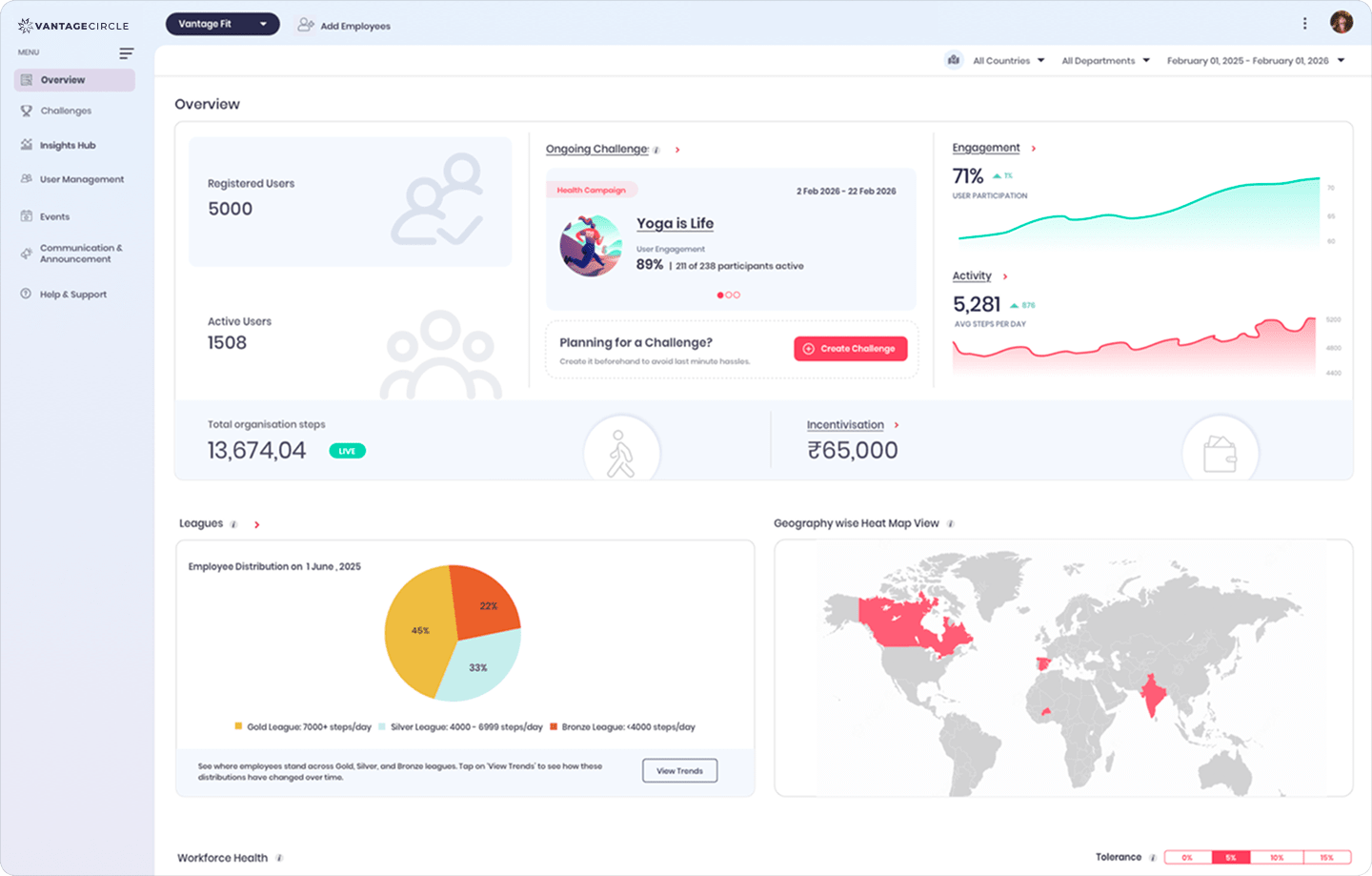
Track it on a dashboard: leave utilization, log-in and log-out hours, hybrid work choices, productivity, engagement scores, and attrition. Add 24/7 counseling alongside it, in-house or through a vendor.
Personalization is what makes any of it land. PwC's wellbeing app helped employees manage stress and sleep; Vantage Fit does the same across more dimensions, with step tracking and wearable sync for physical health, mood tracking and guided meditation for mental health, and team challenges for social. Admins can target programs by department, country, age, or role so employees get something relevant.
9 Management Tips for Improving Employee Wellbeing at Work
Managers improve employee wellbeing by leading through example, recognizing effort, keeping mental health conversations open, running a real wellness program, supporting people who are struggling, empowering wellbeing coordinators, welcoming feedback, backing balance with fitness rewards, and granting autonomy. The manager, not the benefits package, decides whether any of it works.
The old saying, "People don't quit bad jobs; they quit bad managers," has stood the test of time. Culture, benefits, and wellbeing programs can all be in place and still fail under a poor manager.
1. Lead By Example

When leaders model healthy work habits, employees follow. That means visibly taking breaks and vacations, talking about your own self-care practices, and showing a real commitment to physical health and work-life balance.
It also means making it safe to raise a problem. Employees copy what leadership does far more reliably than what a policy document says.
2. Recognize and Appreciate Effort

Recognizing the effort employees put into staying well reinforces that the organization actually values it. The Vantage Circle platform is built for exactly this kind of recognition.
Pair recognition with autonomy, and link people's roles to the organization's broader goals. That combination creates a sense of purpose that a perk cannot buy. Where wellbeing problems are deep-rooted, treat the root cause rather than the symptom.
For instance, if employees struggle with excessive workload, implementing time management strategies or adjusting project timelines can be more effective than simply offering gym memberships or monetary rewards.
3. Foster Open Communication About Mental Health

With anxiety and depression at record highs, particularly among millennial and Gen Z workers, leaders need to actively promote mental health awareness and destigmatize talking about it.
Open communication is what prevents stress from becoming burnout. Four questions do most of the work:
How do you feel about your workload?
Would you like some help completing your tasks?
Do you have any family obligations this week we need to address?
Do you need anything from management to support you?
Then follow up. Asking once and doing nothing is worse than not asking.
4. Implement an Employee Wellbeing Program

Employee wellness programs reduce absenteeism, lift productivity, and improve morale, but only when they are built on what employees actually asked for.
Survey your people first to learn their preferences around wellness challenges. Then build the program around the areas that surfaced, whether that is stress management, physical fitness, or work-life balance. Keep collecting feedback and track the metrics that tell you whether it is working.
Whatever tool you use, the requirements are the same: one place to build and launch challenges, and analytics that show participation and health outcomes as they happen rather than at year end.
Tata Motors' Step Up & Elevate challenge reached a 70% engagement rate across 43 teams. Industry data puts the payoff in context: just 75 minutes of exercise a week can cut absenteeism by four days a year.
"The app has helped increase the amount of walking people in the office are doing, leading to improved physical health and mental wellbeing."
Elsa Robertson, Heidrick & Struggles
5. Provide Support for Employees Who Are Struggling

Employees who are struggling often stay silent out of fear of judgment. You break that stigma by making help visible and easy to reach, not by waiting for someone to ask.
Cover mental-health expenses and offer EAP resources. The workplace mental health checklist walks through the policy, leadership-training, and workload gaps most organizations miss. An EAP gives people fast access to counseling at low or no cost, which removes the practical excuse for not getting help.
6. Empower Wellbeing Coordinators

Wellness coaching, experts, and counselors help employees build strategies suited to their own situation and strengths. This matters most for mental health, where the best workplaces are expanding support fastest.
Coordinators only work if you fund them properly. Give them budget, time, and authority, or the role becomes decorative.
7. Welcome Feedback

There is usually a gap between what managers think employees need and what they actually need. Ask them, through check-ins or a wellness survey, and make it safe to give negative answers.
Then be transparent about what you can and cannot act on. Silence after a survey teaches people not to bother next time.
8. Promote Work-Life Balance With Fitness Rewards
Fitness rewards are the difference between a program employees hear about and one they use. Badges and health points keep people moving, and a transparent rewards process keeps them going after the novelty fades.
Points that redeem for something people actually want close the loop. Other wellness activities for remote employees worth building in:
Virtual yoga or exercise classes
Online meditation sessions
Virtual lunch and learns
Remote wellness challenges with a leaderboard
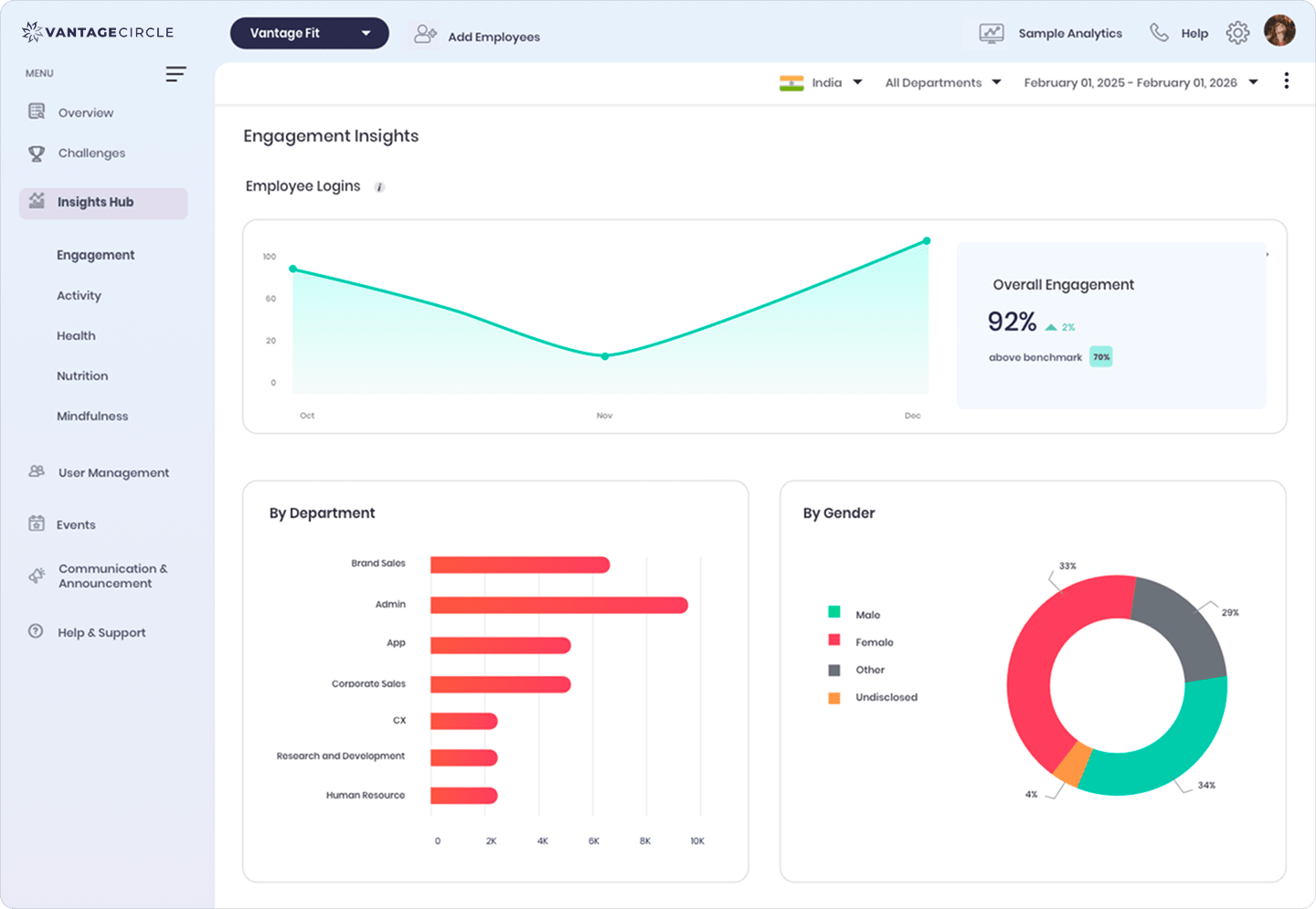
Wipro ran three company-wide challenges across 30+ countries and grew participation from 163 to 550 active employees, a 3X increase, with total step activity up 84% between May and July 2025. Read the Wipro case study →
For KEVA, a mid-size fragrance manufacturer, mobile access was the deciding factor in whether people joined at all:
"The fact that our employees could easily download the application and access all minute details about the Fit-o-meter challenge on their phones motivated them to participate."
Pramod Patil, Deputy Manager HR, KEVA
9. Give Autonomy, and Don't Underestimate Small Gestures
Two of the cheapest levers a manager has cost nothing but attention.
The first is autonomy. Let teams set their own goals and workstyles so people work inside their own flow zone. Pair that freedom with training, mentoring, and growth opportunities, and you get satisfaction no perk replicates.
The second is recognition. A genuine shout-out costs nothing, and so do a company picnic, milestone cakes, or team-building activities that work for remote and in-office staff alike.
How Can You Effectively Measure Employee Wellbeing?

Measure employee well-being by collecting baseline data first, then tracking a fixed set of indicators over time: absenteeism, turnover, productivity, and engagement scores. Add health risk assessments and pulse surveys covering workload, mental health, and work-life balance. Without a baseline, you cannot prove a program worked.
Here is the practical sequence.
To ensure that any investment is profitable, you must first collect baseline data for evaluation. The employee wellness ROI calculator will model the return from your own headcount and cost inputs.
You can conduct health interest surveys, health risk surveys, health risk questionnaires, and biometric screenings, which provide basic best-practice assessments.
Design surveys with tools like Vantage Pulse that focus on specific aspects of well-being, such as engagement, workload, mental health, and work-life balance.
Analyze survey data to identify trends, areas for improvement, and inform well-being initiatives. Track metrics such as absenteeism rates, turnover rates, and productivity levels.
Track metrics such as absenteeism rates, turnover rates, and productivity levels.
Schedule regular check-ins with employees to discuss their well-being, workload, and any challenges they may be facing.
Introduce health risk assessments and biometric screenings at work. It can provide valuable insights into employee health and risk factors.
Regularly review the data to identify trends and target specific health issues.
Create a Tailored Employee Wellbeing Strategy with Vantage Fit

Vantage Fit brings the pieces above into one platform, so you run a single wellbeing strategy instead of managing separate vendors for physical, mental, and social wellness.
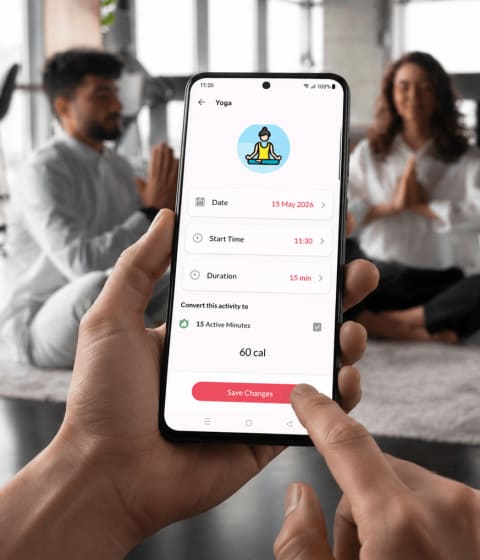
Start by assessing where the need is greatest, then build plans around what employees actually asked for. That can include meditation and mindfulness exercises, virtual challenges, yoga, and step challenges that give people a reason to take part together.
The part most programs skip is what happens after launch. Integrate the platform into your existing HR systems, promote it properly, then track engagement and outcomes so you can see what is working and adjust as needs shift.
Frequently Asked Questions
What are the 5 pillars of employee wellbeing?
Gallup's five pillars of employee wellbeing are physical, social, financial, career, and community wellbeing. Physical covers health and energy, social covers relationships at work, financial covers money security, career covers fulfillment in the role, and community covers connection beyond the workplace. Programs that address only one pillar tend to underperform.
What is the meaning of employee wellbeing?
Employee wellbeing means the overall physical, mental, emotional, social, and financial health of people at work. It reflects how job demands, workplace relationships, and management decisions affect a person's whole life, not just their health at the desk. It is assessed across several dimensions rather than through a single score.
What are the 5 C's of wellbeing?
In a workplace context the 5 C's are communication, coherence, commitment, consistency, and creativity. They come from Evolve Workplace Wellbeing's review of 75 scientific studies covering more than 16,000 people. The framework describes how to implement a wellbeing strategy successfully rather than what wellbeing itself contains.
Why is employee wellbeing important in the workplace?
Employee wellbeing is important in the workplace because it decides productivity, absenteeism, and retention. Gallup found that thriving employees miss 53% fewer days of work due to health problems and are 32% less likely to be job searching, while burnout costs $322 billion a year globally in turnover and lost productivity.
What is workplace wellbeing?
Workplace wellbeing is the overall physical, mental, emotional, social, and financial health of staff in the context of their job. It covers workload, job design, management quality, and the physical or remote work environment. Staff wellbeing and employee wellbeing describe the same thing.
What are the 7 dimensions of employee wellbeing?
The seven dimensions of wellbeing are physical, emotional, intellectual, social, spiritual, environmental, and occupational. Some models extend this to nine by adding financial and cultural wellbeing. The dimensions framework is broader than Gallup's five pillars and is useful for auditing which areas a wellness program currently leaves uncovered.
Why is employee wellbeing a major concern?
Employee well-being is increasingly recognized as a crucial component of workplace productivity and employee retention. An employee who has positive physical and emotional health is more likely to show better commitment at work.
What is the difference between employee wellness and employee well-being?
Employee wellness focuses on physical health and immediate goals such as fitness programs, health screenings, and gym memberships. Employee well-being is broader and longer term, covering mental, emotional, social, and financial health alongside the physical, including work-life balance and resilience.
Why is it important to take a holistic approach to employee wellness?
A holistic approach improves physical, mental, and financial health together. It reduces stress and prevents burnout, which produces more engaged employees than a single-dimension program can.
What are some employee well-being metrics to track?
Useful employee well-being metrics include engagement scores, absenteeism rates, turnover, and productivity levels. Assess mental health regularly alongside them rather than once a year.
What are the benefits of an employee well-being program?
Well-being programs improve health and reduce turnover. They also increase engagement and support a more balanced work culture.
What are some employee well-being initiatives?
Employee well-being initiatives include mindfulness programs, flexible schedules, mental health support, financial wellness workshops, and team wellness challenges. These work best when run together rather than as isolated one-offs. See our full list of employee wellbeing initiatives for more ideas.