An employee well-being index is a single composite score that combines survey responses across several dimensions of wellness, such as physical health, mental health, work-life balance, and financial security, into one number an organization can track over time. It exists so employers measure how their workforce is actually doing instead of assuming. Deloitte’s 2023 Well-being at Work survey of 3,150 people found that 90% of C-suite leaders believed employees were satisfied with their benefits, while only 43% of employees said they were. Just 2% of leaders suspected any dissatisfaction at all.
Vantage Fit approaches this with a wellness score dashboard that breaks wellbeing into measured components rather than survey answers alone, covering physical activity, sleep, mindfulness, and nutrition at individual and team level. A survey-based index and a behavioral score answer different questions, and most organizations end up wanting both.
Key Takeaways
- An employee well-being index turns scattered wellness signals into one score that can be tracked, benchmarked, and acted on.
- Leaders consistently overestimate how well their people are doing, which is the gap an index is designed to close.
- Most indices cover physical, mental, social, financial, and work-life dimensions, with job satisfaction often treated separately.
- Confidentiality determines data quality, because employees who doubt anonymity do not answer honestly.
- An index is only useful if results drive specific initiatives; measuring twice a year and changing nothing is worse than not measuring.
What is an employee well-being index?

The employee well-being index provides a sneak peek into workplace wellness. This, in turn, allows organizations to do the following:
- Identify areas that need improvement in work culture or employee benefits.
- Identify wellness initiatives to support employees better.
- Analyze how effective the wellness program is.
- Doing so can create a more positive and productive work environment.
What are the benefits of using an Employee well-being Index (EWI)?
Utilizing an employee well-being index has benefits for both employees and the organization. Here are some notable benefits:
Benefits for employees:
1. Increased self-awareness of well-being
An EWI illuminates various wellness aspects, such as physical, emotional, financial, etc., allowing employees to identify wellness factors in which they are thriving and where they need assistance.
2. Access to personalized resources and support
Based on the EWI results, employers looking to boost workplace wellness will be motivated to introduce resources to enhance employee wellbeing. Resources such as mental health support, financial wellness workshops, stress management, etc.
3. Improved engagement with employers
Utilization of the employee well-being index instills a feeling of assurance in the workforce. Employees feel valued as the organization considers their wellness needs. It ignites a sense of trust and appreciation towards the management and the organization.
Benefits for organizations:
1. Identify pain points via survey feedback
EWI includes surveys to understand the status of employee wellness in the workplace. The surveys shed light on the areas that cause common issues like burnout, stress, unproductivity, etc.
2. Track ROI of well-being programs with data
At the end of the day, it’s all about ROI. Organizations can calculate the return on investment (ROI) of wellness initiatives with the help of the EWI to track their wellness program’s efficacy. Monitoring engagement levels and turnover risks also becomes easier. For a deeper look at how to quantify this, see ROI on Wellness Programs.
3. Benchmark against industry averages externally
Job seekers nowadays are interested in companies that are more employee centric. Enabling an employee well-being index sets a high benchmark for the organization in terms of workplace wellness. As a result, it helps attract and retain top talent in the workforce.
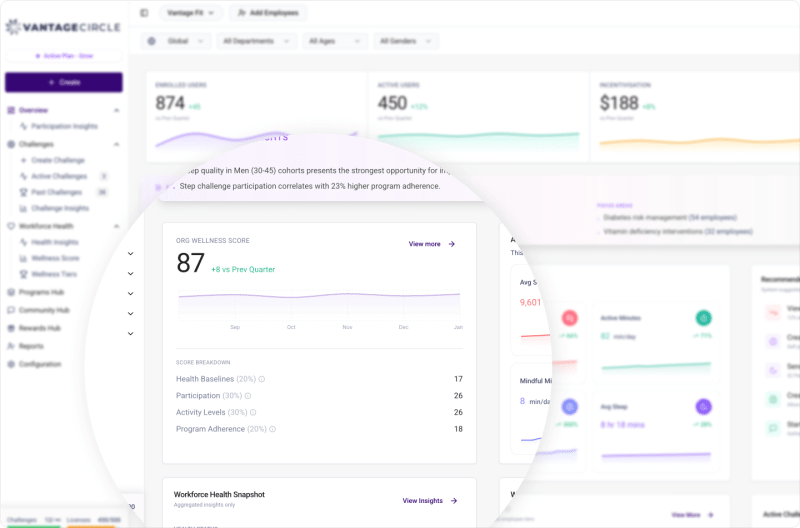
Noting the benefits, platforms like Vantage Fit help organizations go beyond surveys by offering a built-in wellness score dashboard. The platform helps in breaking down employee wellbeing into measurable components like:
- physical activity
- sleep, mindfulness
- nutrition
HR can view individual and team-level scores in real time. As a result, it becomes easier for them to identify where change is needed and which initiatives are driving the most impact.
In Tata Motors’ 6-month Step & Stride Challenge, the data tells a compelling story:
Participants maintained an average organisational BMI of 24, 7 hours 39 minutes of sleep per night, and 7 minutes of daily mindfulness practice. These are the kinds of measurable wellbeing components a wellness score dashboard surfaces.
Numbers like these make the case for continued investment in data-backed programs far easier to put to a finance team. Read the full story: Tata Motors Step & Stride Case Study
Read more: Wellness Assessment: How to Evaluate Your Program's Impact
What Does an Employee Well-being Index Measure?
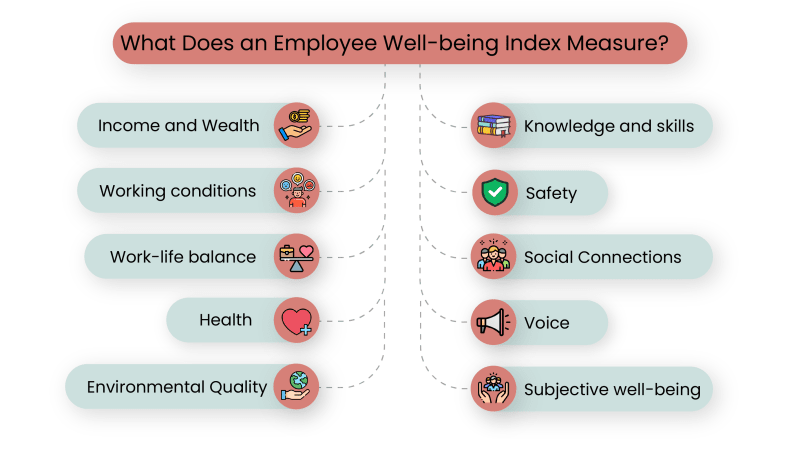
The OECD Well-being Framework, which has guided international well-being measurement since 2011, sets out eleven dimensions of current well-being. Most workplace indices draw their categories from some subset of these, narrowed to the dimensions of wellness an employer can actually influence.
- Income and wealth
- Work and job quality
- Housing
- Health
- Knowledge and skills
- Environmental quality
- Work-life balance
- Social connections
- Civic engagement
- Safety
- Subjective well-being
Physical Well-being:
To measure physical well-being, an EWI includes a questionnaire related to health habits like:
- Exercise
- Sleep Quality
- Nutrition
- Chronic health conditions
- Work-related injuries
- Access to healthcare services
Mental & Emotional Well-being:
To assess the mental and emotional aspects, an EWI includes questions related to:
- Stress levels and anxiety
- Burnout
- Mood type
- Access to mental health resources
- Emotional resilience
Additionally, it may also target aspects like job satisfaction and work-life balance.
Social Well-being:
Studying the social well-being aspect of employees, an EWI includes questions related to:
- Sense of belonging in the workplace
- Quality of relationships at work and personal level
- Opportunities for social interaction
Work-life Balance:
Some EWIs include the work-life balance aspect within the mental and emotional well-being section. However, you can also keep the work-life balance as a separate section of the EWI survey. To assess work-life balance, EWI includes questions related to:
- Satisfaction with work-life balance
- Ability to disconnect after work
- Flexibility in work arrangements
Job Satisfaction:
Another well-being that EWI includes is job satisfaction. To assess it, questions related to the following are studied-
- A sense of purpose at work
- Engagement in work
- Career development opportunities
- Recognition for contributions
Financial Well-being
Lastly, financial well-being is another integral aspect that is studied to measure EWI. To measure EWI for this section, questions that are included revolve around the following-
- Financial security
- Stress levels related to finances
- Access to financial resources
- Benefits offered by the organization
Academic work points the same way. Oxford's Wellbeing Research Centre analyzed roughly one million employee surveys across 1,782 publicly listed US companies, scoring four measures that any index will recognize: job satisfaction, purpose, happiness, and stress. Wellbeing tracked with both firm profitability and firm value, and a portfolio of high-wellbeing companies outperformed standard stock market benchmarks.
How is the Employee Well-being Index typically administered?
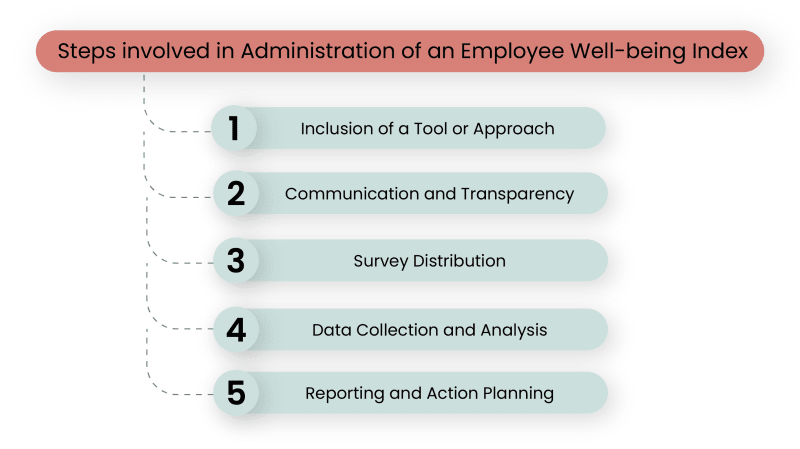
Administration of an Employee Well-being Index (EWI) typically involves these steps:
1. Inclusion of a Tool or Approach:
The primary essence of EWIs involves conducting surveys to learn about the well-being of the employees. Asking the right question matters to gather accurate results. In this case, going for a pre-designed EWI survey from a provider or developing a custom survey aligned with their specific needs will do the trick.
2. Communication and Transparency:
To instill assurance among employees for them to respond genuinely to the survey, maintaining clear communication and transparency. They should be informed about the EWI’s purpose and how it will benefit them.
3. Survey Distribution:
The EWI can be administered online or through paper surveys. This way, the employees can access the survey questions easily.
4. Data Collection and Analysis:
Once you collect the data, analysis is carried out to identify trends and patterns in employee well-being across different teams or departments.
5. Reporting and Action Planning:
The collected analytical data is then shared with relevant stakeholders for discussions to bring in required well-being initiatives.
Confidentiality is crucial to generate accurate responses.
6. Frequency of administration:
You can administer the EWI periodically, like annually or bi-annually, to track progress and measure the progress of well-being initiatives.
Implementing an Employee Well-being Index in Your Workplace
To implement an employee well-being index in your workplace, you must go through the following protocol.
1. Set a course for the implementation process.
Before starting the EWI survey process, it is important to conduct a survey to understand how your employees are doing wellness-wise. Collaborating with an EWI provider will make the process simpler.
2. Choose an authorized EWI provider
Look for providers with a positive industry record and have offered EWI services to renowned organizations.
3. Make effective communication and build trust with the workforce.
Communicating with your employees about the need to implement EWI plays a significant role. Also, maintaining transparency on your intent behind this process builds trust. This will cause them to respond to the surveys genuinely.
The best-known example is the Mayo Clinic Well-Being Index, a 9-question tool validated across more than 21,300 working adults and now used by over 1,000 organizations. It takes under a minute to complete, which is a useful benchmark for how short your own survey should be.
Leveraging the Employee Well-being Index results for Action
1. Study the wellness areas to improve and take action
Introduce wellness initiatives or give access to resources as per the survey results. For instance, if the results show a high score of stress levels, you can consider arranging stress management workshops or mindfulness training.
2. Initiate well-being initiative ideas
Here are some ideas for well-being initiatives that you can implement:
Poor financial well-being score:
Include monthly financial educational workshops to better educate employees on managing finances. Offer monetary incentives sometimes, or discount coupons which they can use to purchase essential items.
Poor work-life balance score:
To create a balance in this case, you can offer flexible work schedules, a partial leave policy, or a work-from-home policy.
Keep an eye on the progress and results.
Measuring and making the most of the employee well-being index is not one day or one month’s work. Just like the phrase “Rome wasn’t built in a day,” unlocking the true power of EWI may take some time.
Meanwhile, monitor how the ongoing EWI is doing, record the impact on the workforce, and improvise the strategy.
Read more: Data-Driven Employee Wellbeing: How Analytics Transform Workplace Wellness
Final words
The EWI is a measuring tool for continuously monitoring and fixing workplace quality. As per the results, you can establish a work environment that promotes employee well-being, which helps unleash the potential of your workforce.
Frequently Asked Questions
How is an employee well-being index calculated?
Employees answer a set of questions across each dimension, usually on a numeric scale. Responses are scored, weighted if some dimensions matter more to your organization, and combined into a single composite figure, commonly out of 100. The individual number matters less than the direction it moves between rounds, so keep the questions and the weighting identical each time or the comparison is meaningless.
What is a good employee well-being index score?
There is no universal pass mark, because scores depend on the instrument, the question wording, and the workforce. Treat your first round as the baseline and judge later rounds against it rather than against another company's number. Where comparison matters, use an established instrument such as the Mayo Clinic Well-Being Index so the figure means the same thing across organizations. Movement within a single dimension usually tells you more than the headline score.
What is the difference between a well-being index and well-being metrics?
Well-being metrics are the individual measures, such as absenteeism, participation rate, sleep hours, or stress scores. A well-being index is one composite number rolled up from several of them, built so it can be tracked over time and reported to leadership. Metrics tell you what is happening in a specific area, and an index tells you whether the overall picture is improving. For the underlying measures, see our guide to employee wellbeing metrics.
How often should you run a well-being index survey?
Annually or twice yearly suits most organizations. That is frequent enough to catch a trend and act within the same budget cycle, and infrequent enough to avoid survey fatigue. Run it more often only if you pair each round with a visible change, since employees stop answering honestly when they see nothing come of it.
Is an employee well-being index confidential?
It has to be, or the data is worthless. Responses should be anonymous, and results should only ever be reported in aggregate, at a team size large enough that no individual can be identified. Say so plainly before the survey opens, and explain who sees the results and what will be done with them. Employees who suspect their answers are traceable will give you the answers they think are safe.