Corporate fitness programs generate something that most wellness initiatives cannot: measurable data. Steps walked, BMI reduced, blood cholesterol changed. These are not merely survey responses. They are measurable results. That distinction matters most when leadership asks whether the program worked.
Key Takeaways
- Corporate fitness programs generate objective, measurable data (steps, BMI, and biomarkers) that wellness programs based on self-reported surveys cannot match.
- Five metrics that make the case for a fitness program: healthcare cost savings, absenteeism reduction, participation rate, BMI trend, and turnover cost avoided.
- Visible data: leaderboards, Wellness Scores, yearly blood tests, and real rewards. This is what sustains participation beyond month one and makes the measurement possible in the first place.
- Measurement activates the habit loop: visible data is the cue, fitness behavior is the action, and real rewards close the cycle. This is why high-measurement programs outlast those built on reminder emails.
What Is a Corporate Fitness Program?
A corporate fitness program is a structured, employer-sponsored initiative. It enables employees to track physical activity, participate in health challenges, and improve measurable wellness metrics. General wellness programs address mental health, financial wellbeing, and social connection. Corporate fitness programs focus specifically on physical health outcomes: daily step counts, body mass index (BMI), blood pressure, cholesterol levels, and biometric screening scores.
Types of Corporate Fitness Programs (and What Each One Measures)
“Corporate fitness program” is an umbrella term, and most organizations run a mix of the formats below. The difference between a program that proves its value and one that does not is whether each format is set up to produce data, not just activity.
| Program type | What it involves | What it measures |
|---|---|---|
| Step and activity challenges | Time-bound individual or team competitions tracked through wearables or a mobile app | Daily steps, active minutes, participation rate |
| Corporate exercise and group classes | On-site or virtual yoga, HIIT, and guided workout sessions employees join on a schedule | Session attendance, consistency, self-reported energy |
| Subsidized gym and membership benefits | Employer-funded gym access or reimbursements | Enrollment and utilization rate, the metric most reimbursement programs never capture |
| Wearable-based activity programs | Company-wide programs that auto-sync Apple Watch, Fitbit, or Garmin data | Continuous activity data with no manual logging |
| Biometric screening and health risk assessment | Pre- and post-program blood tests and HRAs | BMI, blood pressure, cholesterol, and other biomarkers, before and after |
| Walkathons and recreation events | One-off or seasonal step events and company sports days | Reach, participation, and total activity logged |
A subsidized gym membership and a wearable-based step challenge are both corporate fitness programs. Only one of them tells you whether anyone actually moved. That measurability gap is the theme of the rest of this guide.
The Corporate Wellness ROI Problem

Most wellness programs produce VOI (Value of Investment) rather than ROI. They measure engagement and not outcomes. Wellness engagement surveys measure how employees feel about the program but not what physically changed in them. VOI is not meaningless, but it fails line item review.
Corporate fitness programs are designed differently. They track physical metrics and produce before-and-after data that withstands leadership scrutiny. Those metrics are objective and can therefore be measured accurately. That is how you calculate the ROI of corporate wellness programs.
What a Corporate Fitness Program Actually Measures

It provides HR teams with clear baseline metrics before the program begins and measurable, data-driven outcomes once it concludes.
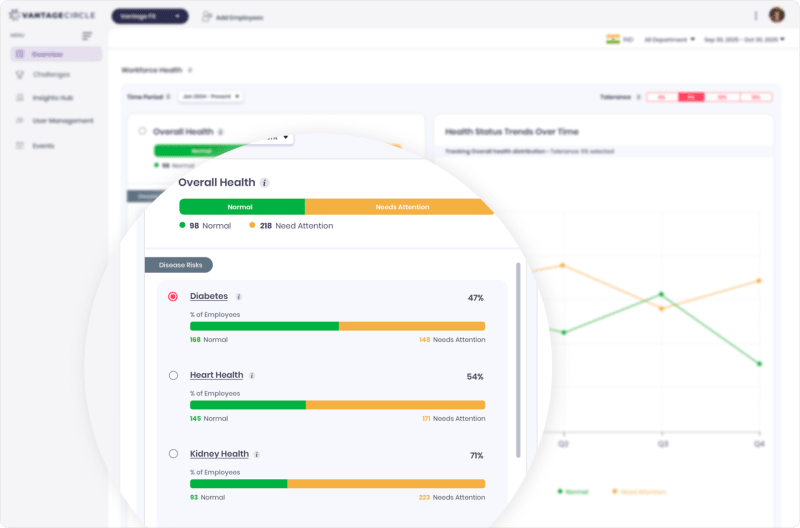
Here’s how it works in practice. Before the program begins, employees complete a Health Risk Assessment (HRA) and undergo a blood test. Once the program concludes, the same assessments are repeated. The HRA highlights visible changes such as BMI and lifestyle improvements, while the blood test reveals internal health shifts, including cholesterol levels, Vitamin D, and other key biomarkers.
| Metric | What It Captures | When Measured |
|---|---|---|
| BMI | Body mass index, the baseline physical health indicator most tied to insurance risk and long-term disease burden | Before (HRA) and After (lab/HRA re-test) |
| Blood pressure | Cardiovascular risk indicator; elevated levels correlate with absenteeism and long-term healthcare cost | Before (HRA) and After (lab/HRA re-test) |
| Daily steps | Universal activity proxy; auto-synced from wearables, no self-reporting required | During (continuous, daily) |
| Cholesterol / HbA1c / Vitamin D | Lab biomarkers that reveal metabolic and deficiency risk at aggregate workforce level | After (lab report upload, AI extraction) |
| Challenge participation rate | Percentage of enrolled employees completing challenge tasks each week, the primary engagement output | During and at program close |
| Wellness Score (0–108) | Composite daily score combining HRA baseline, activity, participation, and challenge adherence, the headline HR metric | During and after (tracked monthly) |
The Before-and-After That Proves It
The three organizations below who used Vantage Fit did not measure engagement. They measured outcomes.
At Brazosport ISD, workforce average BMI dropped from 30 to 27 in a couple of weeks during a Fit Wars campaign. A metric any leadership team will respect.
At Tata Motors, employees sustained an average of 7,600 daily steps over six months, with 53 percent of participating teams recording measurable weight reduction. Not engagement scores. Not survey sentiment. Actual before and after health data.
At Wipro, step counts increased by 84 percent between May and July 2025. Participation grew from 163 employees to 550, nearly tripling through visible progress tracking and meaningful incentives.
Three organizations. Three measurable outcomes. Each driven by a program that established a baseline, tracked progress, and delivered quantifiable results.
The 5 Numbers That Hold Up in a Leadership Team Meeting
The business case for a corporate fitness program does not require an extensive report. It requires five numbers. Most teams taking care of wellness already have access to the data that produces them. Use the employee wellness ROI calculator to run your own numbers before the next leadership meeting.

Further reading: Do wellness programs reduce healthcare costs? for a breakdown of the evidence behind the $250-per-employee savings benchmark.
| Metric | Proof Point | Financial Implication |
|---|---|---|
| Healthcare cost reduction | $250 annual savings per employee (industry benchmark) | For 1,000 employees: $250,000 in annual healthcare cost avoidance |
| Absenteeism reduction | 75 minutes of weekly exercise reduces sick days by 4 per year (industry benchmark) | 4 fewer sick days per active employee x average salary = recoverable productivity cost |
| Participation rate | Wipro: 3X participation increase (163 to 550 employees) | Higher utilization per seat lowers effective cost per engaged employee |
| BMI trend | Brazosport ISD: average BMI fell from 30 to 27 in two weeks | Lower BMI distribution correlates with reduced chronic disease claims and lower insurance premiums over time |
| Turnover cost avoided | Employee replacement cost: $15,000–$25,000 per employee (industry estimate) | Replacing one employee costs $15K–$25K; programs that improve engagement are a retention argument the leadership team understands |
Why Measurement Drives Higher Participation
Behavioral scientists describe habit formation as a three-step process: cue, action, reward. A corporate fitness program, when built around measurement, activates all three.
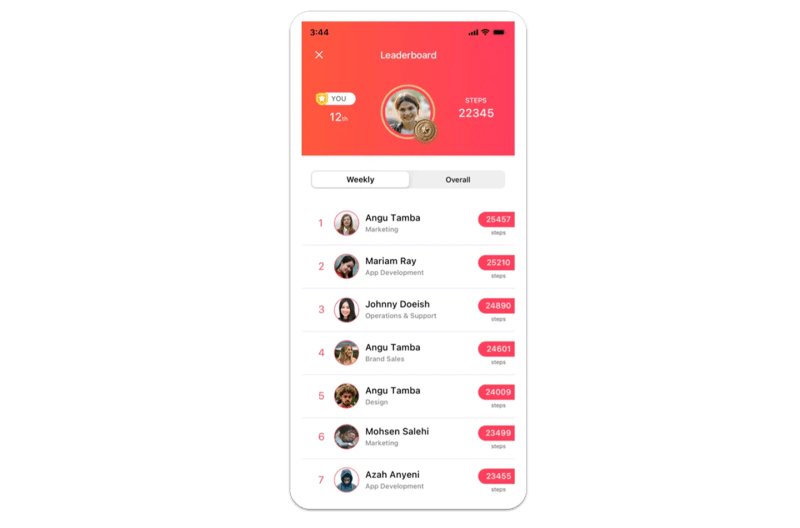
The cue is visible data that progresses over time. A step count that got updated overnight. A Wellness Score that crept upward week over week. A leaderboard with a team sitting just outside the top three. These are not motivational messages from HR. They are cues that prompt action without anyone having to ask. The action is the fitness behavior itself.
The reward is real: points earned, a gift card redeemed, a ranking climbed in a leaderboard. That tangibility is what separates programs with sustained engagement from those that spike in January and flatline by March.
"A healthcare provider reimbursing someone for a gym membership has no accountability for whether that employee is actually using it. A wearable tracks daily activity. Gamify it, add prizes, and you get behavior change."
— Breck L. Rice, Co-founder, ServRx on Vantage Fit Corporate Wellness Podcast
Most wellness programs miss the first stage entirely. Without visible, real-time data there is no cue. Only a reminder email that most employees have learned to ignore. The industry average for sustained wellness program participation is 20–30%. That ceiling exists because the habit loop is never completed.
Measurement is not just how a program proves it worked. It is how gamification for employee fitness closes the loop.
How to Start a Corporate Fitness Program
You do not need a big budget to launch one. You need a baseline and a way to track progress.
- Set a baseline. Run a Health Risk Assessment and capture current participation, absenteeism, and (where available) aggregate biometric data before anything launches.
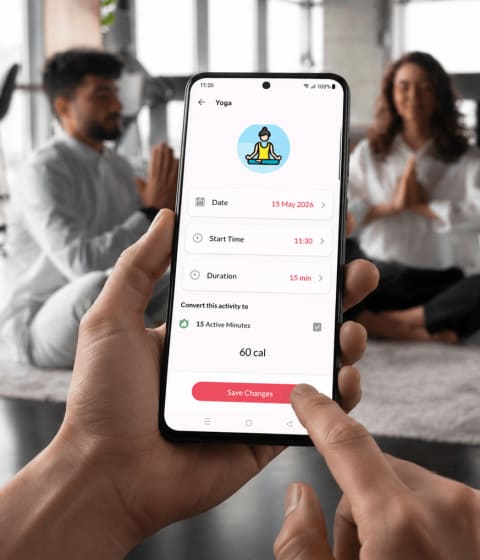
- Pick one anchor format. A step or activity challenge is the easiest first program: it needs only a wearable or a phone, and it produces data from day one.
- Make rewards real. Points, gift cards, or a leaderboard sustain participation past the first month far better than reminder emails.
- Track the right metrics. Participation rate, average step or activity trend, and at least one biomarker movement.
- Report at 6, 12, and 24 months. Compare each result against the baseline so the program reads as a measurable investment, not a perk.
What to Look for in a Platform That Actually Measures
When evaluating a corporate fitness platform on its ability to produce measurable outcomes, these are the questions worth asking before choosing one.
Does it capture a health baseline before the program starts? A platform without a Health Risk Assessment at onboarding and after cannot produce a before-and-after. It can only show activity during the program.
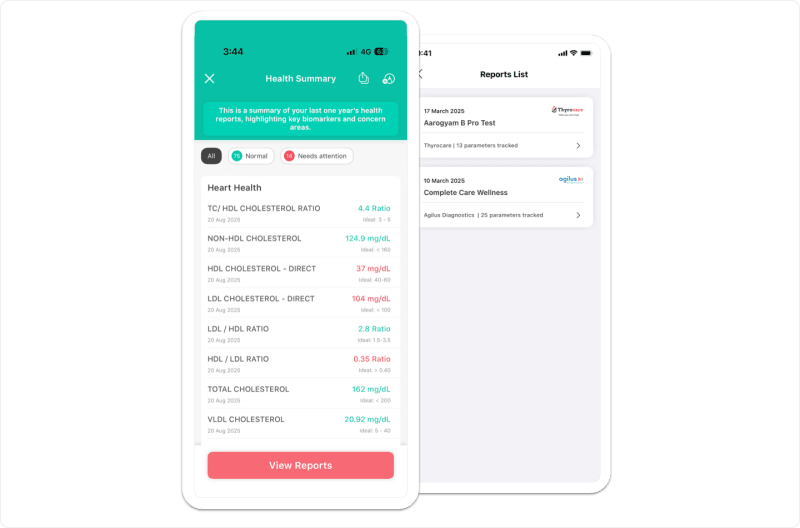
Can employees upload lab results before the program starts and after it ends? Both pre- and post-program blood test uploads with AI analysis of biomarker changes close the measurement loop the HRA opens.
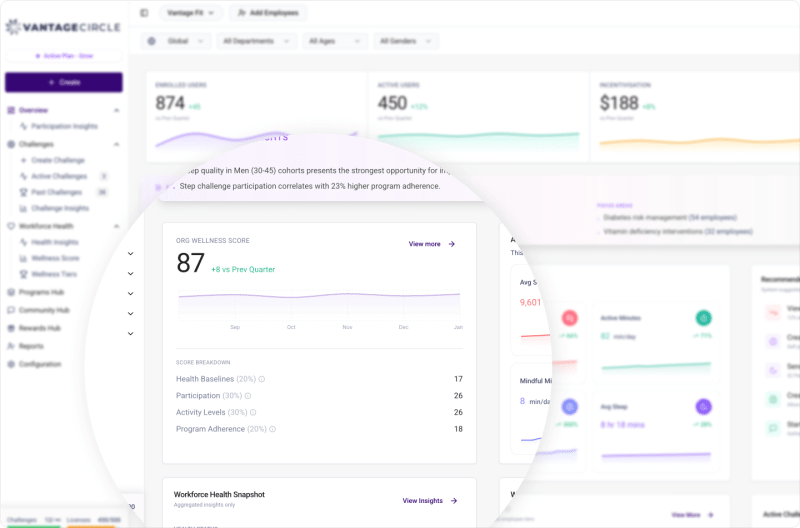
Does it produce a single reportable health metric? A Wellness Score or a similar metric that aggregates HRA data, activity, and challenge adherence into one number makes quarterly leadership reporting straightforward.
Can HR export participation data by department, gender and other demographics? Exportable analytics for the leadership team are what convert program data into a business case.
Does it sync with the wearables employees already own? Continuous passive tracking removes the friction that kills consistent data collection.
Does individual health data stay private? HR should see workforce trends. Employees should control their own records. Any platform that cannot separate the two creates a trust barrier that suppresses participation.
Vantage Fit answers yes to all six.
Frequently Asked Questions
What is the difference between a corporate fitness program and a corporate wellness program?
A corporate fitness program focuses on physical health metrics (steps, BMI, blood pressure, and biometric data) that can be measured before and after the program runs. A corporate wellness program covers a broader range: mental health, nutrition, financial wellbeing, and stress management. Wellness programs are more holistic. Fitness programs are more measurable. Many organizations run both, using the fitness component to generate the objective data that wellness programs sometimes cannot.
What biometrics should HR track in a corporate fitness program?
Start with the six that map directly to medical insurance and absenteeism risk: BMI, total cholesterol, blood pressure, fasting blood glucose, waist circumference, and resting heart rate. Capture them at program start through lab tests and a Health Risk Assessment, and again at program close. HR does not need individual employee data. Aggregate workforce trends across these six metrics are enough to build a compelling leadership report.
How do you prove fitness program ROI to leadership?
With a before-and-after, not a survey. First, participation rate: how many eligible employees enrolled and stayed active. Second, biometric movement: average BMI change, step count increase, or percentage of participants who improved at least one health metric. Third, cost implication: $250 in annual healthcare savings per participating employee is the industry benchmark. Together, those three cover the questions leadership always asks: how many, did it work, and what was the return on investment (ROI).
How long before a corporate fitness program shows measurable results?
Plan for two separate timelines. Engagement metrics (participation rates, step counts, leaderboard activity) are visible within the first two to four weeks and useful for early reporting. Biometric changes take eight to twelve weeks of consistent activity to produce meaningful results. HR should set that expectation upfront with the leadership team and use the early engagement data to demonstrate the program is building toward the biometric outcomes. Reporting both gives leadership a progress narrative, not just an end result.