Employers can reduce healthcare costs by combining preventive wellness programs, tax-advantaged HSAs, smarter network plans, and regular benefits reviews. Mercer’s 2026 survey of employer health plans found employers expect health benefit costs to rise 6.5% in 2026. This will be the steepest increase in 15 years, pushing costs past $18,500 per employee.
In this blog, you will find nine strategies that help absorb that increase without cutting pay or headcount.
It is worth mentioning that the impact of cost rise extends beyond the healthcare budget. As more money goes toward premiums, employers have less flexibility to invest in competitive salaries, employee perks, and other benefits. Wellness platforms like Vantage Fit can help address this pressure by supporting preventive health initiatives and giving HR teams measurable data on participation, outcomes, and potential cost savings across the workforce.
Key Takeaways
- Employers expect a 6.5% rise in health benefit costs in 2026, the steepest increase in 15 years, pushing per-employee costs past $18,500, per Mercer's 2026 survey.
- Wellness programs generate an average of $250 in annual healthcare savings per employee.
- Five chronic-disease risk factors (high blood pressure, smoking, diabetes, inactivity, and obesity) cost U.S. employers $36.4 billion a year in absenteeism alone, per CDC research.
- HSA contributions and withdrawals are tax-free when used for qualified medical expenses, making them one of the simplest cost-sharing tools available.
- Replacing a single employee costs $15,000 to $25,000, so retention-focused benefits like work-life balance directly reduce long-term healthcare and turnover costs.
Metrics That Drive Healthcare Costs
Before we dive into the strategies for healthcare cost reduction, it is necessary to highlight the metrics that drive healthcare costs. There are two types:
Fixed healthcare costs: This involves predictable expenses that employers have to bear on a regular basis like insurance premium, admin costs, salary allotment for employees, and facility costs.
Flexible healthcare costs: This involves variable expenses like medical costs, preventive health costs such as investment in wellness programs, and emergency hospital expenses.
Before jumping into any of these strategies, you should know exactly what’s driving your costs. Is it a handful of chronic conditions, rising pharmacy spend, or gaps in preventive care? Paychex points to this kind of claims-data review as the natural starting point before you commit budget to a fix.
Now, let’s look into the nine healthcare cost reduction strategies employers can apply.
9 Ways Employers Can Reduce Healthcare Costs Efficiently
1. Implement a wellness program

The math is simple here, to be honest. Healthcare costs can be lower if the organization’s employees are healthy. Maintaining a healthier lifestyle is what all employees need to reduce healthcare costs.
So, technically, the power lies in the hands of the employees. It’s well-known that busy professionals often struggle to maintain a healthy lifestyle. This is why employers also play an impactful role here.
You can introduce resources and benefits that will promote employee health. Implementing a wellness program is one way to do so. These are designed to target and improve every sphere of wellness.
But are you wondering how wellness programs can reduce costs? Wellness programs indirectly reduce costs by instilling healthy habits that minimize the chances of diseases. This, in turn, reduces the chances of employers spending on healthcare bills.
Wellness programs are among the most impactful tools for long-term cost containment. Employers with effective wellbeing programs report healthcare cost reductions of up to 35%, according to Wellhub. A Johns Hopkins Bloomberg School of Public Health analysis of General Motors employees found that regularly active employees had roughly $250 lower annual healthcare costs than inactive employees. For employers, this highlights the potential financial impact of getting employees to participate consistently in wellness programs.
Client results back this up. Vantage Circle’s 3-year wellness study tracked 94 employees against annual health check-ups and found 47% showed measurable improvement in at least one major health biomarker. Tata Motors’ Step Up & Elevate challenge drove 70% engagement across 43 teams, with measurable weight reduction for over half of participating teams. And Wipro’s global wellbeing program saw activity levels grow 84% between May and July. Programs with engagement and outcomes at that level are what actually translate into measurable healthcare savings, not just participation on paper.
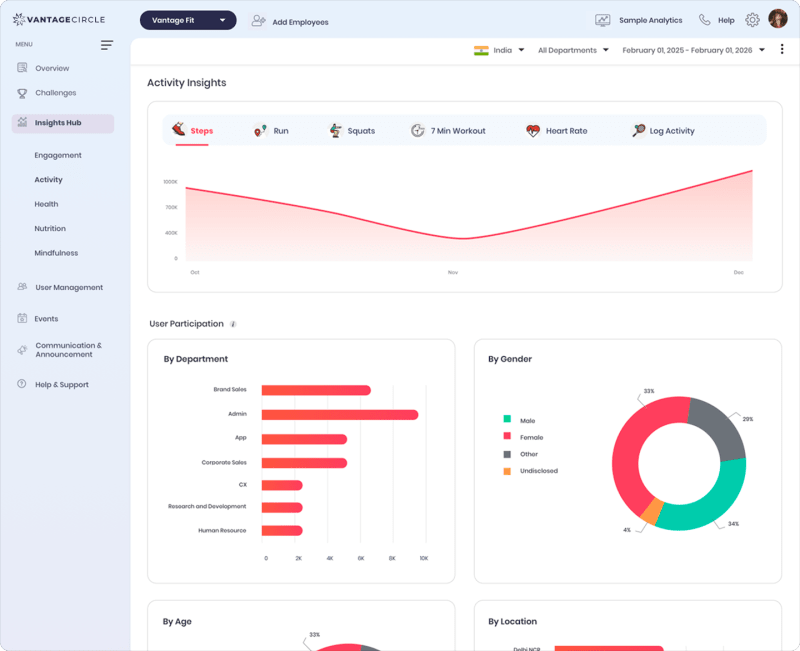
Platforms like Vantage Fit make it easier to put these programs into practice at scale while measuring their impact. Instead of relying on industry averages, HR teams can use engagement data and program metrics to track their own wellness program ROI. With a built-in challenge builder and real-time engagement analytics, Vantage Fit also streamlines program management. HR can handle from launching wellness challenges to monitoring participation and results.
2. Educate employees about the cost of health care
Educating employees about the organization’s healthcare costs in the past and current year is a great way to reduce the cost. Employees should get a peek into the fact that their lifestyle has a direct correlation with the organization’s growth.
Organize workshops for them to learn how to take control of their health for good and how they can contribute towards reducing medical costs. Workshops can also help employees be aware of the rise in chronic illness in the workplace, how it affects their work performance, and a company’s costs in the long run.
The purpose is ultimately to help reduce healthcare costs in the long term. Companies can arrange yearly blood checkup camps to create health awareness among employees.
For instance, my workplace organizes health checkup campaigns and blood donation drive yearly. My first health checkup at work revealed I had low hemoglobin and Vitamin D levels, prompting me to take steps toward better health.
After a month or so of the health camp, I embarked on a wellness journey that turned me into a CrossFit enthusiast. I started eating healthy, which means I included more protein, wholesome carbs, and healthy fat in my diet.
A year passed by, and I participated in the health checkup again. This time, my results came back better. Both my hemoglobin level and Vitamin D level increased slightly.
This is a simple example of how a simple health camp can help ignite awareness and motivation to take on a vigorous lifestyle.
3. Implement Health Savings Accounts (HSAs)
Health Savings Accounts (HSAs) are effective for managing healthcare costs. HSAs offer significant tax advantages when used exclusively for medical expenses. These accounts function as personal savings accounts where individuals can maintain funds to cover medical bills, including doctor visits, prescriptions, and even wellness-related purchases.
HSAs present an opportunity for employers to encourage healthy habits among employees. By establishing these accounts, employers can offer “wellness incentives” to those who demonstrate positive lifestyle changes. Employees, in turn, can contribute to their HSAs either fully or partially, creating a collaborative effort toward healthcare savings.
Now, you might wonder: “How exactly do HSAs help reduce healthcare costs?” The answer lies in their tax benefits. When used for qualified medical expenses, contributions to and withdrawals from HSAs are tax-free.
Since taxes are often a significant financial burden, HSAs are a practical solution to ease this pressure. Both employers and employees benefit from these savings, making HSAs a valuable strategy for reducing overall healthcare expenses.
Incorporating HSAs into your organization’s benefits package promotes financial wellness and incentivizes healthier lifestyles, resulting in long-term cost reductions for both employers and employees.
4. Review benefit packages and make changes as needed
Another strategy to reduce healthcare costs involves reviewing the benefit packages yearly.
An annual review ensures that benefits remain relevant, address employees’ needs, and align with the company’s budget goals. Here are some relevant pointers that employers will find handy.
-
Start by conducting a wellness assessment or employee survey to gather insights into workforce preferences and identify gaps in current offerings.
-
Use the data to make targeted adjustments that meet the needs of the majority while managing your wellness program budget effectively. For example, consider adding these options if employees prioritize mental health or fitness incentives.
-
To streamline the process, leverage HR software or consult benefits experts to benchmark packages against industry standards.
-
Regular updates improve employee satisfaction, promote wellness, and help control healthcare expenses.
Want to see what these strategies could save your company? Use the free Employee Wellness ROI Calculator to model potential healthcare savings against your own headcount and program cost.
5. Invest in technology for health and wellness

Investing in wellness tech and incentivization is an innovative approach to healthcare cost reduction.
Nowadays, the tech industry is booming with crazy advancements, making our lives more convenient in every way. The easiest example here is the launch of fitness trackers. These sleek wearables track heart rate, sleep quality, and whatnot.
If you rewind yourself to two decades back, the existence of a fitness tracker felt like a dream. Now, this is not the case anymore. So, living in an ever-evolving world, making wise use of every available tech in the wellness field is vital.
Hence, encourage the use of fitness trackers and health-tracking apps. In doing so, employees will become aware of their day-to-day lifestyle choices.
Invest in an incentive program to reward employees who are hitting milestones health-wise.
Whether walking 10,000 steps daily or working out for at least 45 minutes daily, employees who achieve such targets should receive appreciation and incentives. It is an excellent motivator for achieving and aspiring employees to continue towards an active lifestyle.
Employees who get at least 75 minutes of vigorous-intensity activity a week miss an average of 4.1 fewer work days a year, according to CDC’s Physical Activity Employer Guide. It is a direct and measurable cost saving tip for employers who consistently track and reward movement.
6. Reduce healthcare costs with network configuration
Networking is how the world is running at all levels. Similarly, employers must configure and maintain their “network” in the wellness industry to reduce healthcare costs. Network, in this case, means building relations with health professionals and admins responsible for caring for the workforce.
Networking is how employers can get healthcare packages at discounted prices. Here are some ways leaders are harnessing the power of network configuration to reduce costs:
Tiered network plan: This includes a wide range of healthcare providers already divided into subdivisions based on cost and quality of care. With this plan, employees can make an informed choice of the health care they wish to go ahead with. At the same time, employers get the power to offer flexible and suitable health benefits to their workforce.
Narrow network plan: This plan comes with a limited number of providers for employees. Usually, such a plan offers health providers the best deals for employer and employee concerns.
Centers of excellence: Develop a designated space or centers of excellence in the workplace for employees to seek specific medical aid. The beauty of this concept is that centers of excellence will have health professionals with thorough knowledge and experience.
Telemedicine: Offering virtual doctor visits means employees can get medical advice without taking a half-day off for a routine appointment. It also cuts down on ER visits for issues a quick video call could have handled instead.
Value-Based Insurance Design (VBID): Instead of the same co-pay for everything, VBID makes the co-pay lower for high-value care, like managing a chronic condition or getting a preventive screening. That way, employees don’t skip the visits that would have caught a bigger, costlier problem early.
7. Leverage Health Risk Arrangements to manage costs
Health risk arrangements are a flexible and affordable way for employers to reimburse employees who are eligible for medical expenses. You can deposit a certain amount in a special account for your employees in this arrangement.
HRAs offer flexibility to the employees to choose the healthcare coverage of their choice depending on their medical demands. Also, HRA accounts are tax-free. Offering employees this benefit is definitely a great strategy to cut healthcare costs.
8. Utilize data analytics to reduce costs

Data analysis is how, nowadays, leaders stay ahead in their business game; it’s no big secret. Similarly, data analytics is how employers can reduce their organizational healthcare costs.
With data analytics, leaders can digitize medical records and generate graphs of employees’ medical history. Such information is helpful for health professionals to provide the proper medical care, reducing the chances of misdiagnosis and costs in the long run.
Interestingly, this is also how leaders in the future will be able to predict their employees’ health status trends and accordingly offer wellness solutions.
9. Prioritize workLife balance
This is one of the simplest yet most effective strategies employers can use to reduce healthcare costs. Worklife balance is essential for any working individual to function productively and carry out personal chores successfully.
Five chronic-disease risk factors (high blood pressure, smoking, diabetes, physical inactivity, and obesity) cost U.S. employers $36.4 billion a year in absenteeism alone, according to CDC-published research. Work-life balance is one of the levers that keeps those risk factors in check.
It’s worth mentioning that the higher the employee morale is, the happier the employees will be. In the long run, such employees will be less prone to chronic diseases, reducing healthcare costs for employers.
Retention is another cost driver often overlooked. The Work Institute’s 2017 Retention Report put the cost of replacing a departing employee at roughly $15,000, once recruiting, onboarding, and lost productivity are factored in, according to HR Dive. Employees with good work-life balance are significantly less likely to leave.
How Can Vantage Fit Support Businesses in Reducing Healthcare Costs?
Vantage Fit is an employee wellness platform designed to promote workplace well-being all the way. From helping to build healthy habits to offering personalized wellness solutions, Vantage Fit offers a wide array of benefits both to employees and employers.
Vantage Fit also contributes towards the reduction of employee health care costs. Here’s a quick view:
1. Heart rate monitor

The heart rate is a primary indicator of how the body is functioning. The average resting heart rate varies between 60 to 100 beats per minute. If the heart rate is anything more or less, this may mean many things, such as stress, poor sleep or diet, or something severe.
So, the heart rate monitor is a great way to keep track of the overall health status. In case of any abnormality, the user can be cautious of their current lifestyle; thus, a stepping stone towards reducing health care costs.
2. Sleep tracker
Sleep is another vital sign that indicates a person’s well-being. Users can log in their sleep data or simply import the data from their wearables into the app. The sleep data is valuable information that health professionals can study to understand the user’s sleep pattern and identify any underlying health conditions.
3. Nutrition tracker
Health experts always emphasize how diet is vital in leading a healthy lifestyle. However, busy professionals retort to quick bites or processed food due to time crunch at work. Such eating behavior is not sustainable and is a ruling factor in causing chronic illness.
This is where a feature like a nutrition tracker helps busy professionals track their food intake even on a busy day. This feature shows how many carbs, fats, and protein intake occurs in every meal log.
4. Miscellaneous wellness programs
The primary objective of Vantage Fit is to help achieve improved employees’ health status and reduce healthcare costs for employees in the long term.
That is why it is power-packed with wellness programs like smoke cessation, achieving well-being with cycling, and getting a shredded body within weeks. Employees can enroll in the programs at discounted prices and reclaim their health in no time.
Frequently Asked Questions
What is the biggest driver of rising healthcare costs for employers?
Chronic conditions (cancer, musculoskeletal issues, cardiovascular disease, diabetes, high-risk maternity, and mental health) drive the majority of employer healthcare spend.
Do wellness programs actually reduce healthcare costs?
Yes. Well-designed wellness programs generate an average of $250 in annual healthcare savings per employee by encouraging preventive habits that reduce chronic-disease risk. Savings compound over time as participation and engagement increase.
How much can HSAs save employers on healthcare costs?
HSA contributions and withdrawals are tax-free when used for qualified medical expenses, reducing taxable payroll costs for both employers and employees. Exact savings depend on contribution levels and company size, but the tax-free structure alone makes HSAs one of the lowest-cost benefits to administer.
What's a typical annual healthcare cost per employee?
Average health benefit costs are expected to exceed $18,500 per employee in 2026, according to Mercer, the highest level in 15 years. Family health insurance premiums alone average $26,993 a year, per KFF's 2025 Employer Health Benefits Survey.
Final Words
Helping your employees make better healthcare decisions ensures a productive and loyal workforce. This reduces the employees’ healthcare costs and ensures they get the best and most necessary treatments.
Focusing on preventive healthcare, adopting health risk assessment, or offering holistic wellness programs are some top strategies to improve your employees’ wellness.