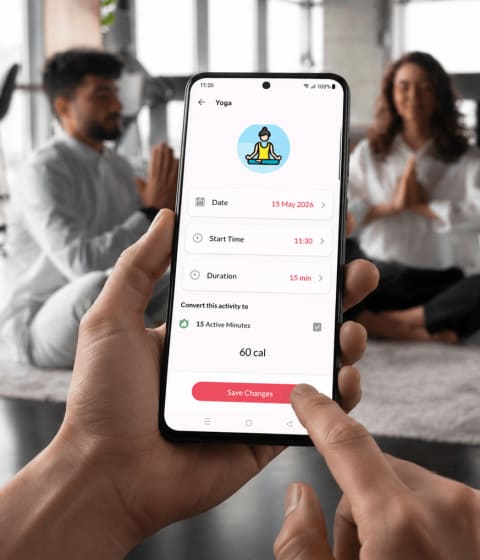
Employee wellness program ideas are specific, ready-to-run activities across physical, mental, financial, social, and occupational health that help HR teams lift engagement, lower healthcare costs, and build a culture people want to stay in. The strongest ideas are cheap to start, simple to run, and voluntary enough that employees actually take part. This guide covers 30+ of them, grouped by wellness dimension, budget, and team type.
We spend around 90,000 hours at work over a lifetime, according to Gettysburg College research, so the workplace is one of the most powerful places to shape everyday health habits. The business case is just as clear: the World Health Organization estimates 12 billion working days are lost each year to depression and anxiety, costing roughly US$1 trillion in lost productivity.
Platforms like Vantage Fit, a corporate wellness platform built for 500 to 10,000+ employee companies, make many of these ideas runnable at scale, whether your team is on-site, remote, or hybrid.
KEY TAKEAWAYS
- The best employee wellness program ideas span six dimensions: physical, mental, financial, social, occupational, and spiritual health.
- Most high-impact ideas are free or low-cost, so budget is rarely the real barrier to starting.
- Match ideas to how people work: remote, on-site, hybrid, and employees with personal or accessibility goals each need different options.
- Programs succeed on participation, not headcount. IBS Software reached 88% engagement in a 28-day Vantage Fit challenge.
- Start with one or two ideas, measure participation, then expand based on what employees actually use.
Here is a quick view of where each idea fits before we go deep.
| Wellness dimension | Sample idea | Typical cost |
|---|---|---|
| Physical | Team step challenge | Free to low |
| Mental | Guided meditation breaks | Free to low |
| Financial | Budgeting workshop | Low |
| Social | Volunteering day | Low |
| Occupational | Mentorship program | Free |
| Spiritual | Quiet reflection space | Low |
A real example shows what “participation, not headcount” looks like in practice. IBS Software ran a 28-day March to Fitness challenge with weekly and monthly health activities.
The program reached 88% employee engagement across 500+ active participants. Along the way, 130 employees tracked daily mood, 118 monitored heart health, and 98 added daily squats. Wellness does not have to be fancy. It has to show employees you care.
What are the benefits of an employee wellness program?
An employee wellness program improves health, engagement, and retention at the same time. When people move more, manage stress, and feel supported, they take fewer sick days, focus better, and stay longer. The upside is both human and financial, which is why wellness is now a core HR priority rather than a perk.
Better physical and mental health
Regular activity builds stamina and heart health, while stress-management practices like yoga and meditation help employees stay calm and focused. The U.S. Centers for Disease Control and Prevention offers employers guidance for building effective workplace health programs, and stresses that they work best when built into the organization’s culture rather than bolted on.
Lower costs and fewer sick days
Healthier employees cost less to insure and miss less work. A RAND Corporation analysis found that workplace wellness programs return about $1.50 in reduced healthcare costs for every $1 invested. Retention adds to that: Gallup estimates that replacing an employee costs one-half to two times their annual salary, so even a small lift in retention helps pay for the whole program.
Stronger culture and loyalty
When companies invest in wellbeing, they build trust. A strong wellness culture encourages people to stay longer and perform better, and it turns your team into advocates who recommend the workplace to others.
Employee wellness program ideas by dimension
Wellness is not one-size-fits-all. The most effective programs offer ideas across six dimensions so every employee finds something that fits, whether they care most about fitness, stress, money, connection, career, or meaning. Use these as a menu, not a checklist.
1. Physical wellness ideas

Physical wellness ideas keep energy up and stress down through movement and rest. They are the easiest place to start because most cost nothing.
- Join a step-tracking wellness challenge with coworkers.
- Take a brisk walk during lunch breaks.
- Do a 10-minute morning stretch.
- Aim for 8 hours of sleep and an earlier bedtime.
- Read for 20 minutes before bed to wind down.
2. Mental wellness ideas

Mental wellness ideas help employees stay focused and resilient. Short, daily practices work better than occasional big events.
- Meditate for 10 minutes with a guided session.
- Go outside for 20 minutes a day.
- Start a gratitude journal with daily entries.
- Attend a yoga class or run one on-site.
- Offer an Employee Assistance Program with confidential counseling.
3. Financial wellness ideas
Financial stress follows people to work. These ideas reduce it and free up focus.
- Host workshops on budgeting and saving.
- Offer access to financial counselors through the workplace.
- Help employees set up an emergency savings fund.
- Share apps to track monthly spending habits.
- Provide guidance on building a debt repayment plan.
4. Social wellness ideas

Social wellness ideas build the connection and camaraderie that keep teams engaged, especially across locations.
- Organize team-building activities like game nights or potlucks.
- Join a community volunteering initiative.
- Start a book club with colleagues.
- Schedule weekly coffee chats with coworkers.
- Plan outdoor activities such as hiking or picnics.
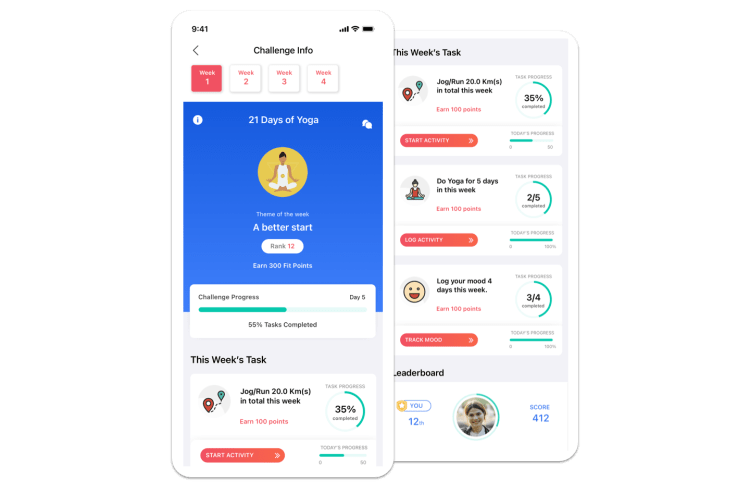
Scaling these activities across a larger or distributed team usually calls for a dedicated tool. Platforms like Vantage Fit make it practical to run many of them at scale, with ready-made challenge templates and five challenge formats, including race, journey, streak, and custom multi-activity challenges, so HR teams can design programs that meet employees where they are, without manual coordination overhead.
5. Occupational wellness ideas

Occupational wellness ideas support growth and prevent burnout at work.
- Offer skill-based courses to advance careers.
- Run mentorship programs.
- Encourage regular breaks to avoid burnout.
- Set achievable professional goals and celebrate progress.
- Support work-life balance with clear boundaries.
6. Spiritual wellness ideas

Spiritual wellness ideas help employees find purpose and calm, independent of any religion.
- Provide a quiet space for mindfulness or reflection.
- Encourage time in nature.
- Share books on personal growth.
- Support activities that align with personal values.
- Host optional community or reflection gatherings.
Employee wellness ideas by team type
The same idea lands differently for a remote developer, an on-site technician, and someone training for a marathon. Group your options by how people actually work so participation stays high.
For remote and hybrid employees
- Run virtual fitness classes and async step challenges.
- Offer stipends for home-office equipment.
- Host online social hours or trivia games.
- Share guided meditation sessions over video.
- Use journey challenges so distributed teams compete together.
For on-site employees
- Set up an on-site gym or fitness area.
- Stock healthy snacks in the breakroom.
- Run walking or hydration contests for friendly competition.
- Provide standing desks or ergonomic furniture.
- Schedule regular mental health days.
For employees with personal fitness goals
- Offer discounts on gym memberships.
- Provide personal training or virtual fitness programs.
- Host goal-based challenges like endurance milestones.
- Organize workplace running or cycling clubs.
- Share meal-prep and nutrition planning resources.
For employees with accessibility needs
- Offer adaptive fitness programs and accessible resources.
- Provide mental health support tailored to specific conditions.
- Create a safe, inclusive space for wellness discussions.
- Invite regular feedback to improve inclusivity.
- Partner with organizations that supply adaptive wellness tools.
Low-cost and free employee wellness ideas
You do not need a big budget to start. Most of the highest-impact ideas are free or a few dollars per employee, which matters because thin program budgets are the most common reason wellness stalls. Launch a couple this week, then reinvest based on what employees use.
- Organize walking meetings instead of desk meetings.
- Add stretch breaks to long meetings.
- Share DIY healthy-snack recipes.
- Plan group outdoor walks or runs.
- Offer a monthly wellness stipend employees choose how to spend.
Quick 5-minute wellness ideas
Short activities fit into any workday and are ideal for staff meetings or busy shifts. They lower the barrier to entry for people who think they have no time for wellness.
- Practice five-minute breathing exercises.
- Do a 10-minute desk stretch.
- Take a short gratitude journaling break.
- Walk a quick loop around the office or home.
- Play calming music to reset focus between tasks.
Read more on: Corporate Wellness Programs: Case Studies and Ideas for HR Leaders
What do employees actually want in a wellness program?
Employees want wellness that is genuinely useful, voluntary, and easy to fit into a real workday, not mandatory fun. Surveys and program data consistently point to flexibility, mental health support, and choice as the features people value most. The fastest way to know for sure is to ask your own team with a short pulse survey before you spend a dollar.
In practice, three things drive participation: options across several wellness dimensions, low time cost, and recognition when people take part. That last point is why gamified rewards work. Aishwarya Verma of Grid India put it simply after a Vantage Fit walkathon.
"The leaderboards and challenges made every step count and turned what could have been a mundane task into an exciting journey towards improved fitness."
— Aishwarya Verma, Grid India
How do you start an employee wellness program?
You start an employee wellness program by assessing needs, picking one or two ideas, securing leadership support, and communicating clearly, then measuring and expanding. Starting small beats launching everything at once, because early wins build the case for more budget.
- Assess needs. Survey employees to learn what they actually want.
- Set clear goals. Define measurable targets for participation and outcomes.
- Start small. Launch one or two ideas, such as a step challenge and meditation breaks.
- Get leadership buy-in. Ask leaders to model the behavior and fund it as a priority.
- Communicate often. Make sure everyone knows what is available and how to join.
- Measure and expand. Track participation, gather feedback, and grow what works.
For education and public-sector teams, the same steps scale. Brazosport ISD hit 86% engagement in a two-week Fit Wars challenge, and POSOCO reached 97% participation in a two-week walkathon. High participation is a design choice, not luck.
How Vantage Fit helps you run these ideas
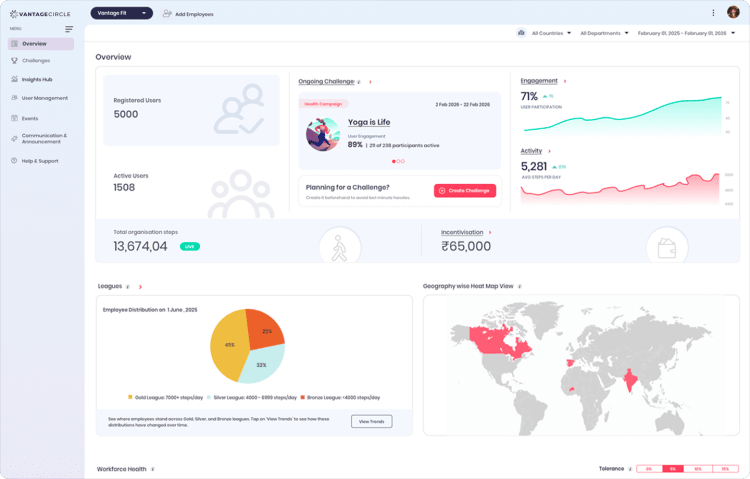
Vantage Fit turns this list of ideas into a program you can launch and measure in one place. It is built to remove the manual coordination that usually kills wellness initiatives.
1. Ready-made challenge templates
Run step contests, step challenges, yoga sessions, hydration streaks, and multi-activity programs that build teamwork while improving health.
2. AI-driven personalization
Vantage Fit matches activities to each employee’s needs, so everyone gets relevant tools rather than a generic plan.
3. Real-time engagement and rewards
Points, badges, and leaderboards keep people motivated and reward consistent participation with gift cards and recognition.
4. Analytics and reporting
An HR dashboard shows participation, engagement, and outcomes, so you can prove wellness ROI to leadership.
5. Secure and compliant
The platform is GDPR-compliant and integrates with existing HR systems, making it a low-friction addition to your stack.
Frequently Asked Questions
What are examples of employee wellness programs?
Common examples include step and fitness challenges, guided meditation and Employee Assistance Programs, budgeting workshops, volunteering days, mentorship programs, and wellness stipends. The best programs mix ideas across physical, mental, financial, social, and occupational health so every employee finds something relevant.
What do employees actually want in a wellness program?
Employees want flexibility, mental health support, and choice, delivered in ways that fit a real workday. They value voluntary, low-time-cost activities and recognition for taking part. A short pulse survey is the most reliable way to learn what your specific team wants.
How much does an employee wellness program cost?
An employee wellness program costs anywhere from $0 to several dollars per employee per month, depending on the platform and perks chosen. Many programs start with zero-cost ideas like walking meetings and stretch breaks, then add low-cost perks. Platform pricing and stipends scale with the features and headcount you choose.
What are free or low-cost employee wellness ideas?
Affordable ideas include walking meetings, stretch breaks, group step challenges, hydration contests, gratitude journaling, and sharing healthy recipes. These cost little to nothing and are easy to launch this week, which makes them ideal starting points for a new program.
What is the ROI of an employee wellness program?
The ROI of an employee wellness program is positive for most well-run programs. A RAND Corporation analysis found a return of about $1.50 in reduced healthcare costs for every $1 invested, and employee retention adds further savings, so even small engagement gains pay off. IBS Software saw 88% engagement in a 28-day Vantage Fit challenge.
What are the best wellness perks to give an employee?
Strong perks include gym memberships, gift cards, and wellness stipends employees spend on their own health needs. Fitness trackers, meditation-app subscriptions, and wellness retreats also rank highly because they signal that the company genuinely cares.
How do you promote wellness in the workplace?
You promote wellness in the workplace by making it part of the culture, not a one-off event. Run visible challenges, share resources regularly, and talk about health openly. Ask leaders to model healthy behavior and celebrate participation with recognition so employees see wellness as supported, not optional homework.
Can you host employee wellness fairs at work?
Yes. Employee wellness fairs are a great way to engage staff with experts, screenings, and hands-on activities in one event. They raise awareness and often kick off longer-running programs like challenges and stipends.