Corporate wellness certifications are credentials that train HR staff, benefits managers, and wellness coordinators to design, run, and measure employee wellness programs. The best-known options for program managers are the Certified Corporate Wellness Specialist (CCWS), Chapman Institute’s WellCert, the Wellness Alliance’s Certified Wellness Practitioner (CWP), and CHES. The CCWS costs $995 plus a $150 annual fee, according to its provider.
We checked every program below on its official website in November 2026. Prices, formats, and renewal rules change, so confirm the details with the provider before you enroll.
Vantage Fit is a corporate wellness platform employees love to use. Its native mobile apps, gamified challenges, and real rewards help HR teams run the programs these certifications teach them to design.
KEY TAKEAWAYS
- CCWS, WellCert, the Worksite Wellness Specialist Certificate, CWP, and CHES are the main credentials for people who manage workplace wellness programs
- CCWS costs $995 plus a $150 annual fee, each WellCert level costs $899, and Spencer Institute's corporate wellness coach certification costs $397
- WELCOA and the National Wellness Institute have joined to form the Wellness Alliance, which now runs the CWP and the Worksite Wellness Specialist Certificate
- Coaching credentials such as NBC-HWC, Wellcoaches, and McMaster's diploma suit staff who coach employees directly
- HRCI, GCHW, and NCQA certify organizations, not individual professionals
Corporate Wellness Certifications Compared (2026)
The table below compares 13 corporate wellness certifications in three groups: credentials for people who run a corporate wellness program, coaching credentials for people who work with employees one-on-one, and organizational certifications for employers. Prices come from each provider’s official website in November 2026.
| Credential | Provider | Best for | Format | Price | Renewal |
|---|---|---|---|---|---|
| Certified Corporate Wellness Specialist (CCWS) | Corporate Health & Wellness Association | HR and benefits professionals | Online, on demand | $995 + $150 a year | Annual fee |
| WellCert (CWPC, CWPM, CWPD, CWWPC) | Chapman Institute | Program coordinators through consultants | Self-paced, live webinar, or onsite | $899 per level | Check provider |
| Worksite Wellness Specialist Certificate | Wellness Alliance | HR, benefits, and worksite wellness staff | Six-week online cohort | $925 to $1,195 | Check provider |
| Certified Wellness Practitioner (CWP) | Wellness Alliance | Experienced wellness professionals | Exam | $425 to $575 (2027 exam) | Every 3 years |
| Certified Health Education Specialist (CHES) | NCHEC | Health education graduates | 175-question exam | $300 to $435 (nonstudent) | Check provider |
| Certified Corporate Wellness Coach (CCWC) | Spencer Institute | Newcomers to corporate wellness | Online, self-paced, about 20 hours | $397 | Every 2 years |
| National Board Certified Health & Wellness Coach (NBC-HWC) | NBHWC | Health coaches | Approved training + board exam | $400 exam + $100 application | Check provider |
| Wellcoaches Core Coach Training | Wellcoaches School of Coaching | Aspiring health coaches | Three training modules | $3,495 to $3,705 | Check provider |
| Diploma in Health and Wellness Coaching | McMaster University (Canada) | Career changers into coaching | Online, 8 courses, 18+ months | Priced per course | Check provider |
| Certificate in Psychologically Safe Leadership | University of New Brunswick (Canada) | People managers | Online, self-paced, 3 courses | $177 | Check provider |
| HRCI Workplace Wellness | HRCI | Employers | Organizational certification | Not listed | Check provider |
| Global Healthy Workplace Certification | Global Centre for Healthy Workplaces | Employers | Organizational assessment | On application | Every 2 years |
| Wellness and Health Promotion Accreditation/Certification | NCQA | Wellness vendors and health plans | Organizational review | Not listed | Check provider |
What Is a Corporate Wellness Certification?
A corporate wellness certification is a credential that shows someone has trained in planning, running, and evaluating employee wellness programs. You’ll also see them called workplace wellness certifications or worksite wellness certifications. They’re aimed at HR professionals, wellness coordinators, benefits managers, and consultants.
Most programs cover the same core skills: building leadership support, assessing what employees need, designing and promoting a program, and measuring results so you can report them to leadership.
Unlike academic degrees in public health, these programs focus on what you’ll do at work next week. Expect practical frameworks, industry examples, and tools you can use right away.
Certificate vs. Certification vs. Accreditation
A certificate shows you completed a course, a certification shows you passed an exam against a set standard, and an accreditation or organizational certification recognizes a company rather than a person. Knowing the difference helps you compare programs fairly, because prices and renewal rules differ by type:
-
Certificates: The Worksite Wellness Specialist Certificate and UNB’s Certificate in Psychologically Safe Leadership.
-
Certifications: CWP, CHES, and NBC-HWC, each earned by passing an exam and kept active through renewal rules.
-
Organizational certifications and accreditations: HRCI Workplace Wellness, the Global Healthy Workplace Certification, and NCQA’s wellness accreditation.
Certifications for Wellness Program Managers
CCWS, Chapman’s WellCert, the Wellness Alliance’s Worksite Wellness Specialist Certificate, CWP, CHES, and Spencer Institute’s CCWC are built for the people who plan and run workplace wellness programs. They cover leadership buy-in, needs assessment, program design, and measurement, and most cost under $1,200 per course or exam.
1. Certified Corporate Wellness Specialist (CCWS)

The Certified Corporate Wellness Specialist is the official certification of the nonprofit Corporate Health & Wellness Association (CHWA). Global Healthcare Resources administers it.
The online course has 11 modules covering leadership, culture, cost savings, mental health, wellness technology, employee well-being, diversity, and program design, delivery, and evaluation, followed by an exam. New modules cover AI, financial wellness, corporate longevity, and metabolic health in the GLP-1 era.
Cost: $995, plus a mandatory $150 annual fee for compliance and continuing education classes
Format: Online, on demand
Continuing education: Pre-approved for HRCI recertification credit
Best for: HR and benefits professionals who want a credential focused on running wellness at work
2. Chapman Institute WellCert

Founded by wellness expert Larry S. Chapman, the Chapman Institute runs WellCert, a workplace wellness certification. Since 2006, more than 7,000 wellness, HR, benefits, safety, and health professionals have completed it, according to the institute.
WellCert has four progressive levels:
-
Level 1, Certified Wellness Program Coordinator (CWPC): Foundational skills such as building senior management support, assessing wellness needs, and designing program infrastructure.
-
Level 2, Certified Wellness Program Manager (CWPM): Builds on Level 1 with vendor management, maximizing participation, and measuring ROI.
-
Level 3, Certified Wellness Program Director (CWPD): Advanced strategies for large organizations, including health and productivity management and culture change.
-
Level 4, Certified Worksite Wellness Program Consultant (CWWPC): Prepares professionals to consult across different organizations, including disability management and health plan claims analysis.
Cost: $899 per level, or four interest-free monthly payments of $224.75. Experienced professionals may qualify for a $499 Level 1 equivalency exam instead of the full Level 1 course.
Format: Self-paced online, live webinar, or onsite
Best for: Coordinators who want a step-by-step path from running a program to directing or consulting
3. Worksite Wellness Specialist Certificate (Wellness Alliance)
The Wellness Alliance unites the Wellness Council of America (WELCOA) and the National Wellness Institute (NWI). Both former websites now redirect to it, and it’s an affiliate of the International Foundation of Employee Benefit Plans.
Its Worksite Wellness Specialist Certificate is a six-week online course. You work through modules of about an hour each at your own pace, with a facilitator and a small learning cohort for discussion. You also build a Worksite Wellness Specialist Portfolio as you go.
Cost (2026): Members $925 early or $995 regular; nonmembers $1,125 early or $1,195 regular
Format: Online, six weeks, cohort-based
Continuing education: Pre-approved for 12.0 CE credits toward CWP, CHES, HRCI, NBC-HWC, SHRM-CP, and SHRM-SCP
Best for: HR, benefits, and worksite wellness professionals who want a shorter, structured course
4. Certified Wellness Practitioner (CWP)
The Certified Wellness Practitioner is the Wellness Alliance’s exam-based credential, built on its Wellness Promotion Competency Model. It suits people from many disciplines, including worksite wellness, coaching, public health, and human resources.
Cost (2027 exam): Members $425 early or $475 regular; nonmembers $525 early or $575 regular
Renewal: Every three years
Eligibility: Check the Wellness Alliance’s eligibility criteria before you register
Best for: Experienced wellness professionals who want a recognized exam-based credential
5. Certified Health Education Specialist (CHES)
The Certified Health Education Specialist credential comes from the National Commission for Health Education Credentialing (NCHEC). It isn’t specific to workplaces. It certifies health education specialists in general, so it fits people with an academic health education background who move into corporate wellness.
Eligibility: A bachelor’s degree or higher, plus either a major in health education or at least 25 semester credits covering the health education areas of responsibility
Exam: 175 questions in three hours, at a test center or by live remote proctoring
Cost (April 2027 exam, nonstudent): $300 early, $360 regular, or $435 late registration
Best for: HR or wellness staff with a health education degree
6. Spencer Institute Certified Corporate Wellness Coach (CCWC)

Spencer Institute’s corporate wellness coach certification is one of the lowest-cost entry points on this list, and it has no prerequisites. It’s accredited by the American Association of Drugless Practitioners (AADP).
Cost: $397 for the course and exam, or six monthly payments of $71
Format: 100% online and self-paced, about 20 hours of study
Exam: 100 multiple-choice questions, 70% to pass, three attempts included
Renewal: The certification lasts two years
Best for: People moving into corporate wellness from fitness, coaching, education, or HR
Health and Wellness Coaching Certifications
If your role involves coaching employees one-on-one, a coaching credential matters more than a program-management one. NBC-HWC is the board certification for health coaches, while Wellcoaches and McMaster University offer in-depth coach training. For a closer look at how coaching fits into a workplace program, see our guide to wellness coaching.
7. National Board Certified Health & Wellness Coach (NBC-HWC)
The National Board for Health & Wellness Coaching (NBHWC) awards the NBC-HWC credential to coaches who pass its board exam.
Requirements: Complete one of more than 138 NBHWC-approved training programs, complete 50 health coaching sessions, and hold an associate degree or higher (or 4,000 hours of work experience in any field)
Cost: $400 exam fee plus a $100 application fee. Training program fees are separate.
Best for: Wellness staff who coach employees on healthy habits
8. Wellcoaches School of Coaching

The Wellcoaches School of Coaching trains professional health and well-being coaches through a core program of three modules. The approach is client-centered: coaches help people make self-directed, lasting changes to their health.
Cost: $3,495 when you buy all three modules together ($1,985 + $660 + $850), or $3,705 when you buy them separately. A $250 early-bird discount is available.
Best for: People who want in-depth coach training before working with employees
9. McMaster University Diploma in Health and Wellness Coaching

McMaster University Continuing Education in Canada offers a Diploma in Health and Wellness Coaching. You earn it by completing eight courses, including these core courses:
-
HWC 200: Behaviour Change for Health and Wellness
-
HWC 201: Motivating for Health & Wellness
-
HWC 202: Health & Wellness Coaching: Principles and Practices
-
HWC 203: Program Design, Delivery and Evaluation
-
HWC 204: Coaching Clients with Chronic Conditions
-
NHW 100: Nutrition Fundamentals
-
NHW 102: Nutrition, Fitness and Healthy Living
Format: Online, about 6 to 8 hours a week per course
Length: 18+ months
Recognition: Pre-approved by the Health Coach Alliance for the Registered Health Coach designation
Cost: Priced per course; see the program’s schedule and fees page
Workplace Mental Health Leadership
If you manage people or lead HR, a mental health leadership credential teaches you to build teams where employees feel safe to speak up. The University of New Brunswick’s Certificate in Psychologically Safe Leadership covers this in three self-paced online courses for $177.
10. University of New Brunswick Certificate in Psychologically Safe Leadership

The University of New Brunswick offers a Certificate in Psychologically Safe Leadership, taught by Dr. Bill Howatt, founder of Howatt Human Resources Consulting. Its three courses show managers how to protect mental health on their teams.
Cost: $59 per course or $177 for the full three-course program
Format: 100% online and self-paced, with six weeks of access per course
Best for: People managers and HR leads responsible for team mental health
A credential like this works best alongside real support for employees. HR professional Ashutosh Thatte made that point on the Vantage Fit podcast:
"Having an employee assistance program is the bare minimum — for any sized organization, any industry. Employees need to know a service is available when they need to seek assistance."
Ashutosh Thatte, HR Professional | Listen to the full episode
Organizational Certifications for Employers
HRCI Workplace Wellness, the Global Healthy Workplace Certification, and NCQA’s Wellness and Health Promotion program certify a company or vendor, not an individual. They’re useful when leadership wants outside recognition for its wellness efforts, or when you’re judging a vendor. None of the three publishes its price online.
11. HRCI Workplace Wellness Certification
HRCI’s Workplace Wellness certification is an organizational certification built on ISO 45003:2021, the international standard for managing psychosocial risks at work. It focuses on reducing workplace stressors, and certified organizations receive a digital badge.
Cost: Not listed on HRCI’s website
Best for: Employers that want to show their commitment to employee wellness and duty of care
12. Global Healthy Workplace Certification (GCHW)

The Global Centre for Healthy Workplaces (GCHW) assesses whether an organization meets a global standard for healthy workplaces. Certification is valid for two years, and certified organizations are entered into its awards program unless they opt out.
Cost: Fees are listed in the application form, not on the website
Note: GCHW’s individual online training course is currently on hold
Best for: Employers that want an international benchmark for their workplace health program
13. NCQA Wellness and Health Promotion Accreditation/Certification

NCQA’s Wellness and Health Promotion program is a formal recognition for wellness vendors and health plans that deliver wellness and health promotion services. Employers usually meet it when evaluating vendors.
Cost: Not listed on NCQA’s website
Best for: Wellness vendors and health plans, or employers comparing vendors
How to Become a Corporate Wellness Specialist
You become a corporate wellness specialist by pairing a related background, such as HR, benefits, fitness, or health education, with a credential that matches the job and hands-on experience running programs. There’s no single required path, but most people follow a similar route:
-
Start from a related role: HR, benefits, fitness, health education, or coaching.
-
Pick a credential that matches the job: CCWS or WellCert for running programs, CHES if you have a health education degree, or a coaching credential if you’ll coach employees.
-
Get hands-on experience: Help run a challenge or program, even as one of your company’s wellness champions.
-
Keep your credential active: Follow its renewal rules and continuing education requirements.
If you want to advise several companies, our guide to becoming a corporate wellness consultant covers the business side.
Is a Certification Required to Manage a Wellness Program?
No. Certifications aren’t mandatory to run a corporate wellness program, but they help. Trained professionals bring evidence-based methods for program design, employee engagement, and measuring return on investment (ROI), which many informal programs lack. Whether you need one depends on your program’s scale and whether you run it in-house or with a partner.
Organizations typically take one of two approaches:
-
Train internal teams: Certify HR staff or build a network of wellness champions to align programs with company culture and goals.
-
Partner with experts: Work with certified external providers for ready-made programs and specialized skills without long-term hiring.
In-house training allows more customization, while outsourcing can be faster to set up. Either way, certified knowledge helps turn wellness from a perk into a strategy that supports employee health and business performance.
For practical frameworks on leading these programs in-house, explore our guide to wellness leadership strategies.
How to Choose the Right Corporate Wellness Certification
The right corporate wellness certification depends on the job you do, your budget, and how much time you have. Program managers, coaches, and employers need different credentials, so start with your role, then compare price, format, renewal rules, and the type of credential. Consider:
-
Program reputation: Choose certifications recognized and respected in the industry.
-
Cost: Make sure the program fits your budget, and factor in the cost of running your wellness program itself once you’re certified.
-
Time and format: Choose a format (online, cohort, or in person) and timeline that suits your schedule.
-
Type of credential: Know the difference between a certificate, a certification, and an accreditation.
-
Renewal: Check whether ongoing fees or continuing education are required to keep the credential active.
Put Your Certification to Work
Putting your certification to work means turning what you learned into a program you can run and measure, which is the day-to-day job of a wellness program manager. Certification builds the foundation, but real impact comes from execution: tracking participation, running initiatives consistently across teams, and reporting outcomes to leadership without relying on endless spreadsheets.
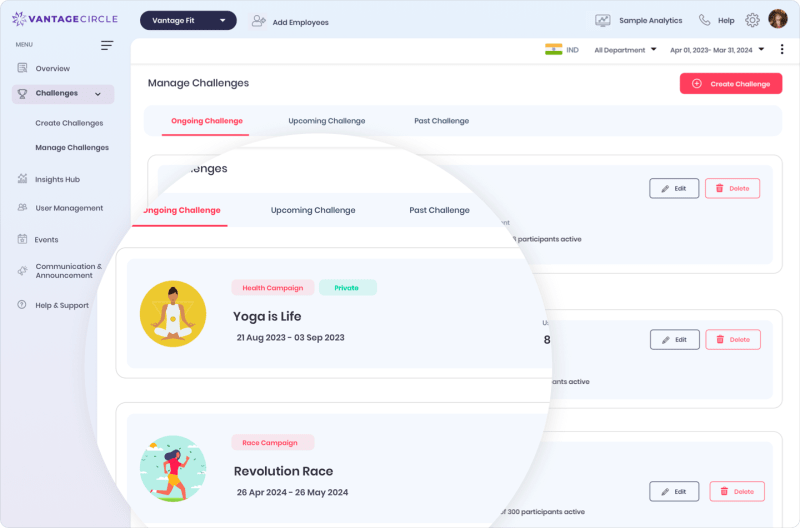
The Vantage Fit app helps bridge that gap between learning and execution. It gives HR teams practical tools to run programs with ease, including a campaign builder, real-time engagement dashboards, and audience segmentation based on department, age group, or location.
Whether you are running a step challenge, a mindfulness initiative, or a multi-activity program, Vantage Fit supports the strategies you were trained to design.
Here’s what that looks like in practice. In its Step Up & Elevate Challenge on Vantage Fit, Tata Motors reached a 70% engagement rate across 43 teams, according to the Tata Motors case study. Wipro tripled participation, from 163 to 550 active users, across its three 2025 challenges on Vantage Fit, according to the Wipro case study.
The Bottom Line
Pick the credential that matches the job you do. CCWS, WellCert, the Worksite Wellness Specialist Certificate, and CWP suit people who run workplace programs. CHES fits health education graduates, coaching credentials fit people who coach employees, and HRCI, GCHW, and NCQA certify the organization itself. Whichever you choose, confirm the current price on the provider’s website before you enroll.
Frequently Asked Questions
Which corporate wellness certification is best for HR managers?
For HR and benefits professionals, CCWS and Chapman's WellCert are built around running workplace wellness programs. The Wellness Alliance's Worksite Wellness Specialist Certificate is a shorter, six-week option. Choose based on budget, format, and renewal rules.
How much does a corporate wellness certification cost?
In 2026, Spencer Institute's CCWC costs $397, CCWS costs $995 plus $150 a year, and each WellCert level costs $899. Coaching programs cost more: Wellcoaches tuition runs from $3,495 to $3,705.
Can I get a corporate wellness certification with no experience?
Yes. Spencer Institute's CCWC has no prerequisites. CHES and NBC-HWC have education requirements: CHES needs a bachelor's degree with health education coursework, and NBC-HWC needs approved training plus an associate degree or 4,000 work hours.
What is the best certification for a wellness coach?
For coaches, the National Board Certified Health & Wellness Coach (NBC-HWC) credential is the board-level option. It requires one of more than 138 approved training programs, 50 coaching sessions, and a $400 exam fee plus a $100 application fee.
Can you get a corporate wellness certification online?
Yes. CCWS, Spencer's CCWC, WellCert, and UNB's Certificate in Psychologically Safe Leadership are fully online. The Worksite Wellness Specialist Certificate runs in six-week online cohorts, and CHES offers live remote proctoring for its exam.
What happened to WELCOA and the National Wellness Institute?
They joined to form the Wellness Alliance, an affiliate of the International Foundation of Employee Benefit Plans. Their old websites now redirect there, and the Alliance runs the CWP credential and the Worksite Wellness Specialist Certificate.
Which wellness certification focuses on workplace mental health?
UNB's Certificate in Psychologically Safe Leadership trains managers to build psychologically safe teams, for $177. For employers, HRCI's Workplace Wellness certification is built on ISO 45003, the international standard for managing psychosocial risks at work.