Employee burnout is a state of exhaustion, mental distance from the job, and reduced effectiveness caused by chronic workplace stress that hasn’t been managed successfully.
The World Health Organization classifies it as an occupational phenomenon. It builds in stages, and the early ones often look like strong performance.
That’s why so many managers catch it late. The pressure behind it is also rising. In the American Psychological Association’s 2026 Work in America survey, 48% of US workers said they feel tense or stressed during the workday, up from 41% a year earlier.
For HR teams, the real challenge is spotting burnout while there is still time to act. Corporate wellness platforms like Vantage Fit can help. Employees get private tools for sleep, mood, and mindfulness, and HR gets a company-level view of how the workforce is doing.
Still, the earliest warnings come from people: managers who recognize the signs and HR teams who measure what matters. Let’s explore the five stages of burnout, the warning signs managers notice first, and the measures that track it without watching anyone’s screen.
Key Takeaways
- Employee burnout is work-specific, which sets it apart from stress, depression, and disengagement, and tells a manager whether to adjust the job or refer the person out.
- Burnout progresses through five stages, from over-commitment to withdrawal, and managers can spot signs such as skipped breaks, sharp replies, and late-night messages well before performance drops.
- Workload, control, reward, community, fairness, and values drive burnout, so prevention starts with workload and manager support, with wellness perks playing a supporting role.
- Measuring burnout well combines a proven instrument, such as the free Copenhagen Burnout Inventory, with operational data like sick days, unused leave, and after-hours work.
- Activity-monitoring software can mistake early burnout for productivity, while consented self-report and aggregate wellbeing data reveal strain much sooner.
What Are the 3 Dimensions of Employee Burnout?
The World Health Organization includes burnout in ICD-11 as an occupational phenomenon, tied to chronic workplace stress that has not been successfully managed. WHO states plainly that burnout “is not classified as a medical condition,” and that the term belongs to the workplace alone.
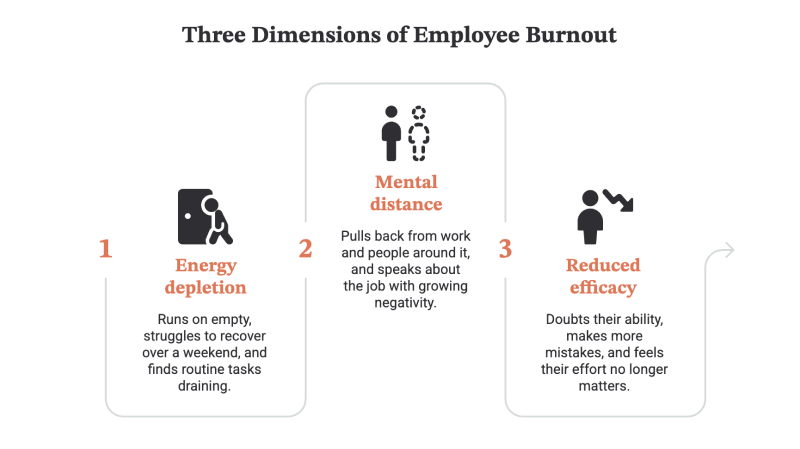
WHO describes burnout through three dimensions, and each one shows up at work in a recognizable way:
- Energy depletion or exhaustion: the person runs on empty, struggles to recover over a weekend, and finds routine tasks draining.
- Mental distance or cynicism: they pull back from the work and the people around it, and speak about the job with growing negativity.
- Reduced professional efficacy: they doubt their ability, make more mistakes, and feel their effort no longer matters.
The three tend to appear together. Someone who is exhausted but still engaged and confident may simply be overloaded, which is why it helps to know what burnout is often confused with.
Burnout vs. Stress, Depression and Disengagement
Depression is the comparison that matters most. Researchers Christina Maslach and Michael Leiter describe burnout as “job-related and situation-specific,” while depression is more general. Experts still debate how much they overlap, so a manager’s role is to notice and refer, leaving diagnosis to a clinician.
| Condition | What it looks like | Where it comes from | What helps |
|---|---|---|---|
| Burnout | Exhaustion, cynicism about the job, falling effectiveness | Chronic, unmanaged workplace stress | Changes to workload and work conditions, plus time to recover |
| Stress | Tension and urgency, with energy still available | A specific pressure or deadline | Rest, and resolving the pressure |
| Mental exhaustion | Persistent mental fatigue and trouble focusing | Prolonged stress, often a step on the way to burnout | Rest and a lighter mental load |
| Depression | Low mood and loss of interest across work and home | A medical condition with many possible causes | Clinical assessment and treatment |
| Disengagement or quiet quitting | Doing the minimum, with energy intact | Poor management, unclear purpose, little growth | Better management and clearer roles |
| Compassion fatigue | Emotional numbness toward the people one cares for | Repeated exposure to others' suffering, common in care roles | Peer support, supervision and workload relief |
The practical test is whether the strain comes from work and how far it reaches. When exhaustion, distance, and falling effectiveness trace back to work, burnout is the likely name. When low mood follows someone home and into the weekend, encourage them to speak with a doctor or your EAP.
The 5 Stages of Employee Burnout
A widely shared practitioner model describes five stages of burnout: honeymoon, onset of stress, chronic stress, burnout, and habitual burnout. Each stage has its own signs, so the right response changes as burnout deepens.
Treat the model as a practical guide for spotting a pattern. It builds on earlier stage models, such as the one Robert Veninga and James Spradley set out in their 1981 book on job burnout, and turns a flat list of symptoms into a progression. That lets a manager place what they are seeing somewhere on the curve.
| Stage | What the employee feels | What a manager can see | What to do |
|---|---|---|---|
| 1. Honeymoon | Energized, committed, eager to prove themselves | Volunteers for everything, works long hours, delivers a lot | Agree on sustainable scope and priorities early |
| 2. Onset of stress | Some days feel harder, and focus slips | Shorter replies, occasional irritability, skipped breaks and lunches | Ask about workload in one-on-ones |
| 3. Chronic stress | Constant pressure, tiredness and frustration | Missed deadlines, more sick days, cynical comments in meetings | Remove or delay work, and protect time off |
| 4. Burnout | Empty, detached and doubtful about their own ability | Withdrawal from the team, visible errors, talk of quitting | Hold a private conversation, cut the workload, point to the EAP |
| 5. Habitual burnout | Exhaustion feels normal, and symptoms persist | Long-term disengagement and repeated absence | Clinical support, a planned return and a redesigned role |
The first two columns describe how burnout feels from the inside. The third column makes the model useful at work because it lists what a manager can actually observe. The next section looks at that column in detail.
How to Spot Employee Burnout: Warning Signs Managers See First
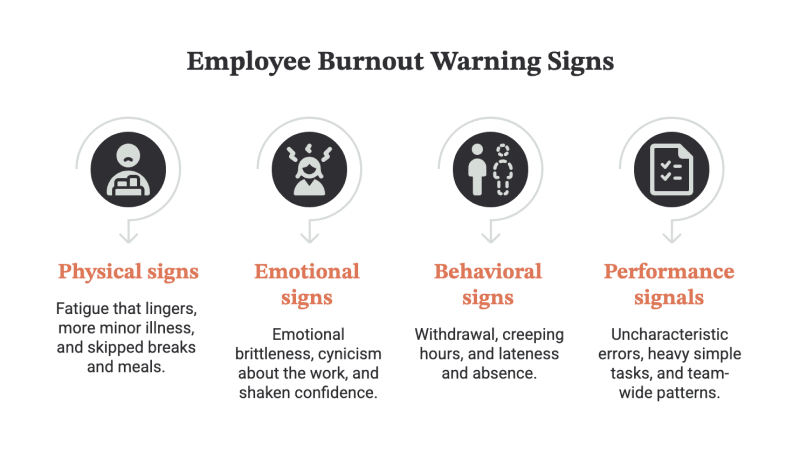
Burnout shows up in four places a manager can see: the body, the mood, everyday behavior, and the work itself. Physical and emotional signs tend to appear first, and performance drops last.
A sign is only useful if you can observe it. “Seems tired” tells you little, while “has stopped speaking in the stand-up they used to run” gives you something specific to ask about. Look for a change from the person’s own normal that lasts for weeks.
Physical signs
- Fatigue that lingers: yawning through morning meetings, mentioning poor sleep week after week, or looking drained by midday.
- More minor illness: colds, headaches, and stomach trouble that turn into short sick days. Gallup found burned-out employees are 63% more likely to take a sick day.
- Skipped breaks and meals: eating at the desk, working through lunch, and rarely stepping away from the screen.
A question to ask: “How is your energy holding up by the end of the week?”
Emotional signs
- Emotional brittleness: small setbacks trigger outsized reactions, such as a sharp reply to a routine request.
- Cynicism about the work: remarks that the project, the client, or the company “won’t matter anyway.”
- Shaken confidence: a capable person starts second-guessing simple decisions and asking for reassurance they never used to need.
A question to ask: “What has been the most frustrating part of the work lately?”
Behavioral signs
- Withdrawal: skipping optional team moments, staying quiet in meetings, or keeping the camera off on calls.
- Creeping hours: messages sent late at night or on weekends, with no change in workload to explain them.
- Lateness and absence: a new pattern of late starts, missed meetings, or unplanned leave.
A question to ask: “I’ve noticed you’re online late most nights. What’s driving that?”
Team and performance signals
- Uncharacteristic errors: typos, missed details, and forgotten follow-ups from someone who is usually careful.
- Heavy simple tasks: routine work takes longer, gets postponed, or needs more help than before.
- Team-wide patterns: several people on one team showing the same signs at once, which points to the workload or the way the team is run.
A question to ask: “Which of your current tasks feels heaviest right now?”
The signs managers usually miss
The hardest case to spot is the high performer. Burnout’s early stages look like dedication, so the person who keeps saying yes, stays late, and never complains may be the furthest along. Erayna Sargent, Burnout Specialist & Speaker, put it plainly on our podcast on burnout relief:
"it's your high achievers, the people who always take on extra and do it with excellence, who are most prone to burn out."
Watch, too, for the person whose output still looks fine while their hours quietly grow, and for the one who has stopped asking for help. When you notice a change, ask an open question in private: “You’ve been carrying a lot lately. How are you finding the workload?”
What Causes Employee Burnout?
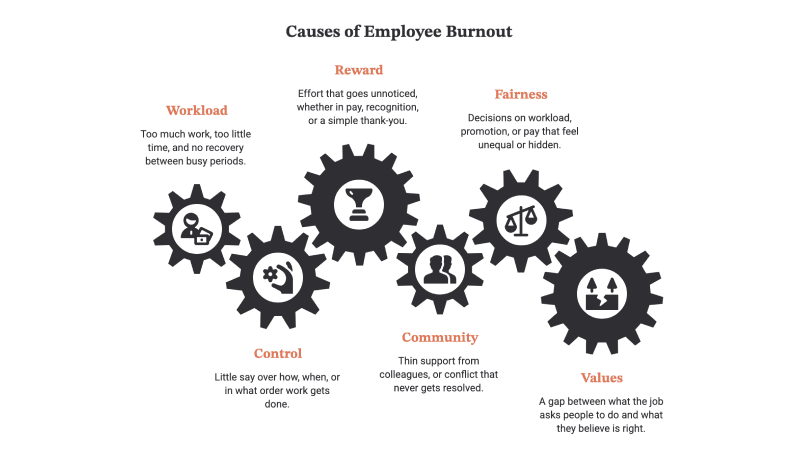
Employee burnout is caused mainly by conditions at work. Research by Christina Maslach and Michael Leiter points to six areas of work life: workload, control, reward, community, fairness, and values.
- Workload: too much work, too little time, and no recovery between busy periods. In their words, “Work overload contributes to burnout by depleting the capacity of people to meet the demands of the job.”
- Control: little say over how, when, or in what order work gets done.
- Reward: effort that goes unnoticed, whether in pay, recognition, or a simple thank-you.
- Community: thin support from colleagues, or conflict that never gets resolved.
- Fairness: decisions on workload, promotion, or pay that feel unequal or hidden.
- Values: a gap between what the job asks people to do and what they believe is right.
Gallup’s study of nearly 7,500 full-time employees arrived at a similar list. Its five strongest causes were unfair treatment at work, an unmanageable workload, lack of role clarity, lack of communication and support from a manager, and unreasonable time pressure.
Both models lead to the same conclusion. Burnout grows from how work is designed and managed, so the lasting fix lies with the job, the team, and the manager. Resilience training and self-care help people cope, and they help most when the job changes too.
How Do You Measure Employee Burnout?
You measure employee burnout in two ways: a validated survey for how people feel, and operational data for what the job is doing to them. The survey shows how much burnout there is, and the operational data shows where it is building.
Validated Burnout Instruments
A validated instrument has been tested to measure what it claims to measure. That makes your results comparable over time and with published research. Five options suit most HR teams, and three of them are free to use.
| Instrument | What it measures | Length | Cost and access | Best for |
|---|---|---|---|---|
| Maslach Burnout Inventory (MBI) | Exhaustion, cynicism and professional efficacy (General Survey version) | 16 items in the General Survey; 22 in the human services and educator versions | Paid license from Mind Garden | Comparing results with decades of research |
| Copenhagen Burnout Inventory (CBI) | Personal, work-related and client-related burnout | 19 items | Free for commercial and non-commercial use, with a citation | Teams that serve clients, patients or customers |
| Oldenburg Burnout Inventory (OLBI) | Exhaustion and disengagement | 16 items | Widely used in research; confirm terms before commercial use | Telling tiredness apart from detachment |
| Burnout Assessment Tool (BAT) | Exhaustion, mental distance, cognitive impairment, and emotional impairment | 23 items, or 12 in the short BAT-12 | Free, used unchanged and with a citation | A modern measure for a general workforce |
| Single-item burnout measure | Overall self-rated burnout on a five-point scale | 1 item | Free and non-proprietary | Quick monthly pulse checks |
The single item is worth knowing. In a study of 5,404 healthcare staff, Dolan and colleagues found it closely tracked a single emotional exhaustion item from the MBI, with 83.2% sensitivity. A score of 3 or higher on its five-point scale is a reasonable flag for a closer look.
Burnout Survey Questions That Actually Surface Something
Whatever instrument you choose, a few rules keep the answers honest. Keep responses anonymous, report only on groups large enough that no one can be identified, and tell people in advance what you will do with the results.
Between full surveys, a short monthly pulse keeps the picture current. These five prompts, answered on a 1-to-5 scale, map to burnout’s three dimensions and workload. They work as a check-in, while the full instrument does the formal measuring:
- Exhaustion: How often do you finish the workday feeling drained?
- Recovery: How rested do you feel at the start of the week?
- Mental distance: How connected do you feel to the purpose of your work?
- Efficacy: How confident are you that you can handle your current work well?
- Workload: How manageable has your workload been over the past month?
For a ready list, see our employee mental health survey questions.
Operational indicators to track alongside
Operational data shows where pressure is building before people say so in a survey. The table below runs from early signals to late ones.
| Indicator | What a rise can mean | Signal type |
|---|---|---|
| Work outside core hours (late messages, weekend logins) | Workload is outgrowing the working day | Early |
| Leave accrued but not taken | People feel unable to step away | Early |
| Meeting load | Less time for focused work, so the day runs longer | Early |
| Short-notice sick days | Strain is building up | Middle |
| eNPS or engagement scores falling | Growing distance from the job | Middle |
| Internal transfer requests | People want out of a team or away from a manager | Late |
| Regretted attrition | Burnout has already cost you someone | Late |
Read these at team level and as trends or patterns. One late night means little, but three months of rising after-hours work on one team is a pattern worth discussing. For a wider set of measures, see our guide to employee wellbeing metrics.
How often to measure
A sensible rhythm is a short monthly pulse using one item or a few questions, plus a full validated survey once or twice a year. Review operational indicators monthly, and act on what you find before the next round, so people can see that the survey leads somewhere.
If you already run stress surveys, add the burnout items to them. Our guide to employee wellness and stress management shows how HR can measure workplace stress with tools you may already have.
Tools to Detect Employee Burnout, and the Monitoring Trap
Burnout detection tools fall into two camps: activity-monitoring software and consented self-report tools. Self-report tools are built to catch the early stages because they measure how people feel, while monitoring measures how much they produce.
Most HR teams already hold some of the tools below. What matters is which ones catch burnout early enough to act on, and that depends on what each one measures.
| Tool type | Examples | What it tracks | What it tells you about burnout |
|---|---|---|---|
| Activity-monitoring software | ActivTrak, Hubstaff, Teramind, Time Doctor, DeskTime | Hours, idle time, app and keyboard activity, after-hours work | Flags overwork, but can read early burnout as high output |
| Validated burnout surveys | Maslach Burnout Inventory, Copenhagen Burnout Inventory, Burnout Assessment Tool | Exhaustion, mental distance and effectiveness | The most reliable reading of burnout levels at a point in time |
| Pulse and eNPS surveys | Short monthly check-ins, employee Net Promoter Score | Workload, energy and intent to stay | An early warning, when the questions cover workload and energy |
| Wellbeing platforms | Vantage Fit | Self-logged mood, sleep, mindfulness and activity | Leading wellbeing signals. Mood logs stay private, and HR sees sleep and mindful minutes as company-level averages |
| HR and leave data | Absence records, unused leave, EAP usage reports, attrition | Sick days, leave balances, support use, exits | Lagging confirmation that strain has built up in a team |
Why productivity monitoring misreads burnout
Several workforce-analytics vendors, including ActivTrak, Hubstaff and Teramind, market burnout features built on hours, idle time and screen activity. The trouble is timing. In burnout’s early stages, people work longer and harder, so activity data can rate a struggling employee as a top performer.
The signals also pull in opposite directions. Some tools treat very long active hours as a burnout risk, while others treat unusually low keyboard activity as a sign of it.
Monitoring can also add to the strain it is meant to catch. In APA’s 2023 Work in America survey, 56% of monitored workers said they typically feel tense or stressed during the workday, compared with 40% of workers who were not. APA notes the survey cannot confirm the cause.
What consented self-report data shows
Self-report works the other way around. When people share how they slept, how they feel, and how stretched they are, you hear about strain in the early weeks, while output still looks fine. That requires trust, so the data must be voluntary and reported only at the group level.
Vantage Fit is built around that principle. Employees get a private five-point mood check-in, a sleep log, and a mindfulness library of audio sessions that run about 5 to 35 minutes. No admin screen shows anyone’s mood.
HR sees company-level trends instead, such as average daily sleep, mindful minutes, and program participation. The health risk assessment reports only company-wide distributions and completion rates. When surveys are turned on, employees can also rate each wellness challenge anonymously, showing HR how the program is landing.
These signals describe wellbeing, and people still decide what they mean. Read alongside a validated survey and your operational data, they give HR an earlier, fuller picture than activity logs alone.
A six-point checklist for choosing a burnout tool
- Aggregate reporting: HR sees teams and trends, not individual answers or health data.
- Opt-in participation: employees choose to participate and can see exactly what they share.
- Leading indicators: sleep, energy, mood, and workload, which move before output does.
- Trends over snapshots: results compared month over month, against your own starting point.
- A validated measure underneath: survey items drawn from an instrument such as the BAT or CBI.
- A route to action: each finding connects to a real response, such as a workload review, a manager follow-up, or an EAP referral.
How to Prevent Employee Burnout
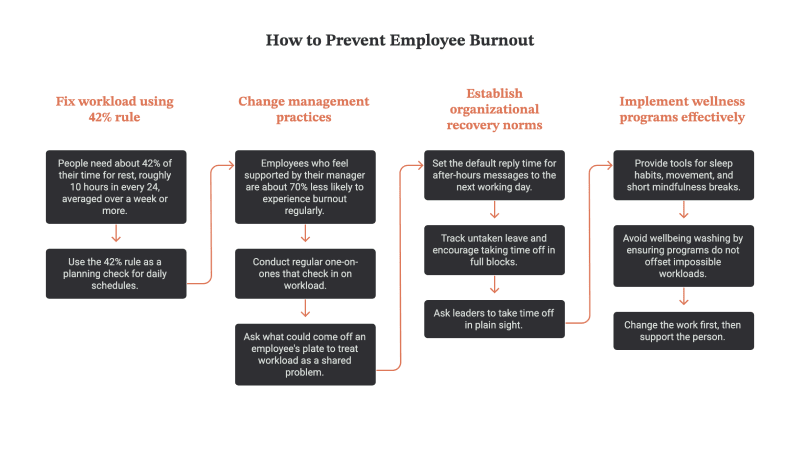
Employee burnout prevention works at three levels: how work is designed, how managers lead, and how the organization treats rest. Perks and wellness programs support all three, and they work best once the workload is under control.
Fix workload first, using the 42% rule
The 42% rule says people need about 42% of their time for rest, roughly 10 hours in every 24, averaged over a week or more. The idea comes from Emily and Amelia Nagoski’s 2019 book, Burnout, where they offer it as a rule of thumb.
Use it as a planning check. Ten hours of rest, including sleep, meals, and downtime, leaves about 14 hours a day for work, commuting, family, and everything else. A team working 11-hour days, plus an hour of commuting, has about two hours left for the rest of life.
What managers need to change
Managers shape most of the six areas of work life. Gallup found that employees who strongly agree they feel supported by their manager are about 70% less likely to experience burnout regularly. That support starts with regular one-on-ones that check in on workload.
Clear priorities matter as much as care. Asking, “What could come off your plate this month?” goes further than “Let me know if you need anything” because it treats workload as a shared problem to solve. Managers also need permission from above to say no to new work.
Organizational recovery norms
Recovery depends on norms the whole company keeps. Microsoft’s 2025 Work Trend Index, drawn from Microsoft 365 usage signals, found meetings after 8 p.m. were up 16% year over year. Set the default reply time for after-hours messages to the next working day.
Make leave usable as well. Track untaken leave, encourage people to take time off in full blocks, and ask leaders to do the same in plain sight. A rule employees see their managers break will not hold for long.
Where wellness programs help, and where they stop
A wellness program helps when it gives people real recovery time and tools they choose to use, such as sleep habits, movement, and short mindfulness breaks. It reaches its limit when it is asked to offset an impossible workload, and employees notice the gap, a pattern known as wellbeing washing.
The research points the same way. A 2017 meta-analysis in JAMA Internal Medicine found that organization-directed interventions reduced physician burnout more than those aimed at individuals. The study covered doctors, but the lesson travels well: change the work first, then support the person.
What to Do When an Employee Is Already Burned Out
Start with a private conversation, then reduce the workload, then agree on a gradual return to full pace, in that order.
Open with what you have noticed, and leave labels out of it: “You’ve seemed stretched for a few weeks. How are you really doing?” Then listen more than you talk. Our free mental health conversation starters for managers offer openers and follow-up questions for this moment.
Next, take something off their plate within days, and make the change visible by moving deadlines, reassigning work, or pausing a project. Point them to your EAP or their doctor if they want support, and agree on a return plan with check-ins every week or two.
Recovery itself takes time and belongs to the employee, with you in a supporting role. Our guide on how to help an employee recover from burnout covers that process step by step.
What Does Employee Burnout Cost?
Employee burnout costs US employers an estimated $3,999 to $20,683 per employee each year, depending on role, according to a 2025 study in the American Journal of Preventive Medicine.
The study put the cost at $3,999 for an hourly worker, $4,257 for a salaried non-manager, $10,824 for a manager, and $20,683 for an executive. For a company of 1,000 employees, that comes to about $5.04 million a year.
Those figures come from a computer simulation that counts burnout alongside related states such as disengagement and overextension. Treat them as a guide to scale, and build your own estimate from data you already hold.
A per-employee cost model you can run
Add three parts together, using your own figures:
Turnover: burned-out leavers per year × replacement cost. Gallup estimates that replacing an employee costs one-half to two times their annual salary.
Absence: extra sick days per year × average daily pay, including the cost of cover.
Presenteeism: affected employees × average salary × an estimated productivity loss. Published estimates vary, so choose a cautious percentage and state it.
As an illustration, take a 500-person company with an average salary of $60,000. If eight burned-out employees leave in a year and each costs half a salary to replace, turnover alone comes to $240,000, before absence or lost productivity.
The legal risk to keep in view
WHO classifies burnout as an occupational phenomenon, so the legal risk usually sits in what surrounds it. In the US, the EEOC says conditions such as major depression and PTSD “should easily qualify” as disabilities under the ADA, which can bring a duty of reasonable accommodation.
OSHA covers workplace stress through guidance, while its General Duty Clause requires a workplace free from recognized serious hazards. In the UK, the Health and Safety Executive states that employers have a legal duty to assess work-related stress and act on it.
(This section is a general overview for information only. Speak to employment counsel about your own situation.)
Frequently Asked Questions
How long does burnout usually last?
Recovery time depends on how severe the burnout is and whether the work behind it changes. Severe cases can persist for years: in a Swedish clinical study, about a third of patients assessed seven years later still had stress-related exhaustion.
Do you ever fully recover from burnout?
Many people do recover, especially when the job conditions behind it change. In a 10-year Swedish follow-up, 78% of people treated for exhaustion disorder were off sick leave, and 73% of those in work had changed workplace. See our guide to burnout recovery.
What happens if an employee keeps pushing through burnout?
Pushing through usually deepens burnout, because the stress behind it continues. Gallup found burned-out employees are 23% more likely to visit an emergency room, and their confidence in their own performance drops.
Is burnout a medical diagnosis?
Burnout is classified by the World Health Organization as an occupational phenomenon in ICD-11, listed among factors that influence health. A doctor may still diagnose a related condition, such as depression or an anxiety disorder, that needs treatment.
Who is most at risk of burnout?
Risk is highest where heavy workload, low control, poor reward, weak support, unfairness, and clashing values stack up. High performers who keep taking on extra work, and people in caring roles, are especially exposed.
Can managers ask an employee if they are burned out?
Managers can ask how someone is coping with their workload, and they should. Questions about diagnoses or medical history are limited under the ADA, so leave clinical topics to the employee's doctor or your EAP.
Catch Burnout Early, Fix It at the Source
Employee burnout gives plenty of warning. It moves through stages that begin with energy and end with withdrawal, and colleagues can see most of it happen. Managers who know the signs, and HR teams who measure the right things, can step in while the fix is still simple.
Start small this quarter. Run one validated pulse, add three operational indicators to your monthly review, and give managers a script for the first conversation. Then change the workload behind whatever you find, because that is where burnout begins.