Employee wellness and stress management are the programs and workplace changes an organization uses to protect employee health. They complement each other: personal tools such as mindfulness and recovery breaks help employees manage stress, while changes at work, such as manageable workloads and flexible hours, reduce the pressure that causes it.
That pressure is common. Gallup’s State of the Global Workplace 2026 report found that 40% of employees worldwide felt a lot of stress the previous day. To help with the personal side, Vantage Fit, a corporate wellness platform, lets HR run wellness challenges built around daily habits such as mindfulness and sleep tracking.
Daily habits are only half the picture, though; the other half is how work itself is organized. Read on for what employee wellness does for stress, what employers can put in place, and how HR can tell whether stress is actually coming down.
Key Takeaways
- Employee wellness and stress management reinforce each other, and changes to working conditions help both employees and the organization, while coping support on its own mainly helps the individual.
- Workplace stressors such as excessive workloads, unclear roles and job insecurity are built into how jobs are designed and managed, so employers can change many of them.
- Chronic stress wears on the immune system, heart, digestion, mood and memory, and work stress is linked to a 10% to 40% higher risk of cardiovascular disease.
- Support works on two levels: short recovery breaks restore energy during the day, while HRAs and taxable wellness stipends fund care beyond the program itself.
- Progress becomes visible through measurement, with a validated stress survey repeated over time and read against absence and turnover by team.
Why Does Employee Wellness Matter?

Employee wellness matters because it helps people handle pressure before it turns into burnout or illness. WHO describes burnout as the result of “chronic workplace stress that has not been successfully managed,” which is why early support protects both health and work.
A strong program covers four dimensions of wellness, and each one eases a different source of stress:
- Physical Wellness: Encouraging healthy habits like exercise, healthy eating, and preventive healthcare.
- Mental and Emotional Wellness: Promoting mental clarity, reducing stress, and fostering emotional resilience.
- Social Wellness: Nurturing strong and supportive relationships with colleagues, friends, family, etc.
- Financial Wellness: Helping employees make informed financial decisions and feel secure about their financial future.
Together, these areas build organizational wellness: a workplace where employee health and business results support each other. When a program supports all four, the payoff shows up in seven ways:
1. Reduced Workplace Stress and Burnout
Work-related stress that goes unmanaged can lead to burnout, absenteeism and lower productivity. Wellness programs help employees cope before it reaches that point, through tools such as mindfulness training, quiet spaces for reflection and stress management workshops.
Mindfulness has good evidence behind it: a 2019 meta-analysis of 23 workplace trials found a moderate reduction in employee stress compared with control groups. Together, these tools ease the daily impact of workplace stress on the people who carry it.
2. Improved Mental and Emotional Well-being

Wellness programs that include mental health resources, counseling services and emotional support help employees manage stress and develop resilience. In turn, that support can lift job satisfaction, sharpen focus and raise productivity across a team.
IBS Software saw this in practice. During its 28-day March to Fitness challenge, powered by Vantage Fit, 130 employees tracked their daily mood and 95 took part in mental wellness activities. The challenge reached an 88% engagement rate across more than 500 participants.
3. Boosted Physical Health and Energy Levels
Wellness programs that promote physical activity, healthy nutrition and regular exercise help employees keep their energy up and improve their overall physical health. Initiatives such as on-site fitness facilities, wellness challenges and fitness classes encourage employees to make that a daily priority.
4. Enhanced Work-Life Balance

A healthy work-life balance is central to managing stress and preventing burnout. Wellness programs that offer flexible work arrangements, additional paid time off and support with personal responsibilities help employees strike that balance, which can lead to greater job satisfaction and well-being.
5. Improved Financial Well-being
Wellness programs that provide financial education, debt management resources and retirement planning help employees take control of their finances. That eases financial stress, a major worry that rarely stays at home and often follows employees into their working day.
6. Increased Employee Engagement and Retention
Employees notice when an employer cares about their well-being, and it shows in their plans to stay. In a 2022 Gallup analysis, employees who strongly agreed that their organization cared about their wellbeing were 69% less likely to search for a new job and 71% less likely to report burnout.
Only 24% of workers felt that way, which leaves most employers with clear room to improve. A program that supports every part of well-being is one of the most visible ways to show that care.
7. Lower Health Risks Over Time

Preventive care and healthy habits lower the risk of chronic illness, and chronic conditions account for most health spending: the CDC reports that 90% of the nation’s $5.3 trillion in annual health care expenditures are for people with chronic and mental health conditions.
Savings from prevention take time to appear, though. A 2019 randomized trial covering nearly 33,000 employees found no significant change in health care spending after 18 months, so lower costs are best treated as a long-term goal rather than a first-year result.
What Are the Causes of Stress for Employees?

Many causes of employee stress sit in how work is designed and managed. The WHO lists excessive workloads, inflexible hours, lack of control, limited support, unclear job roles and job insecurity among the risks to mental health at work, and employers can change most of them.
The table below shows how these and other common stressors tend to look day to day:
| Stressor | What it looks like at work |
|---|---|
| Workload | More to deliver than the available hours allow, week after week |
| Lack of control | Little say over how, when, or in what order work gets done |
| Lack of support | Managers or colleagues unavailable at the point help is needed |
| Job insecurity | Uncertainty about restructuring, contract renewals, or role changes |
| Low income | Pay that does not comfortably cover normal living costs |
| Conflict | Unresolved friction with a colleague, a manager, or another team |
| Poor physical work conditions | Noise, cramped space, weak lighting, or unreliable equipment |
| Unclear expectations | Goals, priorities, or ownership that were never spelled out |
| Work-life imbalance | Work routinely spilling into evenings, weekends, and leave |
| Organizational changes | Mergers, new systems, or leadership churn arriving faster than they can be absorbed |
| Micromanagement | Constant checking in that signals distrust rather than support |
Spotting these stressors is the first step, and each one points to a fix an employer can make. Organizations that tackle them through open communication, flexible hours and supportive management give employees room to do good work without wearing themselves down.
How Does Stress Impact Employee Well-being?
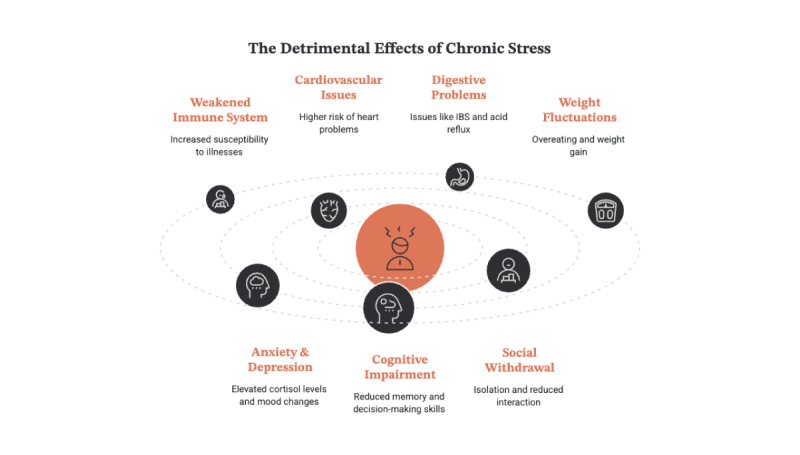
Stress affects employees’ health through the body’s stress response. In short bursts, hormones such as cortisol and adrenaline give the body extra energy to meet a deadline. When stress becomes chronic, those hormones stay high and begin to wear on immunity, the heart, digestion, weight, mood, thinking and relationships.
1. Weakened Immune System
Chronic stress weakens the body’s defenses: a meta-analysis of nearly 300 studies by Segerstrom and Miller linked chronic stressors to a weaker immune response, in both the cells that fight infection and the antibodies that target it. For employees, that can mean more sick days and colleagues picking up the slack.
2. Cardiovascular Issues
Work stress also raises the risk of heart disease. A 2015 review in Current Cardiology Reports, drawing on 27 cohort studies of more than 600,000 people, found that those exposed to stressors such as job strain and long working hours had a 10% to 40% higher risk of cardiovascular disease.
3. Digestive Problems
A 2014 review in the World Journal of Gastroenterology describes psychological stress as an important factor in the development of irritable bowel syndrome, a common gut disorder. At work, stress can surface as stomach pain or discomfort before a deadline, pulling attention away from the task.
4. Weight Fluctuations
Appetite changes in two phases under stress: Harvard Health explains that short-term stress can shut appetite down, while persistent stress raises cortisol, which increases it. Stress also pushes food choices toward meals high in fat, sugar or both, which can lead to weight gain over time.
5. Anxiety & Depression
Prolonged stress can contribute to anxiety and depression, and Medical News Today lists both among the effects of long-term exposure to stress hormones. Employees living with either may lose motivation, feel irritable and struggle to concentrate, which makes ordinary workdays harder to get through.
6. Cognitive Impairment
Memory and concentration suffer too. In a study of more than 30,000 US adults aged 45 and over, reported by Healthline, people with elevated stress were 37% more likely to have cognitive issues, even after adjusting for other health factors. At work, that can mean forgetfulness and poorer decisions.
7. Social Withdrawal
Stress can make an employee pull back from colleagues, because every conversation starts to feel like one more demand. That isolation can deepen anxiety and depression, and it often brings more conflict and less collaboration, which weakens the whole team.
Research by Brigham Young University professor Julianne Holt-Lunstad shows why this matters. Her 2010 meta-analysis of 148 studies found that people with stronger social relationships had a 50% greater likelihood of survival, an effect comparable with well-established risk factors for mortality.
The Business Case: What Unmanaged Stress Costs
These health effects reach the business through lost time and lost focus. The WHO estimates that 12 billion working days are lost every year to depression and anxiety, two of the conditions described above, at a cost of US$1 trillion in lost productivity.
In the US alone, a 2016 study by Stanford’s Jeffrey Pfeffer and colleagues estimated that workplace stress contributes to at least 120,000 deaths a year and adds $125 billion to $190 billion to annual health care spending.
Each organization’s share of that cost depends on its size, turnover and absence rates. Vantage Fit’s free employee wellness ROI calculator uses those figures, along with your industry, to estimate the return a wellness program could deliver for your company.
How Can Employee Wellness Programs Help With Stress Management?

Employee wellness programs help with stress management in two ways. They give employees daily ways to recover, such as guided relaxation and physical activity, and they fund support beyond the program through benefits such as health reimbursement arrangements and wellness stipends.
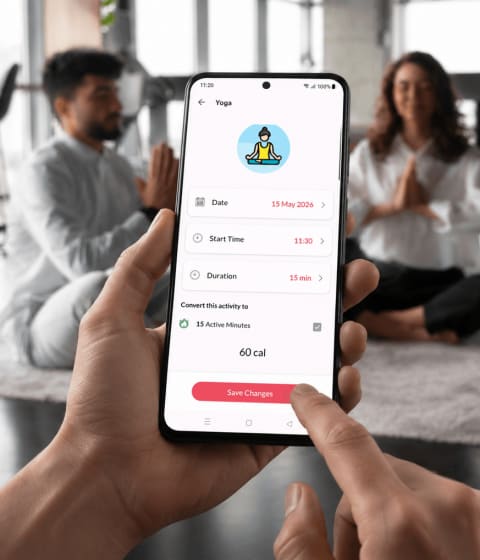
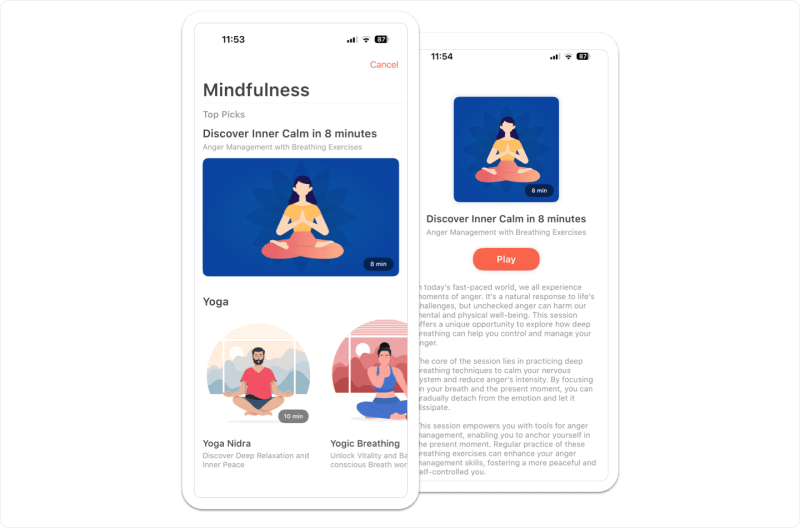
Vantage Fit covers the daily side in one app. Its workplace mindfulness library holds guided audio sessions of about 5 to 35 minutes, from meditation to sleep tracks, which employees can play offline on mobile. HR can also launch a ready-made Stress Free Month challenge without building one from scratch.
The second part is funding. A stress management program pairs well with wellness incentives and personalized benefits that cover what group health insurance leaves out, so employees can look after their well-being on their own terms. Two options stand out:
1. Health Reimbursement Arrangements (HRAs)
HRAs are employer-funded accounts that reimburse employees, tax-free, for qualified medical expenses such as therapy received as medical treatment, doctor visits and prescriptions. Under IRS Publication 502, general fitness costs such as health club dues do not qualify, which is where wellness stipends come in.
The three main types suit different employers:
| HRA type | Best suited to | What it reimburses |
|---|---|---|
| Qualified Small Employer HRA (QSEHRA) | Employers with fewer than 50 full-time employees that do not offer a group health plan | Individual health insurance premiums and qualified medical expenses |
| Individual Coverage HRA (ICHRA) | Employers of any size, including those that want different allowances for different classes of employees | Individual health insurance premiums and qualified medical expenses |
| Integrated HRA | Employers that already offer a group health plan | Out-of-pocket medical costs, such as deductibles and copays, on top of that plan |
2. Taxable Wellness Stipends
Wellness stipends give employees a set amount to spend on approved wellness expenses. The IRS treats them as taxable wages, but they cover a wider range than HRAs, from gym memberships to meditation apps and healthy groceries, so each employee can choose the stress relief that suits them.
To set one up, the free wellness stipend policy template lists more than 30 expense categories and walks through a seven-step reimbursement workflow, with tax and compliance notes for HR and finance teams to review before launch.
Legal Considerations for Wellness Incentives

Benefits and incentives like these are a good way to promote employee health, and in the US they also have to stay within the law. These four areas matter most when you design a program:
| Rule | What it protects | What it means for your program |
|---|---|---|
| Health Insurance Portability and Accountability Act (HIPAA) | Employee health information | Obtain clear consent and maintain confidentiality on any health data you collect |
| Americans with Disabilities Act (ADA) | Access for employees with disabilities | Provide reasonable accommodation, and keep rewards inclusive and non-discriminatory |
| Genetic Information Nondiscrimination Act (GINA) | Genetic information, including family medical history | Never tie wellness rewards to obtaining genetic information |
| Voluntary participation (ADA and GINA, enforced by the Equal Employment Opportunity Commission) | Employees' freedom to opt out | Keep incentives modest enough that taking part stays a free choice. The EEOC's incentive limits were struck down and no replacement rule is in force, so check current guidance with legal counsel |
Stress rarely comes from one place: money worries, poor sleep and unhealthy eating all feed it. A program that pairs daily recovery tools with benefits like HRAs and stipends can reach more of those sources at once, and the tips below add practical steps for employees and employers alike.
Additional Tips to Reduce Stress in the Workplace

Alongside a formal wellness program, employees need simple ways to recover day to day. Recovery means bringing your mind and body back to their normal state after a stressful stretch, and like any skill, it gets easier with regular practice.
Employees can build that recovery into their own day, while organizations shape the conditions that decide how much stress builds up in the first place. Here is what each side can do.
Tips for Individuals
1. Become a Time Management Master
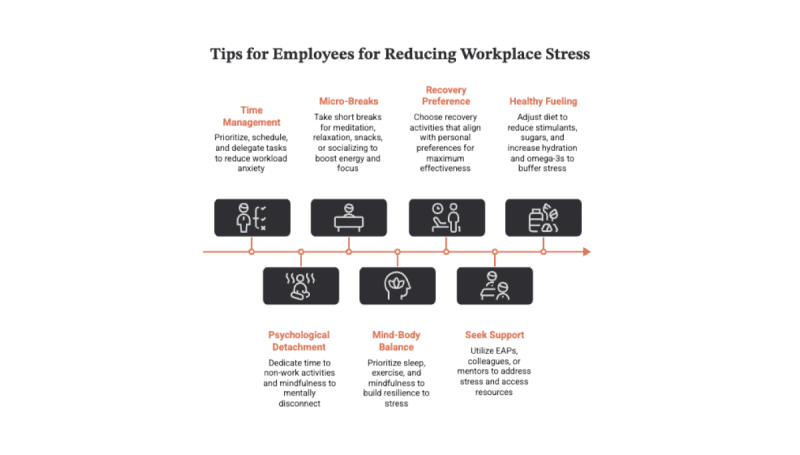
Feeling overwhelmed by deadlines and overflowing to-do lists is a major stressor. Time management techniques such as prioritization, scheduling and delegation ease that pressure, and calendars, planners or productivity apps help you stay organized and ahead of your work.
Suggestion: Notion App
2. Detach Psychologically from Work
Stress at work tends to linger even during break time. You might be having lunch while watching your favorite Friends episode, but your mind is still replaying a client meeting from earlier. To combat that, you need to ‘mentally disconnect’ from work and give yourself a break.
Research by Alyson Meister and colleagues in Harvard Business Review found that “Detachment leads to better recovery and even improvements in work-related outcomes, such as performance and engagement.” That challenges the common belief that longer hours mean better performance.
Here are a few things that you can do:
- Dedicate a specific (even short) amount of time each day to a non-work activity you enjoy. Even a few minutes can benefit your recovery.
- Mindfulness practices can be helpful here: over time, you train your brain to focus on the present moment and reduce its tendency to dwell on work.
- Identify your detachment triggers: if your phone/laptop tempts you to check work emails during breaks, turn it off or silence notifications temporarily.
3. Harness the Power of Micro-Breaks during the Workday
Recovery can also happen during the workday. A 2022 meta-analysis of 22 study samples found that micro-breaks of up to 10 minutes boosted energy and reduced fatigue. Their effect on performance was not significant overall, although longer breaks helped more, so short pauses work best as an energy reset.
These micro-breaks can involve:
- short meditations,
- relaxation techniques,
- taking time for a nutritious snack,
- socializing with colleagues or
- taking a power nap (this one helps a lot, trust me).
4. Mind Your Body and Mind
Prioritize activities that promote well-being. Take regular breaks for mindfulness exercises like meditation or deep breathing. Develop healthy sleep routines and incorporate physical activity into your day, even if it’s just a short walk during lunch. A healthy body is better equipped to handle stress.
Claudia Grace, a corporate health and wellness coach and a guest on the Vantage Fit podcast, answers the “I don’t have time for this” objection directly:
"In as little as 10 minutes, you can completely get your body into that relaxation response. Ten minutes can make a world of difference."
– Claudia Grace, Corporate Health and Wellness Coach | Listen to the full episode
Ten minutes might not sound like much, yet it can slow your breathing, ease tension in the body, and bring your focus back. That small reset often carries forward, helping you respond more calmly, think more clearly, and move through the rest of the day with a bit more control.
5. Consider the Preference for Recovery Activity
Recovery works best when it suits you. Breaks that match your preferences restore you more: if socializing energizes you, chat with colleagues, and if you need quiet time, step away and recharge however you like.
You can also talk to your manager about having more autonomy over your break schedule and activities. Then, use those free slots to do recovery activities that bring you inner peace.
6. Seek Support
Talking about stress early helps keep it manageable. Use resources such as employee assistance programs (EAPs), which offer confidential counseling and support, and lean on a trusted colleague or mentor when work feels heavy.
7. Fuel Your Body to Buffer Stress
What you eat and drink shapes how well your body copes with pressure. These small adjustments remove daily triggers that quietly raise your baseline stress:
- Ease up on caffeine and alcohol. Both can disrupt the sleep your body relies on to recover.
- Cut back on simple sugars. The quick spike and crash in blood sugar can leave you tired and irritable.
- Stay hydrated. A 2012 study in The Journal of Nutrition found that even mild dehydration lowered mood and concentration in young women.
Tips for Organizations
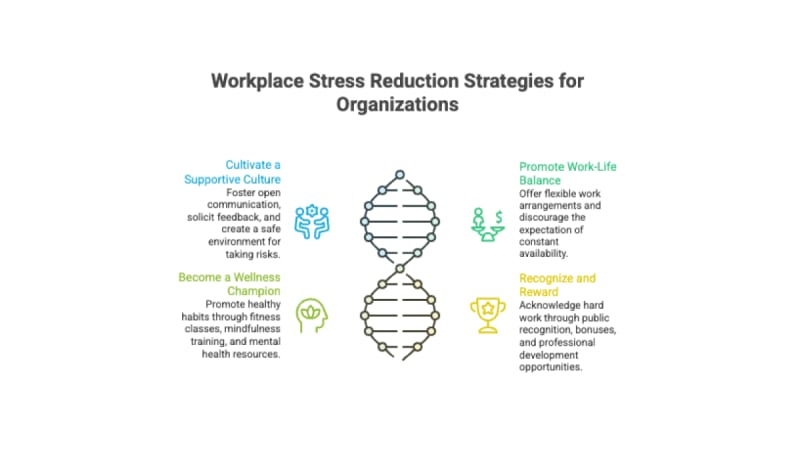
1. Cultivate a Supportive Culture
Foster a work environment where open communication is encouraged. Employees who feel comfortable raising concerns are less likely to experience stress, especially when leaders ask for feedback regularly, act on it, and let people take risks without fear of being punished for mistakes.
2. Promote Work-Life Balance
Offer flexible work arrangements like remote work options or compressed workweeks. It allows employees to manage their personal responsibilities more effectively, reducing stress caused by scheduling conflicts.
Moreover, discourage the expectation of constant availability. Employees shouldn’t feel pressured to check work emails or respond to messages outside of designated work hours. Encourage team members to respect one another’s time off and avoid scheduling meetings or sending urgent requests during breaks or vacation periods. Everyone deserves their own recovery time.
3. Become a Wellness Champion
Organizations can lead by example with practical employee wellness program ideas such as:
- Offering on-site fitness classes or healthy lunch options. Encourage participation in stress-reduction workshops or mindfulness training programs.
- Partnering with mental health professionals to provide resources and support services to employees struggling with stress or anxiety.
- Organizing educational seminars on topics like healthy eating, sleep hygiene, and the importance of taking breaks.
- Arranging on-site health screenings or partnering with healthcare providers to offer discounted wellness plans.
Celegence, a life sciences regulatory consulting firm, shared how one relaxation session landed with its team:
"One of the features I loved the most is the Yoga Nidra session, which helped us relax in the stress-induced environment."
– Celegence (email testimonial)
Read more on: Corporate Mental Health Programs: A Complete Guide for HR Teams
4. Recognize and Reward
Acknowledge your employees’ hard work in public, and back it with rewards such as bonuses, extra paid time off or development opportunities. Recognition lifts morale, and when people see a clear link between effort and reward, they tend to feel more motivated and less stressed.
The same idea works for health goals. Wellness challenges can recognize milestones such as completed challenges and daily step targets, so healthy habits stay visible and rewarded, and employees have a steady reason to keep them up.
5. Train Managers to Spot Stress Early
Managers are often the first to notice when someone is struggling. The WHO recommends manager training that helps managers “recognize and respond to supervisees experiencing emotional distress” and builds skills such as open communication and active listening.
The first conversation is often the hardest part. Vantage Fit’s free mental health conversation starters for managers offer opening scripts based on what a manager has observed, plus a three-phase framework: prepare, open the dialogue and sustain support.
How Can HR Measure Workplace Stress?
HR can measure workplace stress by tracking three kinds of signal together: a validated stress survey run at regular intervals, workforce data such as absence and turnover, and how much employees use the support on offer. Compared over time, these show whether stress is falling and which teams need help first.
1. Survey Stress Directly
A validated questionnaire gives you a reliable baseline. The Perceived Stress Scale, developed by Sheldon Cohen and colleagues in 1983, is one of the most widely used, and the UK Health and Safety Executive offers a free Indicator Tool covering six areas of work: demands, control, support, relationships, role and change.
Both tools work best as a trend line. The Perceived Stress Scale has no score cut-offs, so its value comes from comparing results within your own workforce from one survey to the next, and its developers ask users to request permission, free of charge, through the Mapi Research Trust.
2. Watch the Data You Already Have
Absence rates, turnover, overtime hours and employee assistance program use are figures most HR teams already collect, and each one can reflect rising stress. Reviewing them by team every quarter reveals patterns, such as one department where sick days and resignations climb together.
3. Track Participation in Support
Participation shows whether employees actually use the help on offer. In the Vantage Fit admin dashboard, HR can see participation across challenges and run short anonymous surveys after a challenge ends. Individual mood check-ins stay private to each employee, with no manager view and no mood report.
Start Your Journey Towards a Well Workplace
Stress at work is common, costly and often shaped by how work is organized, which puts much of the fix within an employer’s reach. The strongest programs pair daily recovery support with changes to workload, flexibility and management, then check their progress through regular measurement.
A practical first step is to measure where your teams stand today, then choose one or two fixes from the tips above and review the results after a quarter. Small, steady changes are easier to sustain, and they give employees visible proof that their well-being matters.
Executive coach Fred Kofman puts the case for investing in people this way:
If you just pay (workers), you’re going to get the minimum discretionary effort; they’ll just work for the pay, but if you want them to pour their hearts and souls, you need to give them more.
– Fred Kofman, Executive Coach, Economist, Author
Frequently Asked Questions
How are employee wellness and stress management connected?
Employee wellness programs build the health and habits that help people cope, and stress management lowers the pressure that wears those habits down. A systematic review of 90 job-stress studies found that programs combining individual and organizational changes improved outcomes for both employees and employers.
Can a wellness program actually reduce workplace stress?
Yes, when it includes proven practices. Bartlett and colleagues pooled 23 randomized workplace trials in 2019 and found a moderate drop in stress among employees who received mindfulness training. Results are strongest when the program also tackles causes such as heavy workloads, rather than relying on employee coping alone.
What are the most common causes of employee stress?
Heavy workloads, little say over how work gets done, weak support from managers, job insecurity, unclear roles and work spilling into personal time top the list. Most of them trace back to workload planning, job design and management, which means employers can address them directly.
How quickly do stress-recovery practices work?
Within minutes. A 2022 review of micro-break studies found that pauses of 10 minutes or less lifted energy and eased fatigue, and wellness coach Claudia Grace notes that about 10 minutes can bring the body into a relaxation response.
What are five effective ways to manage stress in the workplace?
Five steps cover most of the ground: set realistic workloads and clear priorities, give employees more say over how and when they work, teach managers to notice early signs of stress, protect breaks and time off, and measure stress regularly so you can act on the results.
Why is workplace wellness important?
Workplace wellness matters because employees who feel supported tend to stay longer and burn out less. Gallup's 2022 research found that workers who strongly felt their employer cared about their wellbeing were 69% less likely to job hunt and 71% less likely to report burnout.
How can HR tell whether workplace stress is going down?
Repeat the same validated stress survey every few months and compare the results by team with absence, turnover and how often people turn to the employee assistance program. When survey scores, sick days and resignations improve together, the program is working.