A wellness program budget is the annual plan that sets how much you will spend on employee wellbeing and how that money is divided across preventive care, fitness, mental health, nutrition, incentives, and the platform that runs them. Most corporate wellness initiatives fail for want of that plan, not for want of good intentions.
A successful corporate wellness program involves more than gym memberships. It’s also more than occasional health seminars. It requires careful planning.
Strategic investment is necessary. A clear budget ensures long-term success. The financial business case is equally compelling: a well-structured wellness program saves an average of $250 per employee in healthcare costs annually, which is the wellness-program industry average. Set that against the cost of losing someone, commonly put at $15,000 to $25,000 per employee, and the arithmetic usually favours the program.
Without proper financial planning, wellness initiatives can fail. Even good intentions aren’t enough. Poor planning leads to wasted resources, and employees may become disengaged.
Research shows that strong wellness programs boost employee engagement, reduce absenteeism, and improve productivity.
A wellness program budget solves these issues. A wellness budget example creates a clear spending framework. This framework helps allocate funds effectively, ensures programs meet objectives and maximizes impact.
A well-planned budget aligns with the company’s size, addresses employee needs, evaluates available resources, and supports long-term sustainability.
In this article, we’ll discuss key steps to building a solid wellness program budget. We’ll use a real-world example to illustrate how organizations structure spending.
KEY TAKEAWAYS
- A wellness program budget sets both your total spend and how that spend is divided across preventive care, fitness, mental health, nutrition, incentives, and technology.
- Build it in six steps: assess employee needs, size the program to your headcount, identify your costs, choose your components, explore cost-effective options, then monitor and adjust.
- Finance approves wellness budgets that carry a measurable objective, a phased ask, and a review date. A total with no story behind it is the most common reason a request stalls.
- Treat the budget as a live document. Quarterly reviews and mid-year reallocation matter more to the outcome than getting the opening split exactly right.
- For per-employee price benchmarks and vendor pricing models, see our corporate wellness program cost breakdown. This guide covers what to do with the number once you have it.
How Do You Build a Wellness Program Budget, Step by Step?

- Assess Employee Needs and Wellness Goals
-
A wellness budget should serve employee needs. Conduct employee surveys, focus groups, and health risk assessments. These help organizations identify wellness priorities. Examples include mental health support, fitness initiatives, or preventive healthcare.
-
Clearly define wellness goals, such as reducing absenteeism, improving employee morale, or enhancing productivity. This ensures the budget aligns with measurable outcomes.
- Budgets vary by company size:
-
Small Companies (under 50 employees): Typically operates with limited wellness budgets, often opting for cost-effective solutions such as workplace wellness challenges, mental health webinars, and digital wellness platforms.
-
Medium Companies (50–500 employees): Allocates moderate budgets, allowing them to invest in initiatives like on-site fitness programs, biometric screenings, and health coaching to enhance employee well-being.
-
Large Enterprises (over 500 employees): Have substantial wellness budgets, enabling them to offer comprehensive programs that include a wide range of wellness initiatives and benefits tailored to employee needs.

- Identify Your Costs
Understanding the corporate wellness program cost structure is vital for long-term sustainability. Wellness budgets differ by industry. The technology and finance industries typically have higher wellness budgets, while manufacturing companies often focus more on occupational health and safety initiatives.
Debbie Bellenger, a veteran Health and Wellness Consultant, emphasizes that the true cost of an unwell workforce often hides in lost productivity:
"There's a direct correlation between employee health, employee happiness, employee engagement, and employee retention. Even if an unwell employee is at their desk eight hours, it might only be six hours of productive time — they're having doctor's appointments, having trouble focusing. Medical and pharmacy claims go up. The cost of sickness is not sustainable."
— Debbie Bellenger, Health and Wellness Consultant | Listen to the full episode
- Identify key wellness components. A structured wellness budget usually includes the following:
-
Preventive Care: Health screenings and vaccinations.
-
Fitness Initiatives: Exercise programs and challenges.
-
Mental Health Support: Counselling and support programs.
-
Nutrition: Diet consultations and educational sessions.
-
Incentives and Rewards: Gift cards and wellness stipends.
-
Technology: Platforms to track participation and engagement.
Explore various wellness program ideas to determine which components yield the highest engagement for your specific demographic.
- Explore cost-effective wellness solutions. Budget constraints shouldn’t limit wellness program effectiveness. Organizations can use:
-
Affordable wellness services and partnerships.
-
Employee health benefits cover preventive care.
-
Digital wellness apps or tools.
-
Wellness services are provided through community partnerships.
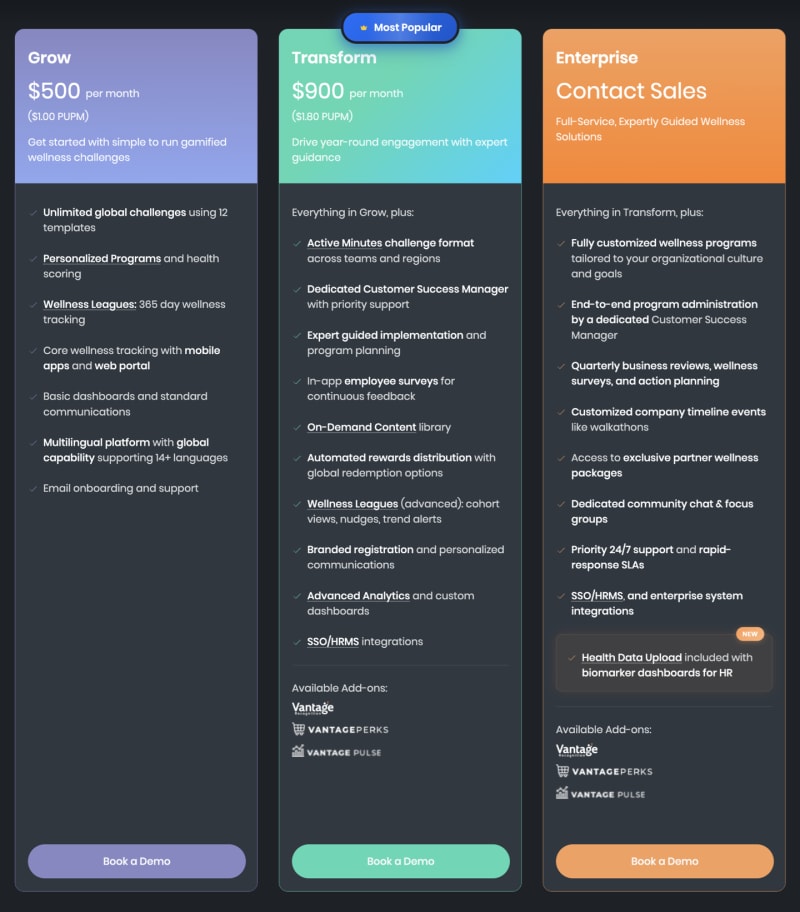
To manage these diverse costs effectively, many HR leaders are moving away from manual spreadsheets to automated wellness platforms. Platforms like Vantage Fit simplify the budgeting process by providing transparent pricing and real-time ROI analytics. With transparent, predictable pricing, organizations can allocate funds precisely across challenges, rewards, and mental health resources without hidden administrative overhead.
Vurshayna Nadoo from Momentum Investments notes how finding an affordable and scalable platform is key to managing a wellness budget effectively:
"Vantage Fit stood out as the ideal partner to meet our unique needs. They offered an affordable solution for our organisation of around 800 employees and made the setup process seamless."
— Vurshayna Nadoo, Momentum Investments
- Monitor and optimize the wellness budget regularly. Measure program effectiveness and ROI on wellness programs on a fixed cadence, track participation, and reallocate toward what works. This is the step where most budgets are won or lost, so it gets its own section below.
How Should You Split the Budget Across Categories?
Once you know your total, the harder question is allocation. Where the money lands matters more than the headline figure, because the same spend produces very different outcomes depending on how it is divided.
There is no single correct split. The right one follows the goals you set in step one. A company trying to bring down healthcare claims funds prevention heavily. A company trying to lift a flat engagement score funds challenges and incentives instead. Use the table below to size each line against what it is actually meant to achieve.
| Budget line | What it funds | How to size it |
|---|---|---|
| Preventive care | Health screenings, vaccinations, health risk assessments | Weight this highest when claims or absenteeism are the problem you are solving. It carries the longest payback and the clearest link to the $250 per employee annual healthcare saving that is the industry average. |
| Fitness initiatives | Step challenges, fitness competitions, subsidised memberships | Scale to how distributed your workforce is. Digital challenges cost far less per head than facilities and reach remote staff, so distributed teams can fund this line lightly and still get reach. |
| Mental health support | Counselling, EAP access, stress management workshops | Size from your needs assessment rather than from benchmarks. Utilisation is typically low and highly variable, so budget for access rather than against a participation target. |
| Nutrition | Diet consultations, educational sessions, healthy food provision | Usually the smallest line and the cheapest to pilot, which makes it a good candidate for phase one while you are still testing appetite. |
| Incentives and rewards | Gift cards, wellness stipends, milestone rewards | The line most often underfunded, and the one participation depends on most. Plan against realistic uptake: sustained participation across the industry averages 20% to 30%, so budgeting for full headcount overstates the cost. |
| Technology and platform | The platform that runs challenges, tracks participation, and reports on spend | Fixed and predictable, which makes it the easiest line to defend. It also decides whether you can measure the other five at all. |
Per-employee price benchmarks, vendor pricing models, and line-item costs for screenings or coaching sit outside the scope of this guide. For those figures, see our full breakdown of corporate wellness program costs.
How Do You Get a Wellness Budget Approved?
A wellness budget rarely fails on the number. It fails on the story around the number. Finance approves wellness spend when the request reads like any other operating investment: a defined problem, a measurable objective, a staged commitment, and a date to review it.
-
Lead with the cost of doing nothing. Turnover is the figure that lands hardest, commonly put at $15,000 to $25,000 per employee. Set your full annual ask against the cost of replacing a handful of people and the request reframes itself from discretionary spend into risk reduction.
-
Attach one measurable objective to every line. Not “improve wellbeing” but “cut the absence rate in the operations team by one day per head”. A line with no metric attached is the first line cut, because nobody can argue for it next year.
-
Ask in phases. A twelve-month ask with a checkpoint at month four is easier to approve than the same total committed up front. Start with the cheapest lines that generate participation data, then use that data to release the rest.
-
Use conservative participation assumptions. Budgeting as though everyone joins inflates the ask and guarantees you underspend, which damages credibility for the following year. Industry sustained participation runs 20% to 30%. Plan there, and treat anything above it as upside.
-
Name the review date in the request itself. Committing to report back in writing at a fixed point is the single cheapest thing you can add, and it moves the conversation from whether to fund to how it will be judged.
Budgeting best practices for employee wellness programs

An effective wellness program budget balances cost-efficiency with impactful initiatives. These best practices can help create a successful wellness budget:
-
Make the Most of Current Resources: Use company facilities efficiently. Utilize in-house experts for wellness activities. Keep costs low while maintaining impact.
-
Prioritize Preventative Care: Focus spending on proactive health measures, such as health screenings, vaccinations, and preventive education. This approach reduces future healthcare costs.
-
Empower Employees to Lead Wellness Efforts: Create employee-led wellness committees. This will boost engagement and align the budget with employee needs.
-
Collaborate With Local Businesses: Partner with local fitness centers or wellness professionals. These partnerships offer discounts, extending the budget further.
-
Seek Out Grants & Sponsorships: Explore grants or sponsorships to secure external funding. Such funding helps enhance wellness offerings without burdening internal finances.
-
Tap Into Community Resources: Use free or low-cost community resources. Examples include nonprofit programs, public health initiatives, or educational sessions.
-
Show Commitment with a Dedicated Wellness Budget: Clearly define funds for wellness initiatives. A dedicated budget demonstrates commitment and improves program sustainability.
-
Roll Out the Program in Phases: Introduce wellbeing initiatives gradually. Start with lower-cost activities. Expand based on employee feedback and available funding.
-
Repurpose Existing Budget: Reallocate funds from underused HR or training budgets. Redirect this spending toward wellness activities to maximize efficiency.
-
Take Advantage of Technology Solutions: Utilize wellness platforms or mobile apps. These reduce administrative overhead, boost employee participation, and track budget effectiveness.
How Do You Track and Reallocate the Budget Through the Year?
An approved budget is an opening position, not a settlement. The organisations that get the most out of wellness spend are rarely the ones that guessed the split correctly in month one. They are the ones that reviewed it often enough to move money before the year ran out.
Set a quarterly review and look at four things:
-
Participation by category. Which lines are being used and which are being ignored. A line nobody touches is not a failure, it is a signal to move the money.
-
Cost per active participant. The only figure that compares an EAP fairly against a step challenge. Total spend per line tells you nothing on its own.
-
Burn rate against plan. Underspending is as much a problem as overspending, because unspent budget invites a smaller allocation next cycle.
-
What the needs assessment predicted against what people actually did. The gap between the two is the most useful thing you will learn all year, and it should rewrite next year’s opening split.
Then act on it. Move funds out of lines with low uptake and into the ones people are already using, rather than holding the original allocation for its own sake. Reallocation mid-year is a sign the budget is being managed, not a sign it was wrong.
For example, Wipro’s 2025 wellness challenges saw a 3X increase in participation (163 → 550 users) across 30+ countries by iteratively optimizing their program based on real-time engagement data.
Case Study: Learn how Wipro scaled participation 3X using data-driven wellness budgeting.
Sample Template for Wellness Program Budget
Here is a sample breakdown for a mid-sized company with 200 employees. Also, an annual wellness budget of $50,000 illustrates how a wellness budget is structured.


Take control of your wellness spending by using our Corporate Wellness Budget Template for strategic planning: Corporate Wellness Budget Template for Smarter Planning
This template helps organizations plan and allocate funds strategically while maintaining cost-effectiveness.
The Bottom Line
A successful wellness plan requires more than just enthusiasm; it needs a structured financial foundation. By following a step-by-step budgeting approach and leveraging technology to track impact, organizations can ensure their wellness investments lead to a healthier, more engaged workforce.
Frequently Asked Questions
1) What is the average cost of a wellness program per employee?
For small businesses, wellness program cost $150 to $2,000 per employee annually. Medium to large companies usually spend between $238 and $742 per employee each year.
2) How much does an employee wellness app cost?
Employee wellness apps generally cost $2 to $10 per employee monthly. Pricing depends on features, customization, support, and company size.
3) How should a wellness budget be split across categories?
There is no fixed split. Allocate against the goal you set: fund preventive care heavily if you are targeting claims or absenteeism, and fund challenges and incentives if you are targeting engagement. Six lines are worth naming separately: preventive care, fitness, mental health, nutrition, incentives, and the platform. To create a wellness program from scratch, start with the needs assessment before you divide anything.
4) Is a wellness budget the financial fuel of a successful corporate wellness plan?
Yes. A dedicated wellness budget demonstrates company commitment and ensures consistent funding. It supports resources, incentives, and activities for employee engagement and program effectiveness fueling a successful corporate wellness plan.
5) How can wellness program grants help offset costs and enhance your employee wellness initiatives?
Grants reduce financial strain, allowing companies to offer expanded wellness activities without tapping internal budgets.
6) How do you get a wellness program budget approved?
Present it as an operating investment rather than a wellbeing request. Lead with the cost of doing nothing, most persuasively turnover at $15,000 to $25,000 per employee. Attach one measurable objective to every line, ask in phases with a checkpoint rather than committing the full total up front, plan against 20% to 30% sustained participation rather than full headcount, and name your review date in the request itself.
7) What are some budget-friendly wellness activities for the workplace?
Some wellness program activities include fitness challenges, walking groups, and virtual wellness workshops.