A corporate wellness plan is an employer-sponsored program that helps employees improve their physical, mental, or nutritional health, usually through challenges, activity tracking, and rewards. The 8 examples below reached 59% to 99% participation. What separates them from programs that stall is design, not budget.
Every example here ran on Vantage Fit, so the participation figures are measured rather than estimated.
Key Takeaways
- The average wellness program loses most participants by month 2. Programs with real rewards, native mobile apps, and team-based challenges hold on to them, as seen at Tata Motors (59%), IBS Software (88%), and Serum Institute (99%).
- The best corporate wellness program examples cover more than steps. Mental wellness, nutrition, and team challenges all outperform single-activity programs.
- Real results are replicable. Tata Motors (59%), IBS Software (88%), Wipro (3X participation), and Serum Institute (99%) all ran structured programs with clear goals and rewards.
- A simple 5-step framework works for any company size: assess, design, launch, reward, and measure. You do not need a large team or a large budget.
- The three most common mistakes HR leaders make are skipping the reward layer, launching once and forgetting about it, and measuring only signups instead of sustained participation.
Most corporate wellness programs fail quietly. Employees sign up in the first week. Participation looks promising. Then month 2 arrives. The numbers collapse.
Across a full program year, only about 21% of eligible employees take part in a workplace fitness program, the best attended of the lifestyle programs. Half of employers report 10% or less. For HR leaders, that is a frustrating pattern. You put the program together. You sent the launch email. You got the signups. And then you watched the numbers fall.
The problem is usually not the intention behind the program. It is the design. Most programs are built once, launched once, and left to run on their own. They have no rewards structure that keeps employees coming back. No social element that makes participation feel like a team activity rather than a solo chore. No easy mobile experience that fits into a workday.
This post is different. Instead of generic advice about “what makes wellness programs work,” it gives you 8 real program examples with verified results. Each one shows what the program involved, what the HR outcome was, and what you can take from it and apply to your own organization. Start with the examples that match your company size, workforce, and goals.
What Makes a Wellness Program Work (vs. Fail)
Before getting into examples, it helps to understand why most programs underperform. There are four patterns that show up repeatedly.
Reason 1: The program is easy to ignore
If participation requires employees to download a separate app, log in through a web portal, or manually enter data every day, most will stop within two weeks. Friction kills wellness programs. Employees are busy. The app that requires the least effort to keep using is the one that gets used.
Programs with native mobile apps and automatic activity sync (Apple Health, Google Fit, Garmin, Fitbit) remove the manual tracking burden. Employees check their steps passively. That means they stay engaged without having to think about it.
Reason 2: There is no real reward at the end
Company swag and certificate emails do not move participation. Real rewards (gift cards to Amazon, Starbucks, or retailers employees actually shop at) create a motivation loop that sustains activity beyond the launch spike.
This is the single most consistent finding across high-participation wellness programs. When employees know their steps and activity convert into something tangible, they keep going. When the reward is a PDF certificate or a branded water bottle, they do not.
Reason 3: There is no social element
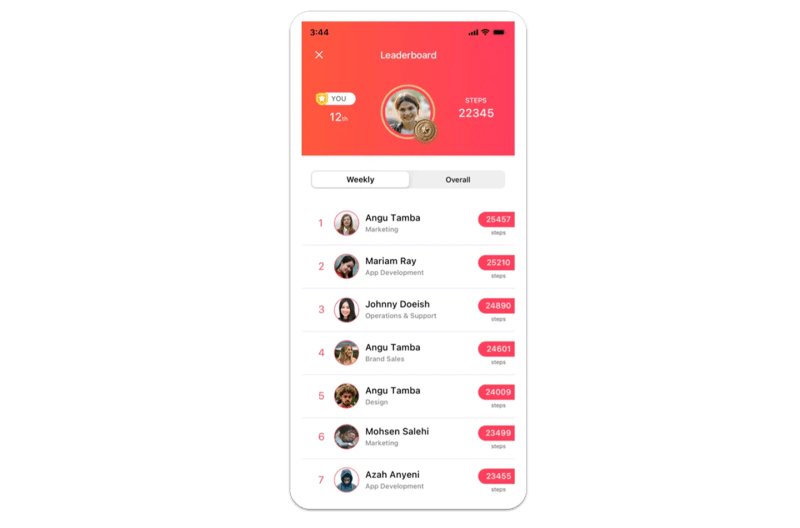
Wellness that happens in isolation rarely lasts. When employees see colleagues on a leaderboard, compete as part of a team, or share progress in a challenge feed, the activity becomes social. Social accountability is one of the most powerful drivers of sustained participation. In most workforces, it outperforms individual motivation alone.
Team challenges and department leaderboards transform wellness from a personal project into a shared activity. That shift changes everything about how long participation holds.
Reason 4: The program runs once and never comes back
A single 30-day challenge creates a spike. A quarterly wellness calendar creates a culture. HR leaders who run back-to-back programs with different themes (a step challenge in Q1, a mindfulness month in Q2, a nutrition challenge in Q3) see participation compound over time. Employees who finish one challenge look forward to the next.
Set against the 21% average uptake above, the gap is stark. High-performing programs with gamification, real rewards, and a mobile-first experience consistently achieve 50% or higher. The examples below show what that looks like in practice.
8 Real Corporate Wellness Program Examples
The following examples are drawn from real organizational programs. Where client results are cited, they come from verified case study data. Each example includes what the program involved, the HR outcome, and what you can adapt for your own organization.
Example 1: The Multi-Activity Corporate Step Challenge (Tata Motors)
Company type: Large automotive manufacturer, 40,000+ employees
Program name: Step Up & Elevate Challenge
Tata Motors ran a 6-month multi-activity challenge with 43 participating teams. The challenge was not a simple step race. It combined step tracking, team leaderboards, weekly themes, and a structured reward system that kept employees coming back month after month.
Employees competed as teams, not just individuals. That meant a quiet participant in one department could see their team climbing the leaderboard and feel direct motivation to contribute. Weekly updates and push notifications kept the challenge visible. Real rewards for top performers provided a tangible goal.
HR outcome: Tata Motors achieved 70% engagement across the Step Up & Elevate Challenge, with an average of 7,600+ daily steps per participant, a 6% increase in physical activity. 53% of the 43 participating teams reduced their average weight over the six months, with top performers Sanand 2-Material (−12.36%) and Lucknow-Prolife (−10.77%) leading the programme.
What HR can steal from this: Run the challenge for longer than 30 days. Monthly challenges create spikes. Six-month programs with rotating weekly themes build habits. Add team competition alongside individual leaderboards. That expands the social accountability surface area significantly.
If your company has departments that rarely interact, a cross-department step challenge is one of the fastest ways to break down silos. Teams of 5–10 employees from mixed departments compete together, which creates connections that outlast the challenge itself.
Example 2: The Month-Long Fitness Challenge (IBS Software)
Company type: Software company, technology sector
Program name: March to Fitness Challenge
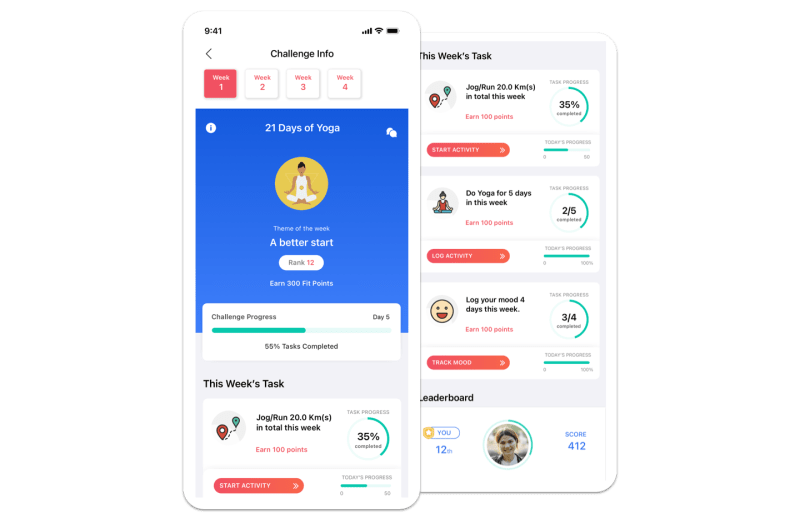
IBS Software ran a month-long employee fitness challenge with a focus on daily step goals and weekly progress benchmarks. The challenge used a native mobile app with a real-time leaderboard visible to all participants.
The program was designed to hit a 70% engagement benchmark. That is an ambitious target for a 30-day program. The combination of daily step tracking, visible leaderboard rankings, and a reward structure for top performers pushed participation well above that threshold.
HR outcome: IBS Software achieved 88% engagement, 17 percentage points above their 70% benchmark. The program attracted 500+ active participants, with 236 employees hitting 30,000 or more steps per week.
What HR can steal from this: Set a public benchmark before the challenge begins. When employees know HR is measuring against a 70% target, the social motivation to contribute increases. Leaderboards alone drive competition. Visible organizational goals create shared buy-in.
Example 3: The High-Participation All-Staff Program (Serum Institute of India)
Company type: Pharmaceutical manufacturer
Serum Institute of India achieved the highest recorded participation rate in this dataset: 99%. That number is worth pausing on. At most companies, 99% of employees participating in anything voluntary is not a realistic outcome. At Serum Institute, the combination of leadership support, an easy mobile app experience, and a well-designed challenge structure got it done.
The key factors: the program was accessible on mobile devices employees already used, there was visible leadership participation, and the challenge design made joining feel low-effort and worthwhile from day one.
HR outcome: 99% participation rate. That is the highest recorded across verified case study data.
What HR can steal from this: Leadership participation is a multiplier. When senior leaders join the leaderboard and share their step counts, employee participation rates climb. It signals that the program is a real organizational priority, not a box-checking exercise.
Example 4: The Multi-Challenge Growth Program (Wipro)
Company type: Global IT services company, 30+ countries
Wipro ran not one but three sequential wellness challenges over a single year. The multi-challenge approach was intentional: run one program, learn what drove the most participation, and apply those learnings to the next program. Each successive challenge built on the momentum of the previous one.
The program spanned 30+ countries and needed to work across radically different workforce demographics. The native mobile app format made it viable globally. Employees in India, the US, and Europe all used the same platform without localization friction.
HR outcome: Wipro achieved a 3X participation increase across the three challenges, growing from 163 to 550 active users. Daily steps increased by 84% from the May to July period.
What HR can steal from this: Plan a quarterly wellness calendar instead of a single annual event. The second and third challenges at Wipro outperformed the first because employees already knew how the platform worked. Familiarity with the tool reduces friction on every subsequent launch.
The challenges at regular intervals keep employees motivated to stay fit.
– Vantage Fit customer testimonial
Example 5: The Mental Wellness Month Program
Company type: Any office-based or hybrid company with 50–2,000 employees
Program theme: Mindfulness and Stress Awareness Month (April)
Mental wellness programs are the fastest-growing category in corporate wellness. A dedicated mental wellness month gives HR a structured way to address stress, burnout, and focus. These are topics employees increasingly want their employer to take seriously.
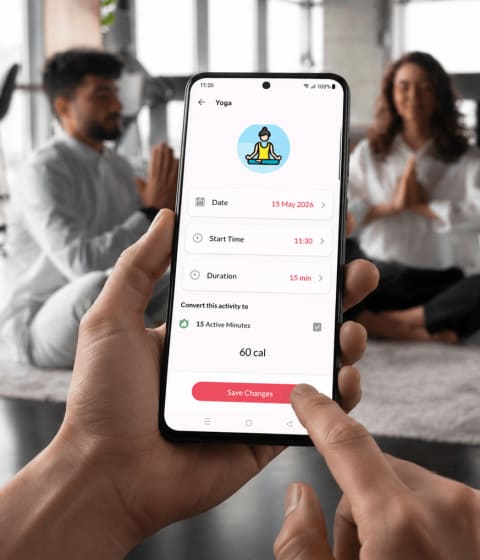
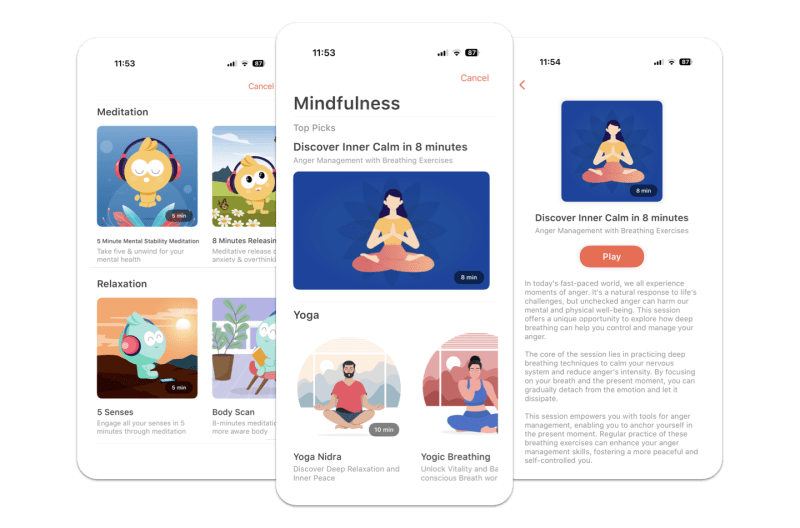
The format: a 30-day challenge where employees log mindfulness sessions, guided meditation, yoga sessions, and breathing exercises. Sessions range from 5 minutes to 20 minutes and can be completed at a desk, at home, or during a lunch break. Every completed session earns points toward a team or individual leaderboard.
A platform with a built-in mindfulness library removes the need to source content separately. Employees access guided sessions directly in the wellness app, completing a 5-minute meditation before a stressful meeting or a 12-minute sleep meditation at the end of the day. HR sees participation data by day and by department.
Approved stat: A 40% reduction in stress-related eating is associated with consistent mindfulness practice. That is an outcome HR can report alongside physical activity numbers when presenting program results to leadership.
What HR can steal from this: Tie the mental wellness month to a known calendar event: April is Stress Awareness Month. May is Mental Health Awareness Month. Using the existing awareness calendar gives the program context without requiring HR to create a narrative from scratch.
Mental wellness challenges work best when they are opt-in and pressure-free. Frame participation as personal time for employees, not a tracked productivity metric. That framing significantly increases engagement among employees who are already stressed.
Example 6: The Nutrition Challenge
Company type: Any company with a food-conscious workforce or a history of high healthcare costs related to diet
Program theme: National Nutrition Month (March) or a standalone 4-week healthy eating challenge
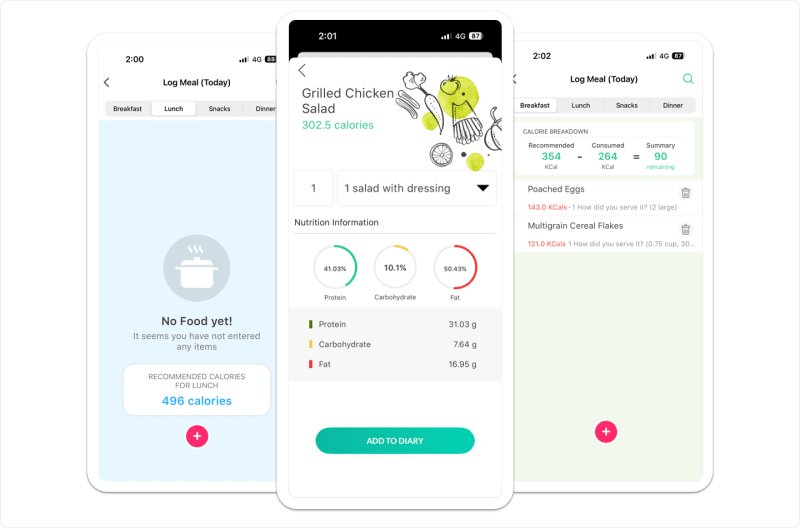
Nutrition challenges address the part of employee health that step trackers do not. Employees log meals across breakfast, lunch, snacks, and dinner. The platform tracks calories, macros (protein, carbs, fat), and a nutrition quality score. Employees earn points for consistently hitting daily nutrition goals, not just for reaching a calorie target.
The challenge design combines individual logging with team accountability. Employees can see their team’s aggregate nutrition score on a shared dashboard, which creates gentle social pressure to stay consistent.
Adding food logging to a multi-activity challenge creates a complete health picture: physical activity, mental wellness, and nutrition in one program. HR gets a single dashboard showing all three dimensions across the workforce.
Approved stat: $250 in annual healthcare savings per employee is the estimated ROI of a well-run corporate wellness program. That figure includes reductions in diet-related health costs alongside physical activity improvements.
What HR can steal from this: Pair a nutrition challenge with a step challenge rather than running it standalone. Employees who are already tracking steps have established the habit of opening the app daily. Adding a food logging task to an existing challenge is much easier than launching an entirely new program.
Example 7: The 30-Day High-Volume Walking Campaign (Landmark Group)
Company type: Retail and hospitality conglomerate
Landmark Group ran a 30-day wellness campaign with a focus on collective step achievement. The program was designed around a single, company-wide goal: how many steps can the entire workforce accumulate together? Individual leaderboards remained visible, but the campaign framing was collaborative.
The collective goal format works particularly well in industries with high frontline worker populations. Frontline employees are often excluded from desk-worker-centric wellness programs. A step challenge that counts every step (from a warehouse floor walk to a store floor shift) is inherently inclusive.
HR outcome: Landmark Group accumulated 4.3 million+ steps across the 30-day campaign.
What HR can steal from this: Set a collective milestone alongside individual competition. “Can we reach 5 million steps as a company this month?” is a goal that makes every participant feel like a contributor, regardless of where they rank on the individual leaderboard. This format reduces the feeling of futility for employees who know they will not win the individual race.
Example 8: The Wellness Leagues Program (Always-On Engagement)
Company type: Any company that wants continuous wellness engagement between challenge periods
Program format: Bronze, Silver, and Gold tier system based on rolling average daily steps
Every wellness challenge ends. The calendar resets. Employees who were highly engaged during the challenge often drop off in the weeks between programs. The Wellness Leagues format solves this problem by creating a persistent, always-on engagement mechanism that does not require HR to run a new campaign.
Employees are assigned to Bronze, Silver, or Gold tiers based on a 21-day rolling average of their daily step count. The default thresholds are: Bronze below 5,000 steps per day, Silver between 5,000 and 7,000, and Gold above 7,000. Thresholds are configurable per company.
Employees see their current tier and what they need to reach the next one. Tier movement happens weekly. The ongoing visibility of “I am 800 steps per day away from Gold” creates a daily motivation that no one-month challenge can sustain on its own.
For HR, the league reports show distribution by department. If the engineering team has 80% of its employees in Bronze and the sales team has 50% in Gold, that is an actionable insight. HR can run a targeted challenge for low-activity departments without disrupting the rest of the organization.
What HR can steal from this: Launch Wellness Leagues as the foundation layer of your wellness program. Run time-bound challenges on top of it. Employees who are already tracking steps in the leagues system will join challenge programs at higher rates because the behavior is already established.
See how Vantage Fit makes wellness programs employees love to use.
How Much Does Poor Employee Wellbeing Cost a Business?
More than most wellness budgets. The World Health Organization estimates that 12 billion working days are lost every year to depression and anxiety, at a cost of around US$1 trillion a year in lost productivity. That is the scale of the problem a wellness program is trying to reduce.
Physical inactivity compounds it. WHO reports that 31% of adults, roughly 1.8 billion people, do not meet the recommended 150 minutes of moderate activity per week, and puts the cost of physical inactivity to healthcare systems at about US$300 billion between 2020 and 2030. Against those numbers, the programs below are inexpensive.
How to Build Your Own Wellness Program (Step-by-Step)
The examples above show what is possible. This section shows how to get there. The five-step framework below works for companies of any size, from 50 employees to 2,000.
Step 1: Assess Your Workforce
Before designing any program, answer three questions. First, what is your current baseline? If you have run wellness programs before, what was your participation rate? If you have not, what percentage of employees do you estimate are physically active during the workday?
Second, what does your workforce actually want? A quick pulse survey with 3 questions (preferred program type, preferred reward type, biggest wellness barrier) takes 10 minutes to send and eliminates weeks of guesswork.
Third, what are your HR outcomes goals? Participation rate alone is not a business outcome. Are you targeting absenteeism reduction? Healthcare cost savings? Engagement scores? Your goal shapes which program type to run and which metrics to track.
A health risk assessment built into your wellness platform adds another data layer. Aggregated, anonymized data showing the percentage of your workforce in low, medium, or high physical activity categories helps HR prioritize program design without accessing individual employee data.
Step 2: Design the Program
Choose a program format that matches your workforce and your goal. The examples in this post map to different scenarios:
| Goal | Best Program Format | Recommended Duration |
|---|---|---|
| Maximum participation at launch | All-staff step challenge with team leaderboard | 30 days |
| Sustained year-round engagement | Wellness Leagues + quarterly challenges | Ongoing with 30–60 day challenge cycles |
| Address stress and burnout | Mental wellness month with mindfulness sessions | 30 days, tied to Stress Awareness Month |
| Holistic health improvement | Multi-activity challenge (steps + mindfulness + nutrition) | 6–8 weeks |
| Inclusive across frontline and desk workers | Collective step milestone campaign | 30 days |
| Build healthy eating habits | Nutrition challenge with meal logging | 4 weeks |
Once you have selected a format, define the reward structure before launching. Decide what employees earn for completing the challenge, how points convert to rewards, and what the top-performer prizes are. Having this defined before launch prevents ambiguity that erodes trust in the program.
Also define your target audience. Not every challenge needs to go to everyone. A step challenge program works well company-wide. A nutrition challenge might be better suited to your office population than your field teams. Targeting by department, location, or health risk profile makes programs more relevant and participation rates higher.
Step 3: Launch With Momentum
The first week of any wellness challenge sets the tone. A low-energy launch creates a low-energy program. A high-energy launch creates momentum that carries into week two and three.
Three launch tactics that consistently raise first-week participation:
Get at least one senior leader to join publicly. One message from a VP saying “I joined the challenge and I am already in Silver league” does more for participation than three all-hands emails from HR.
Send the invite through a channel employees actually check. Push notifications through the app work better than email for employees who already have the app downloaded. For first-time programs, a Slack or Teams message from a team manager outperforms a mass HR announcement.
Make joining take less than two minutes. Every extra step in the onboarding process reduces the percentage of employees who complete it. A wellness app that employees download and sign into with their work email, with no IT setup required, keeps the activation rate high.
Step 4: Keep It Going With Rewards
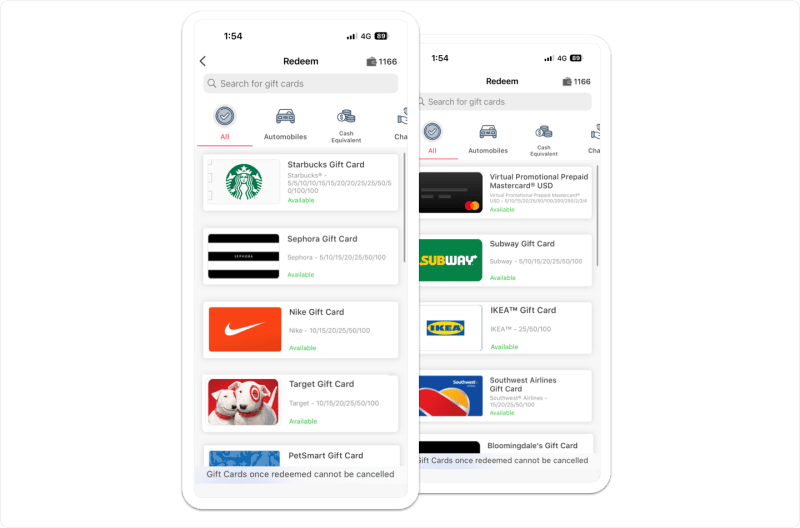
The reward layer is what separates programs with 25% sustained participation from programs with 75% sustained participation. Real rewards work. Symbolic rewards do not.
A points system that converts to gift cards at retailers employees actually use (Amazon, Starbucks, Nike, local retailers) gives every employee a personal reason to keep participating. It does not require a large budget per employee. Even a $10–$25 gift card for completing a 30-day challenge is enough to keep most employees engaged through the full program.
Beyond individual rewards, team prizes for the top three teams create group accountability. When the reward goes to the team rather than just the individual, every member has a reason to encourage their teammates.
Push notifications play a supporting role. A weekly progress notification showing an employee their current rank, their team’s position, and how many steps they need to move up one tier is a low-effort way to keep the program top of mind without requiring HR to manually communicate throughout the challenge period.
Step 5: Measure What Matters
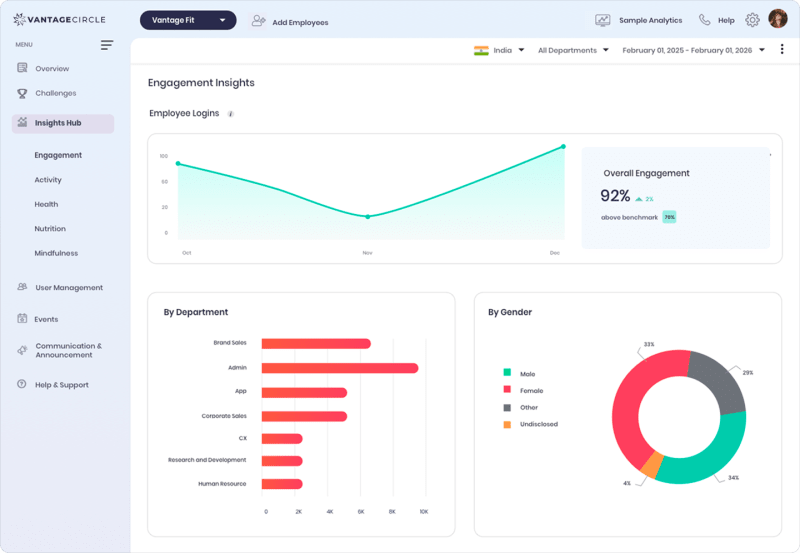
Track three numbers for every program: participation rate at launch, sustained participation rate at 30 days, and completion rate. These three metrics tell HR whether the program worked, where it lost momentum, and whether the reward structure was strong enough to sustain engagement to the finish line.
For executive reporting, add two outcome metrics: average daily steps change (or whatever the primary activity metric was) and department-level participation breakdown. Department breakdowns are particularly useful because they surface which teams are thriving and which need a targeted follow-up program.
Your wellness program goals and objectives should be set before the challenge begins. Goals set after the fact are not useful for improvement. Goals set before the launch become the benchmark against which every future program is measured. That is how wellness programs compound over time.
See what other employee wellbeing initiatives are working across industries for ideas to complement your core wellness program structure.
3 Common Mistakes HR Leaders Make With Wellness Programs
Even well-intentioned programs fail when these three mistakes appear. Each one is fixable.
Mistake 1: Measuring Signups Instead of Sustained Participation
Most HR reports show how many employees joined a wellness program. That number is almost always higher than the number of employees still active 30 days later.
Signups are a vanity metric. Sustained participation is the real number. An HR leader who reports “we had 85% signup” without tracking active usage at day 30 is presenting an incomplete picture to leadership. That sets up the next budget conversation on shaky ground.
Track active users at 30, 60, and 90 days. That is your real engagement rate. That is the number worth optimizing.
If your wellness platform does not show you daily active user counts and retention curves, you cannot accurately measure your program’s success. Participation reports should be available in your admin dashboard without manual tracking.
Mistake 2: Skipping the Reward Layer to Save Budget
It is tempting to launch a wellness program without a real reward structure. Participation should be its own reward, right?
It is not. Not for the majority of your workforce. The employees who are already intrinsically motivated to exercise do not need a wellness program. They are already active. The employees who need the program most are the ones who need an external motivator to get started and keep going.
Real rewards (gift cards, tangible prizes, recognition) reach that group. Cutting the reward budget to save money typically cuts participation by a third or more. The cost of a $15 gift card per completing employee is almost always smaller than the cost of running a program with 20% participation that HR cannot justify to leadership at renewal time.
Mistake 3: Running One Program Per Year
A single annual wellness challenge creates a single annual spike. It does not build a wellness culture. It does not compound engagement. It does not teach employees to use the app as a daily habit.
Companies with the highest sustained wellness engagement run 3–4 programs per year with different formats and themes. The step challenge in Q1 attracts the competitive employees. The mental wellness month in Q2 attracts the employees who would never win a step race. The nutrition challenge in Q3 attracts a different group again. By Q4, most of your workforce has found at least one program that resonated.
A wellness calendar with pre-planned quarterly challenges removes the pressure on HR to invent new programs from scratch each time. Platform templates with pre-built challenge formats and configurable goals make it possible to launch a new program in under an hour.
Look at employee wellness ideas by theme and month to build your quarterly calendar without starting from a blank page.
For a list of platform options to support these programs, see the guide to corporate wellness companies with verified ratings and feature comparisons.
Frequently Asked Questions
What is an example of a wellness program?
An employer-sponsored initiative that helps employees improve their physical, mental, or nutritional health. A simple example is a 30-day step challenge tracked on a mobile app with a leaderboard. The 8 examples below range up to six-month multi-activity programs.
What does a successful corporate wellness program look like?
Three characteristics: employees use it voluntarily, participation holds beyond the first month, and HR can measure results. Programs reaching 50% or higher combine an easy mobile app, gamification, and rewards employees want. Tata Motors hit 59%, Serum Institute 99%.
How do you measure wellness program success?
Core metrics are participation rate, sustained engagement at 30, 60, and 90 days, average daily activity, and challenge completion. Secondary metrics include absenteeism, healthcare claims, and survey scores. An analytics dashboard pulls these without manual tracking.
How much does a corporate wellness program cost?
Vantage Fit prices challenge packages rather than per seat, so per-employee cost falls with headcount. A 4-week Basic challenge is $10 per employee at 50 staff, $6 at 300 and $4 at 1,000. Above 1,000 is custom.
What are the best wellness program examples for small companies?
For companies under 500 employees, team step challenges, mental wellness months, and multi-activity campaigns work best. They build cohesion and need no dedicated wellness manager. A 30-day step challenge with a leaderboard and a small prize can reach 70–90% participation.
How do I get employees to participate in wellness programs?
Three levers matter most: an easy mobile app, team challenges that create social accountability, and rewards employees actually want. Programs relying on intrinsic motivation alone stay near the industry average, which RAND puts at 21% uptake for fitness programs.