

Wellness programs are employer-funded initiatives that support employee health through fitness, mental health, and preventive care. The main pro is lower healthcare costs and stronger engagement. The main con is high cost and weak participation when programs are poorly run.
The pros and cons of wellness programs almost always come down to one thing: execution.
Key Takeaways
- Wellness programs can lower healthcare costs and absenteeism, but only when participation is sustained over time.
- The biggest risks are cost, administrative load, privacy concerns, and low participation, which often runs around 20 percent without incentives.
- Rigorous research such as the Illinois Workplace Wellness Study found weak short-term clinical results, so set realistic expectations with leadership.
- Well-run programs mitigate the cons with aggregate-only data, voluntary participation, and templates that cut admin time.
Pros and cons of wellness programs at a glance
Here is the short version. Wellness programs deliver measurable gains in cost, health, and retention when they reach enough people, but they carry real risks around budget, admin load, and privacy.
The table below weighs both sides so you can scan the trade-off before you read the detail.
| Pros | Cons |
|---|---|
| Lower healthcare costs: about $3.27 saved for every $1 spent on wellness (Health Affairs meta-analysis) | High upfront and ongoing cost, hardest to justify for small and mid-sized teams |
| Lower absenteeism: about $2.73 saved for every $1 spent on wellness (same Health Affairs analysis) | Heavy administrative load to coordinate activities, track participation, and keep the program relevant |
| Stronger retention: replacing an employee costs about $15,000 on average (Work Institute) | Privacy and data-security concerns around sensitive employee health information |
| Lower stress, which can ease habits like stress eating and reduce burnout | Risk of excluding employees with chronic conditions or disabilities |
| Higher engagement and a stronger workplace culture | Low participation: a median of about 20 percent without incentives (RAND) |
| Easier to attract health-conscious talent | Hard to measure ROI, and short-term studies show mixed clinical results |
What are corporate wellness programs?

Corporate wellness programs are employer-sponsored initiatives that help employees build healthier habits through fitness, mental health support, nutrition, and preventive care. According to the US Chamber of Commerce, around 60 percent of companies report reduced healthcare costs after introducing them.
A typical program bundles several of these elements:
- Health screenings and preventive care
- Fitness classes, step challenges, and gym access
- Mental health and stress-management support
- Nutrition counseling and healthy-habit coaching
The aim is to encourage preventive health and reduce chronic illness, while supporting engagement and retention along the way.
If you are starting from scratch, our guide to building a corporate wellness program walks through the setup step by step. It also helps to set clear wellness program goals before launch, so you know what success looks like from day one.
The pros of wellness programs

The strongest case for wellness programs is financial and measurable. Employers see lower healthcare spending, fewer sick days, and better retention.
The most cited figures come from peer-reviewed and industry research rather than vendor marketing.
Lower healthcare costs and absenteeism
The headline numbers are about cost. A widely cited Health Affairs meta-analysis by Baicker, Cutler, and Song found that medical costs fall about $3.27 for every dollar spent on wellness programs, and absenteeism costs fall about $2.73 for every dollar spent.
Individual employers have reported returns in the same range. Johnson & Johnson estimated its programs saved around $250 million in healthcare costs over a decade, about $2.71 for every dollar spent.
The savings show up in specific places: fewer medical claims, fewer urgent-care and emergency visits, and earlier detection of risk factors through screenings.
Absenteeism is the other lever. When employees are physically healthier, they take fewer unplanned sick days, and the cover, overtime, and missed deadlines that come with those absences shrink too.
Better retention and engagement
Wellness programs also support the people side of the business.
Replacing an employee costs about $15,000 on average, roughly a third of annual salary once you account for recruiting, onboarding, and lost productivity, according to the Work Institute. So anything that strengthens loyalty has a clear financial argument.
Employees who feel their wellbeing is genuinely valued tend to be more engaged day to day, and more likely to stay through the moments when they might otherwise look elsewhere.
Engagement compounds the effect. A program that gets people moving together, through team challenges or shared goals, builds the kind of informal connection that pulls a workforce closer.
You can dig into these gains in our breakdown of the benefits of employee wellness programs.
Lower stress and a stronger culture
Programs that address the whole person, not just physical fitness, help with stress too. Easing chronic stress can curb the unhealthy coping habits it tends to drive, from stress eating to poor sleep, and help employees feel more in control of their day.
Stress is expensive in quieter ways as well, surfacing as burnout, presenteeism, and turnover long before anyone files a claim.
A focus on holistic wellbeing that combines movement, nutrition, rest, and mental health tends to reach more employees than a fitness-only approach, because it gives people who are not gym-inclined a way in.
A visible, consistent commitment to health also becomes a recruiting asset.
The cons of wellness programs

The case against wellness programs is just as real. They cost money, demand ongoing administration, raise privacy questions, and often fail to reach the people who need them most.
Independent research has also questioned their short-term clinical impact, and a credible pros-and-cons assessment has to sit with that.
They are expensive
Implementing a program is a real financial commitment, and it is hardest for small and mid-sized companies. Gym memberships, mental health resources, coaching, incentives, and the software to run it all carry ongoing costs, and when budgets are tight that money competes directly with wages and growth.
The harder problem is timing. Most of the savings discussed above arrive over months or years, while the costs land immediately.
If a program is slow to show returns, or if no one set up a way to measure them, the spend becomes one of the first things questioned in a budget review.
They are difficult to manage
Running a program is a job in itself. Someone has to coordinate activities, enroll participants, track who is engaging, manage rewards, and keep the content fresh enough that people do not lose interest by week three.
Small HR teams often absorb all of this on top of an existing workload, with no extra headcount.
Without proper management, the program drifts. Communications go quiet, the same handful of people keep participating, and a wellbeing initiative becomes another stalled project.
Participation is often low
This is the quiet problem behind most disappointing programs. RAND's Workplace Wellness Programs Study found a median participation rate of around 20 percent in programs without incentives, which means the majority of employees never meaningfully take part.
Those who are not already active can find fitness-led activities intimidating, and a generic, one-size-fits-all program rarely changes that.
Low participation also distorts the results. When mostly the already-healthy sign up, the program can look effective in a report while doing little for the people whose health it was meant to improve.
Privacy and discrimination risks
Wellness programs frequently collect sensitive health data, from biometric screenings to activity tracking, which raises legitimate privacy concerns.
Employees may be uncomfortable sharing personal information if they are unsure how it will be stored, who can see it, or whether it could affect how they are treated at work.
There is a fairness dimension too. A program built around step counts or gym workouts can unintentionally exclude employees with chronic conditions, disabilities, or caregiving constraints.
When that happens, a wellbeing initiative starts to feel like a penalty on the people it overlooks.
The evidence is mixed
The most rigorous study on this question is sobering.
The Illinois Workplace Wellness Study, a randomized controlled trial of nearly 5,000 university employees, found that the program raised health-screening rates but produced no significant effects on medical spending, health behaviors, or productivity in its first years.
The researchers also found that healthier employees were the most likely to opt in, which can make a voluntary program look more effective than it really is.
How to mitigate the cons: what effective programs include
The cons are mostly execution problems, not reasons to skip a program altogether. Each disadvantage has a practical counter, and the programs that succeed tend to apply all four from the first week rather than bolting them on after participation stalls.
- Control cost. Start with a clear budget and a few high-impact activities rather than a broad menu you cannot sustain, and benchmark against the real wellness program cost before committing. Decide upfront how you will measure return, then phase new elements in as participation proves they are worth funding.
- Cut the admin load. Most of the management burden comes from manual coordination, so remove it. Reusable challenge templates, automated activity tracking, and a single reporting view replace the spreadsheets and chase-up emails that drain a small team.
- Protect privacy. Keep participation strictly voluntary, collect only the data you genuinely need, and store it securely. Report to leadership at the aggregate level so they see workforce trends and never individual health records.
- Design for participation. This is where most programs are won or lost. Offer options across fitness levels and abilities so no one is excluded, get managers visibly involved early, and use light gamification and rewards to build momentum.
A platform helps carry the load here.
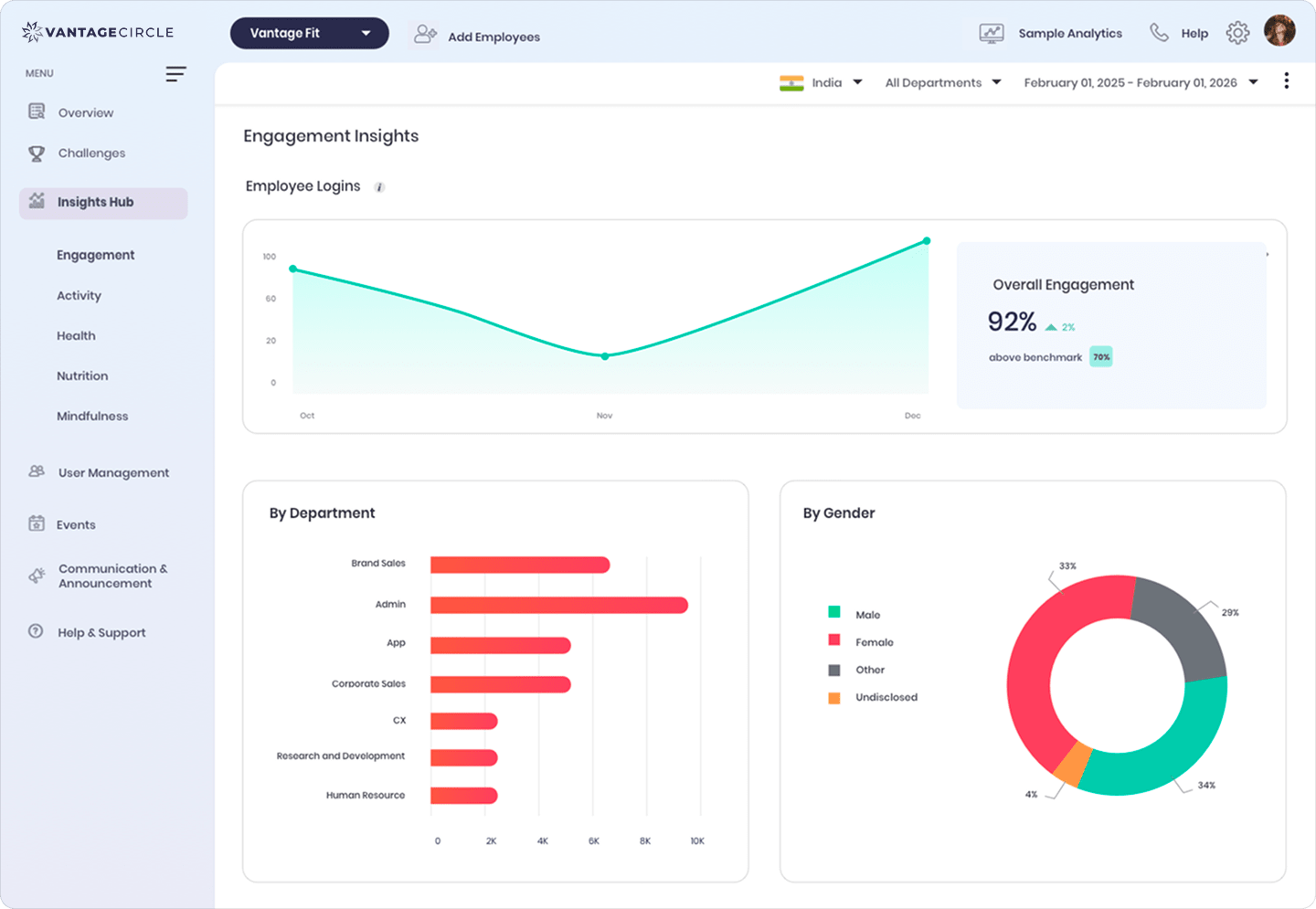
Vantage Fit pulls challenges, activity tracking, and aggregate reporting into one place. A small HR team can run an engaging program and still show leadership how participation and workforce health are trending, without handling individual health records by hand.
Do wellness programs actually work?
Yes, when they are designed for sustained participation. Programs that reach a broad share of employees and run consistently show measurable gains in absenteeism, engagement, and retention.
Programs that rely on a small, already-healthy group, or that launch with energy and then fade, tend to show little return. The idea is sound. Design is what decides the outcome.
In practice, "designed for participation" means a few concrete things. The program offers something for different fitness levels and life stages, so the majority can take part rather than just the enthusiasts.
It also runs on a steady rhythm of activities instead of a single annual push.
It is also measured from the start, so HR can show what is working and adjust what is not, and it keeps participation voluntary and employee data private. Programs that get these basics right are the ones that move the numbers.
Read more on: A complete guide to corporate wellness programs for HR leaders
The bottom line
The pros and cons of wellness programs are not evenly matched, and they are not opposites either. The pros, lower healthcare costs, fewer sick days, stronger retention, and lower stress, are real but conditional. The cons, cost, admin load, privacy risk, and low participation, are real but largely fixable.
A program that controls its budget, runs without overwhelming a small team, protects employee data, and is built so most of the workforce can take part will tend to land on the upside. One that launches without those foundations will spend money and struggle to prove it did any good.
The decision is rarely whether to run a wellness program. It is whether you are set up to run one well.
Frequently asked questions
Are wellness programs worth it?
For most organizations, yes, but only when the program reaches enough employees to move the numbers. Well-run programs are linked to lower healthcare costs and fewer sick days. Programs with low participation rarely return their cost, so design for reach before you measure ROI.
What is the biggest disadvantage of wellness programs?
Low participation. Median participation runs around 20 percent in programs without incentives, and a program that reaches only a small, already-healthy group will show little measurable impact. Cost, admin load, and privacy concerns are real too, but weak participation is what undermines most programs.
Do wellness programs actually reduce healthcare costs?
Often, but not always. A Health Affairs meta-analysis found medical costs fall about $3.27 for every dollar spent on wellness programs, and the US Chamber of Commerce reports that about 60 percent of companies see reduced costs. The Illinois Workplace Wellness Study, however, found no significant short-term effect, so results depend heavily on design and participation.
How do you measure the ROI of a wellness program?
Track three things over time: participation rate, health and absenteeism trends, and cost impact. Use a before-and-after view rather than a one-off survey, and report at the aggregate level. Set the expectation early that engagement metrics appear within weeks while cost and health outcomes take months.
Are workplace wellness programs a privacy risk?
They can be, because they often collect sensitive health data. The risk is manageable: keep participation voluntary, collect only what you need, store data securely, and report only aggregate workforce trends to leadership. HR does not need individual health records to demonstrate that a program is working.
Share