Weight Loss Challenge for Employees
A structured 30-day program that builds three sustainable habits simultaneously — food logging, activity tracking, and weekly weigh-ins — so your team finishes with real data and lasting routines, not just a leaderboard result.
What Is the Weight Loss Challenge?
Weight challenges work when they don't feel like punishment. This one is built around three simple daily habits: log what your employees eat, track their activity, and record their weight weekly. Stack them one at a time so the routine feels manageable before it becomes automatic.
The leaderboard ranks by consistency, not by how much anyone loses. Employees who show up every day finish at the top — making it one of the few wellness challenges where every participant, regardless of starting point, competes on exactly equal terms.
The end goal is a structured 30-day window in which your team builds energy-balance habits that outlast the program itself. Fully remote-friendly — all three core tasks are completed on each employee's own device at their own pace. No gym, no shared space, no coordination overhead. Perfect for in-office, hybrid, and remote teams.
Challenge Snapshot
Everything at a glance
Benefits of the Weight Loss Challenge
Sustainable weight management comes from understanding both sides of the energy balance: what goes in and what gets burned. This challenge builds both habits simultaneously. Employees who log food consistently develop macro awareness — not just calorie awareness — and start making more informed daily choices without being told what to eat.
The WHO recommends gradual weight loss through a combination of reduced calorie intake and increased physical activity. This challenge follows exactly that structure: one habit layer at a time, over four weeks.
- Builds macro awareness through daily food logging — employees understand their energy balance without being told what to eat
- Weekly weigh-ins create an accountability loop that is built into the habit, not enforced externally
- Combines movement and nutrition tracking for a complete picture of daily lifestyle habits
- Leaderboard ranks by consistency — rewards effort regardless of physiology or starting point
- Builds habits that carry beyond the 30-day window — a measurable before-and-after of daily routines
- Overweight and obesity are top drivers of sick days, reduced productivity, and rising healthcare claims — structured programs link to $250 in annual savings per employee
- Leaderboard ranks by task completion, not weight lost — widens participation and removes sensitivity around the topic
- Fully remote-friendly — all three core tasks are completed on each employee's own device with no shared equipment
- Individual health data (weight, food entries, calorie totals) is never visible to HR — only aggregate task-completion rates
- Generates a 30-day data set for leadership: participation rates, logging consistency, and week-over-week trends
- Accessible to in-office, hybrid, and remote teams — no gym, no coordination overhead, no equipment required
IBS Software achieved 88% employee engagement in a 28-day multi-activity wellness challenge on Vantage Fit — 17% above the 70% industry benchmark.
See it in actionHow the Weight Loss Challenge Works
Set up the challenge
As an HR leader or wellness coordinator, you configure the challenge duration (30 days is standard), the weekly task structure, and the point values for each daily task — food logging, activity logging, and weekly weigh-ins. Scope it to specific departments or your entire workforce; enrollment can be open or invitation-based.
Employees log their starting baseline
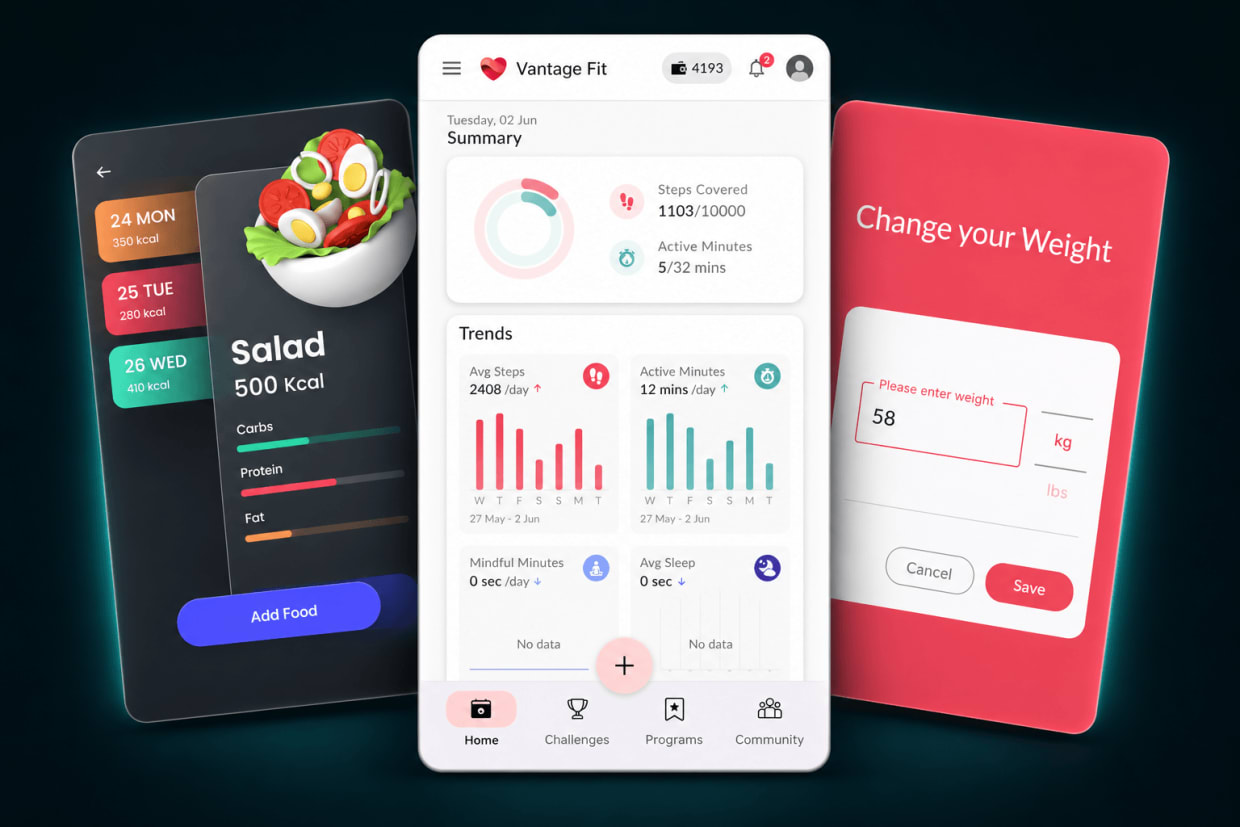
On Day 1, employees record their starting weight through the Health Vitals section of the Vantage Fit app and select a personal fitness goal. This baseline is private — visible only to the individual employee and never surfaced in admin views or shared with colleagues.
Daily food and activity logging
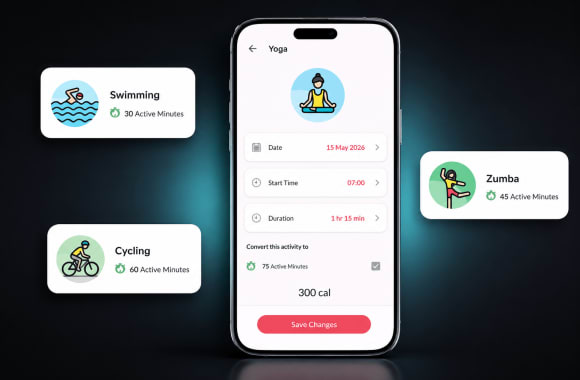
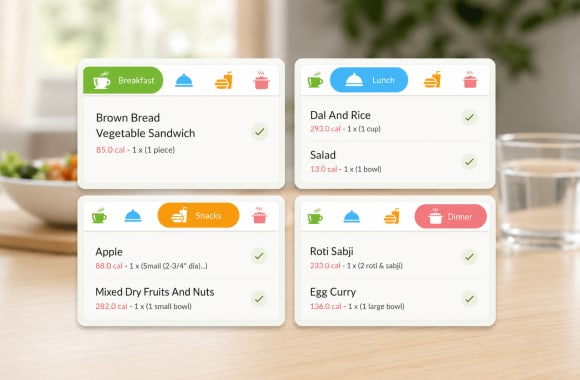
Each day, employees log their meals across breakfast, lunch, snacks, and dinner — capturing food items, serving sizes, and quantities. Alongside this, they record physical activity of any kind: walking, cycling, yoga, gym sessions, or anything else. Tracking both intake and expenditure gives each employee a clear picture of their daily energy balance.
Weekly weigh-ins build the picture
At the end of each week, employees record their current weight. This check-in shows progress against their starting baseline and gives them data to adjust habits for the week ahead. Points are earned for completing each task — food log, activity log, and weigh-in — rewarding effort and consistency rather than the amount of weight lost.
Monitor participation through the dashboard
Throughout the 30 days, you track participation rates, food logging completion, activity logging rates, and weekly weigh-in completion through the admin dashboard. Individual weight data, food entries, and calorie totals are never visible to you — only aggregate task-completion data. Final leaderboard standings rank by points earned, not by weight or weight lost.
Ready to run this challenge for your team?
No gym required. Up and running in minutes — for remote, hybrid, and in-office teams.
Sample Weight Loss Challenge Plan
This is a suggested 4-week structure that introduces one habit layer per week — logging, activity, weigh-in — so the program stays manageable at every stage. As an HR leader or wellness coordinator, you configure the exact task list and point values to match your workforce's goals.
Week 1: Know Your Baseline (Days 1–7)
Daily task
"I logged my starting weight on Day 1 and recorded at least 2 meals today."
The first week focuses on establishing the logging habit at a deliberately low threshold — two meals per day rather than the full four. The goal is to start building the routine before adding volume. Employees who find two-meal logging easy will naturally log more; those who find it challenging will still participate without dropping out.
Milestone
Employees who log meals on 5 of 7 days in Week 1 earn their first Consistency recognition.
HR Action
Send a Day 1 welcome message covering the 4-week structure, how points work, and a quick walkthrough of the food logging feature in the app. A short screenshot guide reduces first-week friction.
Week 2: Build the Food Habit (Days 8–14)
Daily task
"I logged all four meals today and stayed within my personalized daily calorie target."
Week 2 increases food logging to all four meals across the day. Employees logging consistently start to see patterns in their calorie intake relative to their personalized daily target. Macro awareness — protein, carbohydrates, fat — develops alongside calorie awareness. Encourage employees to notice patterns rather than judge them.
Milestone
Employees who logged meals every day across Weeks 1 and 2 receive Consistency Badge recognition.
HR Action
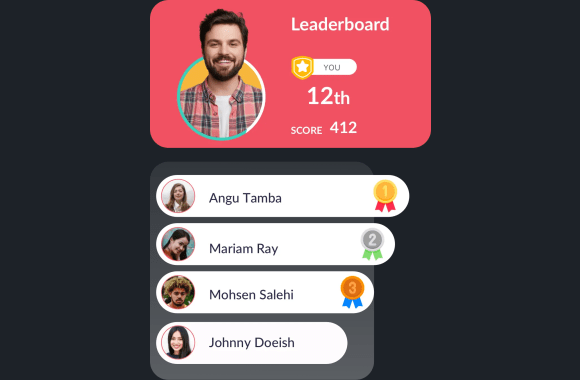
Share a leaderboard update ranked by points with a callout for the most consistent loggers. Recognize logging effort, not any weight-related metric.
Week 3: Add the Movement (Days 15–21)
Daily task
"I logged my food today and recorded at least one physical activity."
Combine consistent food logging with daily activity logging. Employees are now tracking both sides of the energy balance — this is the week the challenge shifts from a food habit into a full lifestyle habit. Any movement counts: walking, cycling, yoga, gym sessions, or anything else. Post a group participation update showing the percentage of enrolled employees who logged both food and activity on the same day. This nudges the group without singling anyone out.
Milestone
Employees who complete both a food log and an activity log on the same day for 5 or more days earn additional recognition.
HR Action
Post a group participation update showing the percentage of enrolled employees who logged both food and activity on the same day. This nudges the group without singling anyone out.
Week 4: Measure and Complete (Days 22–30)
Daily task
"I logged my food and activity today and completed my Week 4 weigh-in."
Hold all three habits through the final week and complete the Week 4 weigh-in. Employees who reach Day 30 with a consistent record finish with a meaningful before-and-after picture of their own habits — 30 days of food entries, activity logs, and four weight data points that show exactly how consistent effort translates to lifestyle change.
Milestone
Challenge Completion Badge for every employee who meets the completion criteria. Top 10 leaderboard positions receive the Leaderboard Rank Badge.
HR Action
Send a Day 30 wrap-up email with final leaderboard standings (by points, not weight), group participation statistics, and recognition for every employee who completed the challenge.
Rewards and Points
You configure the point value for each daily task during setup — food logging, activity logging, and weekly weigh-ins each carry their own point allocation. Because the leaderboard ranks by points rather than weight lost, the challenge rewards consistency and effort rather than outcomes that vary by individual physiology.
Challenge Completion Badge
Awarded to every employee who completes the full 30-day food logging, activity logging, and weigh-in challenge.
Leaderboard Rank Badge
Awarded to the top 10 participants on the final leaderboard — ranked by total points, not by weight lost.
Consistency Badge
Awarded to employees who maintain a sustained daily logging streak across all four weeks of the challenge.
Points earned through the challenge are added to the employee's Vantage Points balance. Employees can redeem these points for gift cards from Amazon, Starbucks, Nike, and hundreds of other options through the Vantage Fit rewards marketplace. Points carry over and combine with earnings from other active challenges.
Running the Weight Loss Challenge on Vantage Fit
The Weight Loss Challenge runs on Vantage Fit's food tracking, activity logging, and health vitals features — combined into a single 30-day custom challenge structure. All three tracking mechanisms are available from the same employee-facing app.
Food logging with macro breakdown
Employees log meals through the food tracking feature — searching a food database, selecting serving sizes, and recording quantities. The app automatically calculates calories and macros (protein, carbohydrates, fat) for each entry. Each employee's daily calorie target is personalized based on their weight loss goal and activity level.
Activity logging across 65 activity types
Physical activity is logged through the activity tracking feature, which supports 65 activity types — walking, running, cycling, yoga, gym sessions, and more. Employees log the activity type and duration; the app calculates calories burned based on the employee's profile. Any movement counts toward the daily task.
Weight tracking and weekly weigh-in trend
Weight is logged through the Health Vitals section in kg or lbs. The app stores each entry with a timestamp and displays a trend graph over the 30-day window — four weekly weigh-ins build a clear before-and-after picture. Individual weight data is private to the employee and never visible in the admin dashboard.
HR dashboard and participation insights
The admin dashboard shows participation rates, daily food and activity logging completion rates, and weekly weigh-in completion across the 30-day period. Individual weight readings, food entries, and calorie totals are never surfaced — only aggregate task-completion data. You see who is participating consistently without seeing any individual health data.
Automated reminders
The platform sends daily meal logging reminders, a weekly prompt to complete the weigh-in at the start of each new phase, and a mid-challenge progress update. A wrap-up email is automatically sent at the end of Day 30 with final leaderboard standings and links to completion certificates.
Frequently Asked Questions
Can remote employees participate in the Weight Loss Challenge?
Yes. All three core tasks — food logging, activity logging, and the weekly weigh-in — are completed individually on each employee's own device. No gym, no shared equipment, no commute to a facility. Remote, hybrid, and in-office employees participate on exactly the same terms.
How is weight tracked on Vantage Fit?
Employees log their weight manually through the Health Vitals section of the app, in kg or lbs, whichever they prefer. The app stores each entry with a timestamp and displays a weight trend over the 30-day period. Weight data is private to the individual employee and is never visible to HR or to colleagues.
How long should a Weight Loss Challenge run?
30 days is the most effective format. Shorter programs don't give employees enough time to build consistent food logging and activity habits. The 4-week structure allocates Week 1 to baseline setting, Weeks 2–3 to habit formation, and Week 4 to measuring change. Extensions to 60 or 90 days are possible for organizations that want a longer program.
What if an employee misses a day of logging?
Missing one day doesn't disqualify anyone. Points accumulate over the full 30-day period, and the completion criteria are set by you when configuring the challenge. An employee who misses one day and maintains a strong record across the remaining days can still qualify for the completion badge.
How is the winner determined?
The leaderboard ranks employees by total points accumulated across 30 days, earned by completing the daily and weekly tasks — food log, activity log, and weekly weigh-in. The challenge does not rank by weight lost, weight, or BMI. Those metrics reflect individual physiology rather than effort and consistency.
Is individual weight and food data visible to HR or colleagues?
No. Weight readings, food entries, calorie totals, and macro data are visible only to the employee who logged them. HR admins see only aggregate participation metrics — the percentage of enrolled employees completing each task on a given day. No individual health data appears in the admin dashboard or is shared with colleagues.
Related Challenges
Launch the Weight Loss Challenge on Vantage Fit
Trusted by companies like IBS Software, Tata Motors, and Wipro to run structured wellness programs that drive real employee participation.