Introduction
The majority of roundups of corporate wellness apps combine platforms with completely different functions. Financial wellness tools, gym access networks, mental health apps, nutrition apps, and all-in-one wellness platforms each address a distinct issue for HR departments.
The corporate wellness app market is arranged in this guide by category, which is how HR buyers actually make decisions. Ten apps are covered in depth across 5 categories, and each one carries enough information to tell you whether it belongs on your review.
Vantage Fit publishes this guide. We have done our best to present competitors accurately and fairly. G2 and Capterra ratings reflect Q1 2026 data. Pricing reflects publicly available information. Confirm directly with vendors before budgeting.
How We Compared These Apps
Key Takeaways
- Employee wellness apps split into five categories, and buying from the wrong one is the most common and most expensive mistake: a gym benefit and a wellness platform look alike in a demo and do entirely different jobs.
- Only the all-in-one category runs a company-wide program. Gym network benefits and mindfulness apps deliver content and access, with no challenges, leaderboards or HR analytics behind them.
- Take-up is the number that decides value. RAND’s employer survey puts median participation at 20% with no incentive and 40% once a reward is attached.
- Published prices are not comparable across this list. Five of the ten quote only on enquiry, and the rest mix monthly seat fees with per-challenge packages, so the same headcount produces very different bills.
- Most employers already run something. The question is which tool fits the program, rather than whether to have one.
Ten platforms were assessed against the same five criteria, chosen because they are what HR teams get asked about internally: engagement mechanics, admin analytics, integrations, pricing transparency, and how far the program can be shaped to a specific workforce.
Take-up was weighted above feature count. A platform with a long feature list and no participation is a line item, not a program. The RAND Employer Survey found median participation of 20% where no incentive was attached, 40% where a reward was, and 73% where a surcharge applied. The mechanic matters more than the catalogue.
Scope was set deliberately. Gym network benefits appear in their own category rather than alongside wellness platforms, because they provide access rather than a program. Consumer fitness trackers are excluded, since an employer cannot administer them. Ratings come from public review platforms and vendor documentation as of September 2026, and pricing from each vendor’s published figures, which is why several rows read “contact for pricing” rather than carrying an invented number.
Two things worth stating plainly. Vantage Fit is our own product, and it appears here because it competes in Category 1, not because the list was built around it. Read its section with that in mind. And no vendor interface screenshots are published here, because those screens belong to the vendors rather than to us.
This is not a market-entry question for most readers. In the KFF 2025 Employer Health Benefits Survey, 83% of larger firms already offered a program in at least one of smoking cessation, weight management, or behavioral coaching, against 56% of firms with 10 to 199 workers. The decision in front of you is usually which tool, not whether.
The 5 Types of Corporate Wellness Apps
Before evaluating any individual app, match your need to the right category. Many HR teams overspend by buying tools from the wrong category for their actual goal.
The 10 Apps at a Glance
| Platform | Best For | Starting Price | Standout Feature |
|---|---|---|---|
| Vantage Fit | Challenge-led engagement on a fixed budget | From $250 per 4-week challenge at 25 employees | Priced per challenge package rather than per user |
| Wellable | Content breadth alongside challenges | $4.00/user/month | Large on-demand wellness content library |
| Wellbeing+ | Teams already inside Reward Gateway or Edenred | Enterprise, on enquiry | Recognition and wellbeing in one account |
| Woliba | Small and mid-sized teams wanting one tool | $2.00/user/month | Wellness, recognition and engagement surveys together |
| Personify Health | Enterprises needing clinical navigation | On enquiry | Health navigation with clinical data |
| WellRight | US programs needing activity variety, HRA and biometrics | On enquiry | Modular challenge design |
| WebMD Health Services | Employers wanting managed delivery | Enterprise only | Managed program services |
| IncentFit | Incentive and reimbursement administration | From $3.00 PEPM | Automated incentive management |
| Terryberry | Wellness sitting under a recognition program | On enquiry | Recognition-first platform |
| WellSteps | US employers wanting a guided, evidence-based rollout | $1.75 PEPM | Guided program playbook |
Which Category You Need
| Category | What It Does | Typical Cost | HR Use Case |
|---|---|---|---|
| 1. All-in-One Wellness Platforms | Challenges, rewards, tracking, leaderboards, admin analytics | $1.75–$6.00 per employee per month where published, or per challenge | Running an ongoing wellness program |
| 2. Mental Health and EAP Apps | Mindfulness content, therapy access, stress and burnout reduction | $2–$15/user/month | Supporting mental health as a standalone benefit |
| 3. Fitness Network Benefits | Access to gym and studio networks through a single employer benefit | $12–$50/user/month | Subsidizing gym and studio access for employees |
| 4. Financial Wellness Apps | Budgeting tools, financial planning, earned wage access | Custom or free-to-employer | Addressing financial stress as a workforce health risk |
| 5. Nutrition and Weight Management | Behavior-based nutrition coaching, metabolic health, GLP-1 support | $5–$20/user/month | Targeting cardiometabolic risk in the workforce |
Category 1: All-in-One Corporate Wellness Platforms
When you need this: You want to run a structured wellness program with team challenges, point-based rewards, wearable integration, and participation analytics. These platforms are built ground-up for HR teams, not consumer apps with a business license bolted on.
Think of them as the operating system for your entire wellness initiative. For a head-to-head comparison of the top platforms by engagement model, analytics depth, and integration fit, see the best digital wellness platforms for HR teams.
Three things mark out a real platform in this category. It carries an admin side, so HR can build a challenge, watch it fill, and report on it without opening a spreadsheet. It scores activity against rules you set, which is what turns logged steps into a leaderboard, a league or a reward. And it holds the whole year, rather than a single campaign, so participation has somewhere to go once the launch excitement settles.
That last point is where most of the money is won or lost. Every platform here will fill a launch week. The ones worth paying for are the ones still being opened in month four, which is why the vendor sections below give as much weight to what sustains a program as to what starts one.
This is the category most HR buyers are searching for when they look for “corporate wellness apps.” These ten platforms share three defining traits: a dedicated HR admin dashboard, gamified engagement mechanics (challenges, leaderboards, points), and program-level analytics that HR can report to leadership.
Quick Comparison
| Platform | Pricing | G2 Rating | Best For | Key Differentiator |
|---|---|---|---|---|
| Vantage Fit | From $250 per challenge at 25 employees; $8/employee at 250 | 4.5/5 (567 reviews) | Mid-market to enterprise, global | Real gift card rewards + gamification at the lowest full-feature price |
| Wellable | From $4.00/user/mo | 4.7/5 (1,331 reviews) | Content-led wellness programs | Modular design + on-demand fitness content + highest G2 rating |
| Wellbeing+ (MoveSpring) | Custom | NA | Reward Gateway clients | Step challenge heritage inside an employee engagement suite |
| Woliba | From $2.00/user/mo | 4.6/5 (160+ reviews) | SMB needing wellness + recognition | Combines wellness with employee recognition + surveys |
| Personify Health | On enquiry | 4.3/5 (113 reviews) | Large enterprise, benefits admin | Wellness + health plan admin + care navigation in one stack |
| WellRight | Custom | Limited G2 data | US self-insured employers | 400+ wellness activities + NCQA-certified HRA |
| WebMD Health Services | Custom enterprise | 4.2/5 (215+ reviews) | Large enterprise, managed programs | Full-service wellness + Limeade technology + biometric screening |
| IncentFit | From $3.00 PEPM | Limited G2 data | Comprehensive with reimbursement | Wellness challenges + reimbursement + HRA in one platform |
| Terryberry | Custom enterprise | 4.6/5 (239 reviews) | Recognition + wellness bundle | Only platform unifying recognition, wellness, and surveys |
| WellSteps | From $1.75 pupm | Limited G2 data | Guided US wellness programs | Consultative approach: program design + technology bundled |

Vantage Fit
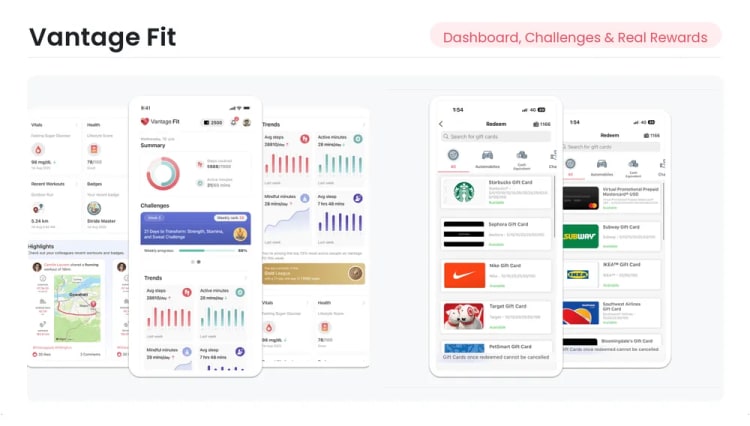
Vantage Fit is a corporate wellness platform built around the biggest problem in workplace wellness: keeping employees interested and engaged. The platform doesn’t rely on short-term campaigns; instead, it focuses on getting people to keep participating and changing their habits in ways that can be measured.
It has gamified challenges for physical, mental, nutritional, and heart health that can be accessed through an app on iOS and Android. Employees get Vantage Points for taking part, which they can use to get rewards from companies like Amazon, Starbucks, and Nike. This creates a clear incentive loop that keeps people interested.
HR can use a single admin dashboard to start challenges from pre-made templates, monitor real-time participation by department, and send engagement reports to leadership for review.
The platform automatically syncs with Apple Watch, Fitbit, and Garmin, which gets rid of the need to log in manually, which is a big reason why people drop out early. Wellness Leagues (Bronze, Silver, Gold) set up an incentive system that is always on between active challenge periods.
Part of the Vantage Circle suite: Vantage Fit is one product within Vantage Circle’s employee engagement platform, which also includes Vantage Recognition (recognition), Vantage Pulse (employee surveys), and Vantage Perks (discounts and benefits). Organisations that start with Vantage Fit can expand to the full suite without changing vendors, giving HR a single platform for wellness, recognition, feedback, and perks.
Consider if: You need a platform that employees will actually use (not just install), with real rewards, gamification, and a native mobile experience that works across 190+ countries. Pricing is charged as a challenge package rather than a monthly seat fee, worked out from a per-employee weekly rate that falls as headcount rises, from $2.50 a week at 25 employees to $1.00 at 1,000.
Recommended for: Small to medium-sized companies (up to 2,000 employees) globally that want a wellness platform employees will actually use: mobile-first design, gamified challenges, real rewards, and straightforward HR admin.
G2
4.5/5 (567 reviews)
Squat counting by camera in the mobile app
Gamified challenges (physical, mental, nutritional)
Vantage Points and real-world rewards
Native iOS and Android apps
Syncs with Apple Watch, Fitbit, and Garmin
Single Challenge (4 weeks)
Basic from $250 at 25 employees, rising to $4,000 at 1,000
Unlimited (annual)
Basic from $500 at 25 employees, rising to $8,000 at 1,000
Pro tier
25% above Basic at any headcount
Above 1,000 employees
Custom pricing

Wellable
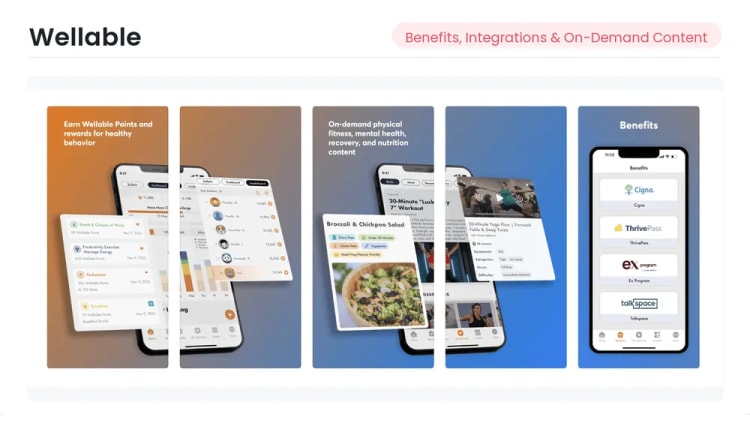
Wellable is a content-driven wellness platform that enables HR teams to build holistic programs across physical, mental, and financial wellbeing. The platform includes an extensive on-demand fitness video library alongside challenge mechanics, making it a strong fit for organizations that want to combine activity challenges with health education content.
A key differentiator is its dedicated Customer Success support, assigned from day one to guide program administration, engagement strategy, and rewards distribution. It also offers personalized wellness assessments that align employee goals with organizational health priorities, along with benefits navigation to simplify access to care.
Unique to this platform is an in-built expense tracker to take care of financial health.
Consider if: Your wellness program goal emphasizes content consumption and health education alongside activity tracking, and you have budget for the implementation support Wellable provides.
Recommended for: Organizations wanting a fully modular, customizable wellness program with strong content libraries and hands-on customer success support.
G2
4.7/5 (1,331 reviews)
On-demand fitness video library
Modular challenge design
Personalized wellness assessments
Dedicated Customer Success support
In-built expense tracker for financial health
Essentials
$4.00/user/month
Pro
$6.00/user/month

Wellbeing+ (formerly MoveSpring)
MoveSpring was acquired by Reward Gateway and rebranded as Wellbeing+. The platform has a strong step challenge heritage with 750+ company clients, but it is increasingly bundled within the broader Reward Gateway employee experience platform rather than sold as a standalone wellness tool.
HR teams already using Reward Gateway for recognition or perks may find the integration valuable.
Consider if: You are already a Reward Gateway client and want wellness challenges embedded in your existing employee engagement platform.
Recommended for: Organizations already in the Reward Gateway or Edenred ecosystem looking for wellness integrated with their existing employee engagement suite.
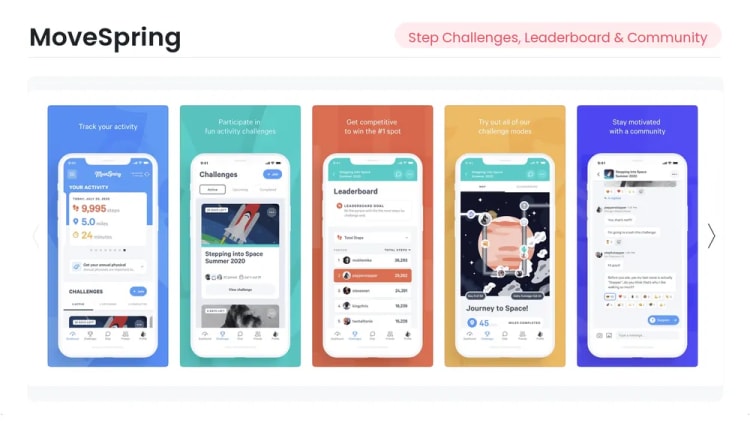
Strong step challenge heritage
Integration with Reward Gateway ecosystem
Mobile-first experience
Team-based engagement
Custom
Enterprise pricing via Reward Gateway

Woliba
Woliba offers a unified platform combining wellness challenges, peer recognition, and engagement surveys with a strong focus on workplace culture. Its AI-driven analytics enable deep personalization while helping organizations measure health risks, participation trends, and program ROI.
The platform also includes comprehensive health risk assessments and biometric management tools that support proactive health initiatives and cost control. Features like live coaching, interactive events, and targeted communications further strengthen engagement while reinforcing a culture of well-being.
Consider if: You are an HR team of one or two managing wellness alongside recognition and want a single vendor relationship for both.
Recommended for: Small to mid-sized companies (20–5,000 employees) that want wellness challenges, employee recognition, and engagement surveys in a single platform.
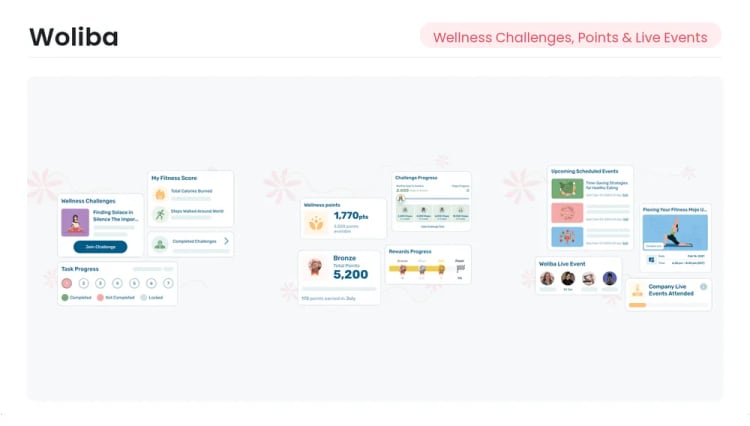
G2
4.6/5 (160+ reviews)
Unified wellness, recognition, and surveys
Health risk assessments (HRA)
Biometric management tools
Live coaching and interactive events
AI-driven culture analytics
Starts at
$2.00/user/month

Personify Health (formerly Virgin Pulse)
Personify Health combines benefits administration, care navigation, and holistic wellbeing in a single platform. Formed from the 2023 merger of Virgin Pulse and Personify Health, it brings together a strong wellness platform heritage with health plan administration and integrated care services.
Employees can access personalized health journeys, coaching, on-demand content, and rewards through a unified dashboard. Its AI-driven personalization adapts programs in real time based on individual data, supporting areas such as stress management, sleep, grief support, addiction recovery, and chronic condition care.
Given its breadth and complexity, the platform is best suited for large HR and benefits teams with dedicated implementation resources.
Consider if: You are at a large enterprise with existing Virgin Pulse infrastructure, need deep HRIS integration, and have a benefits team large enough to manage a complex implementation.
Recommended for: Large enterprises (5,000+ employees) needing benefits administration, care navigation, and wellness in a single integrated health platform.
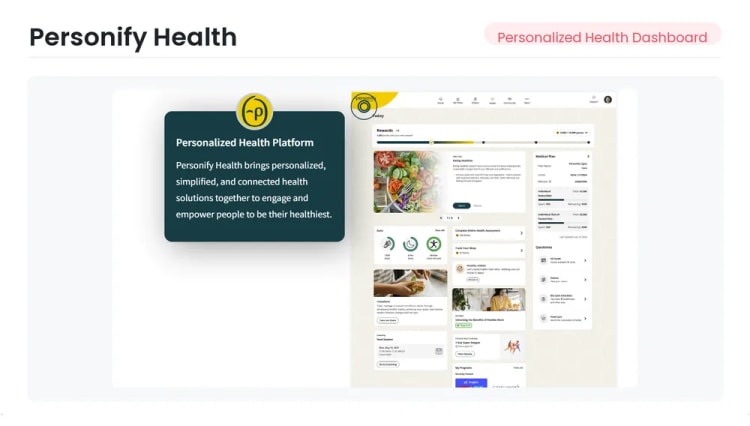
G2
4.3/5 (113 reviews)
Integrated health plan administration
Personalized health journeys
Chronic condition care
AI-driven personalization
Democratized coaching
Custom
On enquiry. No public figure on the vendor site, G2 or Capterra

WellRight
WellRight offers 400+ unique wellness activities, NCQA-certified health risk assessments, and built-in biometric screening tools. It is a US-focused platform with a strong track record in the employer market, particularly with self-insured employers who want to connect wellness program participation with health plan cost management.
Consider if: You are a US self-insured employer connecting wellness participation to health plan cost management and need robust HRA and biometric tools natively in the platform.
Recommended for: Mid-market to enterprise US-based organizations wanting a high-activity-variety wellness program with strong HRA and biometric tools.
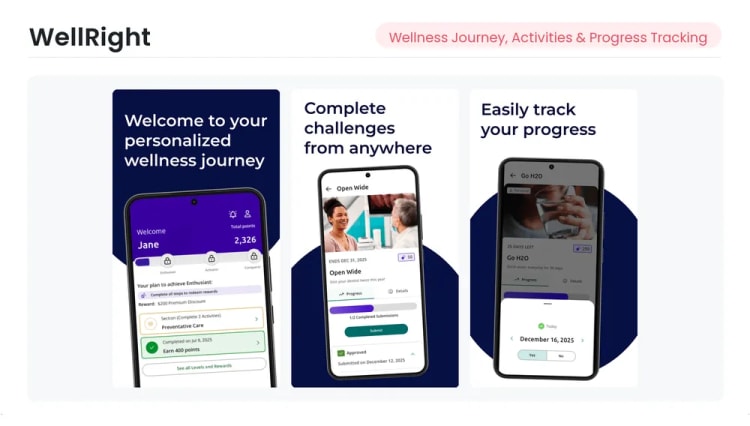
400+ unique wellness activities
NCQA-certified HRA
Built-in biometric screening
Health plan cost management integration
Custom
Contact for pricing

WebMD Health Services
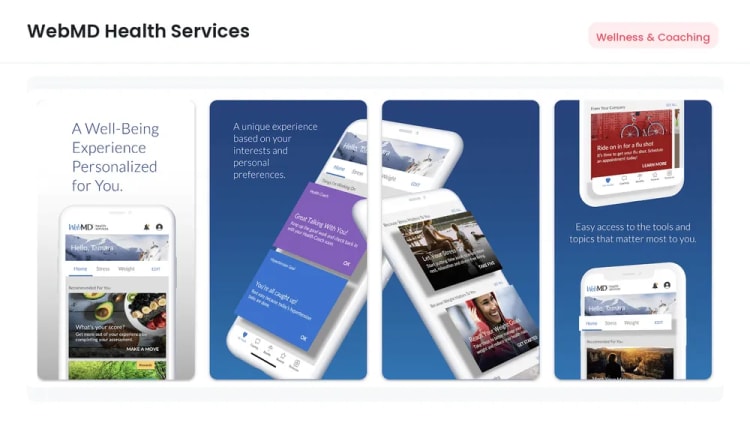
WebMD Health Services combines digital wellness technology with managed program services. In 2023, it acquired Limeade, strengthening its platform with additional employee engagement and wellbeing capabilities alongside existing offerings such as health assessments, biometric screenings, wellness challenges, coaching, and incentive management.
Unlike many vendors that provide only the technology, WebMD Health Services also delivers program management and strategic support. This makes it a strong choice for large employers and health plans seeking a single partner to run both the wellness platform and the program itself.
Consider if: You are a large enterprise that needs both the technology platform and the managed services to run a wellness program. Not the right fit if you want a lightweight self-service app.
Recommended for: Large enterprises (1,000+ employees) that need a fully managed wellness program with health assessments, biometric screening, coaching, and clinical data integration.
G2
4.2/5 (215+ reviews)
Managed program services
Limeade technology integration
Clinical data integration
Biometric screenings
Strategic program support
Custom
Enterprise pricing only

IncentFit
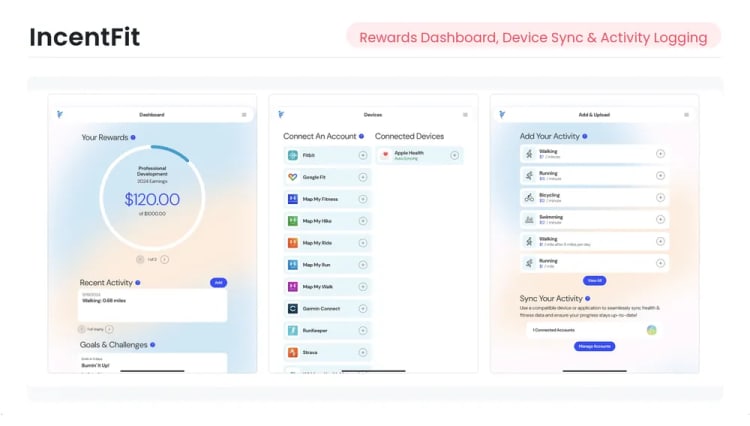
IncentFit takes a fundamentally different approach to corporate wellness. Rather than building gamification and challenges around a platform, IncentFit reimburses employees for fitness-related spending: gym memberships, fitness classes, athletic equipment, and wellness services.
HR sets the reimbursement rules and budgets, employees submit claims with receipts, and IncentFit handles verification and payment. The platform also includes wellness challenges, health risk assessments, and activity tracking.
Consider if: Your employees have diverse fitness preferences across locations and demographics, and would be more motivated by choosing and being reimbursed for their own activities than by participating in structured platform challenges.
Recommended for: Organizations wanting a comprehensive wellness platform with strong reimbursement tools where employees choose their own fitness activities and get reimbursed, rather than participating in structured platform challenges.
Fitness-related expense reimbursement
Claim verification and payment handling
Wellness challenges and HRA
Activity tracking
Essentials
$3.00 PEPM
Engage
$4.50 PEPM
Empower
$6.00 PEPM
Account management
$300/month add-on

Terryberry
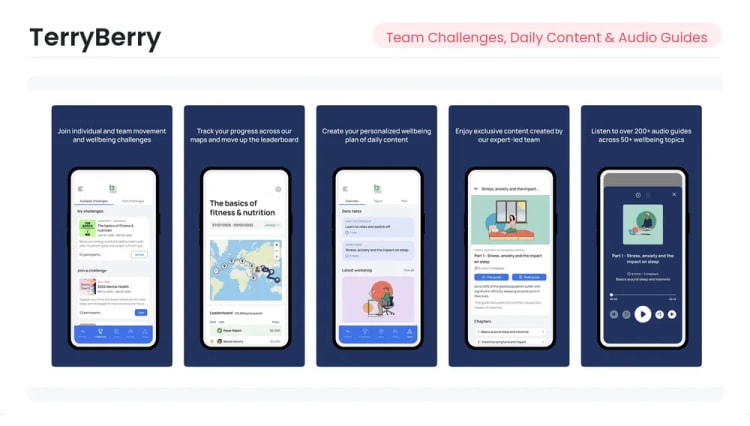
Terryberry combines employee wellness with recognition programs and engagement surveys in a single platform. The wellness module includes health risk assessments, wellness challenges, biometric screening integration, and an educational content library powered by integrations with LifeSpeak and Headspace.
Where Terryberry differs from pure-play wellness platforms is the tight connection between wellness participation and recognition rewards. Employees completing wellness activities can earn recognition points redeemable through Terryberry’s rewards catalog.
For HR teams that manage wellness alongside recognition programs, Terryberry eliminates the need for separate vendors and logins.
Consider if: You want wellness, recognition, and engagement surveys from a single vendor. Terryberry is the closest analog to the Vantage Circle ecosystem (Vantage Fit + Vantage Recognition + Vantage Pulse) in this category.
Recommended for: Mid-market organizations wanting employee recognition, wellness challenges, and engagement surveys from a single vendor instead of stitching together separate platforms.
G2
4.6/5 (239 reviews)
Unifies recognition, wellness, and surveys
LifeSpeak and Headspace integrations
Wellness points redeemable for rewards
Biometric screening integration
Wellness Core, Plus and Pro
On enquiry
Capterra listing
$3.75 per feature per month, not per employee

WellSteps
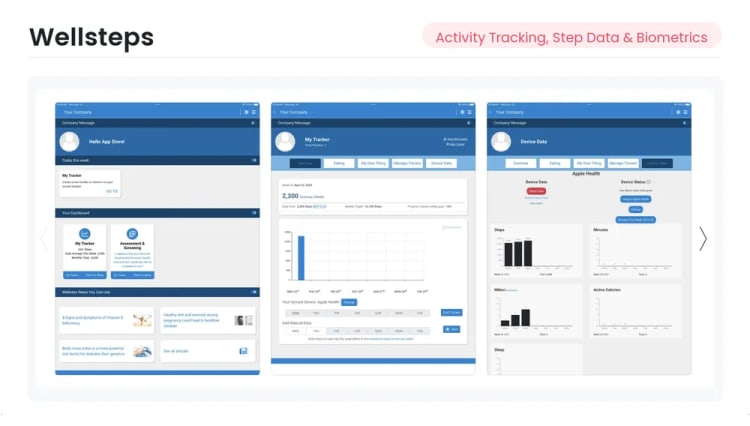
WellSteps operates across all 50 US states and provides both the technology platform and the program design expertise. The company emphasizes evidence-based wellness programming with health coaching, wellness challenges, incentive management, and biometric screening coordination.
Where WellSteps differs from self-service platforms is the guided approach. Rather than handing your HR team software and leaving implementation to them, WellSteps provides a structured program playbook, dedicated coaching resources, and ongoing program optimization.
This consultative model is particularly suited for organizations whose HR teams lack the bandwidth to design and manage a wellness program from scratch.
Consider if: Your HR team needs a partner that provides both the platform and the program, not just software. WellSteps is best when you want someone to guide the strategy, not just provide the tool.
Recommended for: US employers wanting a guided, evidence-based wellness program with coaching support, not just a self-service software platform.
Guided program playbook
Dedicated health coaching resources
Incentive management
Biometric screening coordination
Starts at
$1.75 PEPM
Category 2: Mental Health and EAP Apps
When you need this: You want to support employee mental health (stress reduction, mindfulness, therapy access, or burnout prevention), either as a supplement to your wellness program or as a standalone benefit. This category splits into two distinct purchase decisions: mindfulness apps (lower cost, broad usage) and digital EAP platforms (clinical-grade, higher cost, licensed therapists).
Before buying: decide whether you are supplementing your existing EAP or replacing it. Mindfulness apps (Calm, Headspace) are not EAP replacements. They provide content and self-guided tools. If an employee needs licensed therapy or crisis support, a mindfulness app is not the right tool.
Mindfulness and Stress Management Apps
These are consumer-first products sold to employers via bulk licensing. They do not have challenge engines, team leaderboards, points systems, or HR program analytics. They are content subscriptions for employees.
Calm for Business: Starting at approximately $30–$64/user/year (scales down with headcount). Calm is the most recognized consumer mindfulness brand, with content covering sleep, meditation, relaxation, and focus. The business tier adds basic usage analytics at the organization level.
Best suited as a supplemental mental health benefit where brand recognition helps employee uptake.
Headspace for Work: Pricing from approximately $45–56/employee/year (~$3.74–$4.67/month). Headspace offers structured learning paths in addition to an open content library. The platform also offers EAP-adjacent coaching and therapy access as add-ons, positioning it in the middle ground between content subscription and clinical platform.
Meditopia for Work: Growing corporate presence with content in 15+ languages. Best suited for global organizations that need multi-language mindfulness support and are deploying mental health benefits across non-English-speaking workforces.
Digital EAP and Mental Health Benefit Platforms
These are B2B-native, clinically graded platforms with licensed therapist access, outcomes measurement, and HR and benefits data integration. Higher cost, higher clinical rigor, more robust ROI measurement.
Lyra Health: Custom enterprise; outcomes-based pricing available. Lyra is known for being the first to offer outcomes-based pricing in mental health benefits. A published study found 26% health plan cost reduction for participants. Client list includes Morgan Stanley, Uber, and Amgen.
Spring Health: Custom enterprise; ROI performance guarantee available. Spring Health uses AI-powered care matching to route employees to the right level of care faster than traditional EAPs. The platform claims $1,070 in savings per participant in year one and has issued ROI performance guarantees to enterprise clients.
Modern Health: Custom enterprise; 50+ languages. Combines WHO-based mental health assessment with a tiered care model: digital self-care, coaching, and licensed therapy. Best suited for global enterprises needing multilingual mental health access at scale. Clients include Lyft, Dropbox, and Eventbrite.
Talkspace for Business: Custom enterprise. Talkspace offers text and video-based therapy access and integrates with major payers for in-network billing. Growing 33% year-over-year in its payer business as of Q1 2025.
ComPsych GuidanceResources: Custom enterprise; world’s largest employee assistance program provider by number of covered lives. ComPsych serves 78,000+ organizations and delivers EAP counseling, crisis intervention, work-life services, and digital wellness tools through its GuidanceResources platform.
Unlike newer digital-first entrants in this category, ComPsych has decades of clinical infrastructure and established relationships with major insurers and Fortune 500 employers. Best suited for organizations that want a full-service EAP with breadth of clinical coverage rather than a tech-forward digital therapy experience.
Category 3: Fitness Network Benefits
Key distinction: Gym access benefit platforms are not wellness programs. You cannot run a company-wide step challenge or track department participation on Wellhub or ClassPass Corporate. These are fitness subsidies administered like a benefits plan, typically deployed alongside, not instead of, a Category 1 wellness platform.
Wellhub (formerly Gympass): Employee plans from $11.99/month; employer subscription custom. Wellhub is the largest fitness benefit network with 60,000+ partner gyms, studios, and wellness apps across 12+ countries.
Employees choose from multiple access tiers covering local gyms, boutique studios, and partner apps. Wellhub claims 3–5x higher enrollment versus traditional gym discounts. Best for large enterprises wanting a single benefit that covers diverse fitness preferences globally.
ClassPass Corporate: Employer-subsidized; employee plans by credit tier; custom corporate pricing. ClassPass is the largest boutique fitness studio marketplace, primarily serving urban and suburban markets. It is a metro-area benefit: employees in smaller cities will find limited options.
Best for organizations with a significant employee concentration in major cities who want boutique studio access as a differentiating benefit.
Category 4: Financial Wellness Apps
Financial stress is the single largest driver of lost employee productivity. According to a 2025 survey of 2,000 US employees by New York Life Group Benefit Solutions, 48% of financially stressed employees report difficulty concentrating at work, and financial challenges ranked as the top well-being challenge for employers.
These apps address the root cause that no step challenge can solve.
BrightPlan: Custom enterprise. Integrates with employer benefits data and 401(k) information to give each employee a personalized financial plan, backed by AI tools and access to Certified Financial Planners. Best for organizations that want financial wellness to connect directly with their existing retirement and benefits programs.
LearnLux: Custom enterprise; operates in 70+ countries. Offers fiduciary-grade financial guidance through digital planning tools and licensed Certified Financial Planners. Fiduciary-grade means the advice is legally required to be in the employee’s best interest: a meaningful differentiator in this space.
SmartDollar (Dave Ramsey): Custom enterprise. Built on Dave Ramsey’s Baby Steps debt-reduction methodology, delivered as gamified digital lessons. For organizations that want a prescriptive, step-by-step financial wellness program rather than open-ended personalized planning.
Payactiv: Free to employer in many configurations (revenue from interchange fees). Gives employees access to earned-but-unpaid wages on demand, eliminating payday gaps that drive financial stress and emergency borrowing. One of the few financial wellness tools with no employer cost in some configurations.
SoFi at Work: Custom enterprise; free student loan verification tool available. SoFi brings one of the most recognized consumer financial brands into the employer benefits space.
The platform offers student loan repayment assistance, 529 college savings plan contributions, financial planning tools, educational resources, and employee access to SoFi’s consumer products including investing, banking, and lending at preferential rates.
Best suited for employers whose workforce skews younger or carries significant student loan debt.
Category 5: Nutrition and Weight Management Apps
Most Category 1 all-in-one platforms include nutrition tracking as a feature. Standalone nutrition corporate apps are the right choice when your workforce has a specific clinical need (metabolic health management, diabetes prevention, or GLP-1 medication support) that requires behavior science and clinical coaching beyond what a wellness challenge platform provides.
Noom for Work: Custom enterprise; individual consumer plans from approximately $17/month. Noom’s corporate product is built on nearly two decades of cognitive behavioral therapy (CBT) research applied to weight and nutrition behavior. The enterprise tier adds population health analytics and integration with GLP-1 medication programs through Noom Med.
For employers managing rising cardiometabolic risk or supporting employees on GLP-1 therapy, Noom for Work offers clinical depth that no all-in-one wellness platform matches.
Omada Health: Custom enterprise; health plan and employer partnerships. Omada is a virtual care platform focused on chronic condition prevention and management, covering prediabetes, diabetes, hypertension, and musculoskeletal health. The program combines connected health devices, personal health coaching, and behavioral science to drive sustained lifestyle changes that reduce claims costs.
Best suited for self-insured employers with high chronic condition prevalence.
WW (Weight Watchers) for Business: Custom enterprise; individual consumer plans available. WW brings its well-known weight management methodology into the workplace, including personalized nutrition plans, group workshops (virtual and in-person), digital tracking tools, and 1:1 coaching. The brand recognition alone drives higher enrollment than lesser-known clinical platforms.
Best suited for employers where weight management and metabolic health are primary workforce health concerns.
Virta Health: Custom enterprise; health plan partnerships available. Virta specializes in type 2 diabetes reversal and cardiometabolic health through a physician-led, continuous remote care model combined with nutritional ketosis. The program has published peer-reviewed clinical outcomes showing sustained HbA1c improvements and medication reduction at two years.
Best suited for self-insured employers or health plans with high diabetes prevalence seeking clinically validated outcomes that directly reduce pharmaceutical and claims costs.
Recommended Read: Corporate Nutrition Programs: 6 Benefits & Implementation Guide
How to Build Your Corporate Wellness App Stack
Most organizations do not need five apps. They need one platform and possibly one or two specialized tools layered on top.
Start with a Core Platform from Category 1
An all-in-one wellness platform is the foundation of any workforce wellness program. It gives HR a single place to run campaigns, track participation, and measure ROI.
Without a core platform, point solutions (a mental health app here, a financial wellness app there) lack the connective tissue to become a program employees engage with consistently.
When evaluating Category 1 platforms, the most important question is whether employees will actually use it. A platform that reaches 20% of your workforce generates one-fifth the health outcomes and one-fifth the ROI of a platform that reaches 80%. Native mobile apps, real rewards, and gamification are what drive that usage gap.
Layer in specialized apps based on your workforce’s top health risks
| If your top workforce risk is… | Add this category | Example vendor |
|---|---|---|
| Burnout, anxiety, or stress leave | Category 2: Digital EAP platform | Spring Health, Lyra Health |
| Low physical activity or sedentary workforce | Category 1 core platform is sufficient | Vantage Fit, Wellable |
| Employees in major metros wanting studio variety | Category 3: Fitness network benefit | Wellhub, ClassPass Corporate |
| Financial stress driving absenteeism | Category 4: Financial wellness | Payactiv, LearnLux |
| Rising cardiometabolic risk or GLP-1 programs | Category 5: Nutrition platform | Noom for Work |
Questions to Ask Before Buying Any Wellness App
Every demo looks good. These eight questions are the ones that separate a platform which will run your program from one that arrives with a login and leaves the rest to you.
Is this built for employers, or a consumer app with a company login? A platform built for employers gives HR an admin console, department-level reporting, and a way to launch and score a challenge. A consumer app hands every employee the same screen they would see at home, and leaves HR counting sign-ups in a spreadsheet.
What participation did comparable clients actually reach? Ask for the rate at a company your size, in your industry, three months in rather than at launch. A vendor with real numbers will name the client and the challenge. A vendor without them will offer an industry average.
Will it work on the phones and watches your people already carry? Automatic sync from Apple Health, Google Fit, Fitbit and Garmin removes the daily logging step, which is where most programs quietly lose people. Ask which syncs happen on their own and which still need someone to open the app and type.
How long does it take HR to launch a challenge? The answer you want is measured in minutes, from a template, with no ticket to IT. Ask to watch someone do it live in the demo rather than see a recorded flow.
What keeps people going once the novelty fades? Month one runs on curiosity. Ask what the platform offers in month three: rolling leaderboards, streaks, rewards that arrive without a manual approval, and a reason to open it on a day nobody is competing.
Does HIPAA apply to your setup? It applies when the program runs through your group health plan, where the vendor handles protected health information and a Business Associate Agreement becomes part of the contract. A step challenge offered as a workplace perk usually sits outside it. Settle this early, because the answer shapes the paperwork rather than the feature list.
Which certifications does the vendor hold, and will they send the reports? SOC 2 and ISO 27001 are the two worth asking for by name, with ISO 27701 where European privacy matters. GDPR and state privacy laws cover employee health data whether or not HIPAA does, so a vendor who treats certification as a sales badge rather than a document is telling you something useful.
What can an administrator actually see? The line to hold is group trends for HR and individual data for the employee alone. Ask for the admin screen itself during the demo, rather than a slide describing it.
A vendor worth shortlisting answers all eight in the first call.
Frequently Asked Questions
Q. What is the best corporate wellness app?
A: Top-rated platforms on G2 include Vantage Fit, Wellable, and Personify Health. The best option depends on workforce size and program goals. Vantage Fit stands out for value, with challenge-package pricing (from $250 for a 4-week challenge at 25 employees, and a per-employee rate that falls as headcount rises) covering challenges, rewards, leaderboards, wearable sync, and HR analytics.
Q. Are Calm and Headspace corporate wellness platforms?
A: No. Calm and Headspace are mindfulness apps offered to employers through bulk licensing. They provide mental health content but lack challenges, rewards, team leaderboards, and HR analytics. Many companies use them alongside full wellness platforms.
Q. What is the difference between a wellness platform and an EAP?
A: An EAP provides crisis support, counseling, and referrals to mental health professionals. A wellness platform focuses on engagement through challenges, activity tracking, and rewards. The two serve different purposes and are often used together.
Q. How much do corporate wellness apps cost?
A: Public per-user pricing runs up to $7.00+/user/month. Vantage Fit instead uses challenge-package pricing rather than a per-user fee, starting at $250 for a 4-week challenge at 25 employees, with the per-employee rate falling as headcount rises. Enterprise platforms like Personify Health use custom pricing. Mental wellness apps like Calm generally cost $30–$64 per user per year.
Q. Do corporate wellness apps integrate with Apple Health and Fitbit?
A: Yes. Most platforms integrate with Apple Health, Google Fit, Fitbit, and Garmin. Integrations reduce manual logging and make it easier for employees to stay engaged with wellness programs.