The benefits of a walkathon land in three places at once.
Walkers get better heart health, a lift in mood, and leg strength without the joint impact of running. Teams get a shared goal that crosses departments. And because a walking event needs almost no equipment or venue, organizers get all of it at close to no cost.
The benefit that makes the rest possible, though, is participation, and that is where most wellness initiatives fail.
Walking asks for no skill, no kit and no gym, so uptake tends to beat anything gym-based: when POSOCO ran a two-week walkathon on Vantage Fit, the challenge saw around 97% participation.
MindPoint Group recorded the same 97% on a two-week walkathon of its own, so it is not a one-off.
Let’s dive in and look at each of those benefits properly, along with what it takes to run a walkathon of your own.
KEY TAKEAWAYS
- A walkathon is a walking event run over a fixed period, where employees log steps toward an individual or team goal.
- Participation is the standout benefit: POSOCO saw around 97% participation, 11 million+ steps, and 161 km covered per participant in two weeks.
- Walking is one of the most inclusive activities you can pick: low-impact, self-paced, and open to every fitness level, which is why uptake beats gym-based challenges.
- The seven benefits below span health, community, cost, gamification, habit-building, engagement, and awareness.
- To run one, you need five things: a tracking platform, a clear goal, promotion, rewards, and a follow-up challenge to hold the momentum.
What is a walkathon, and how does it work?

A walkathon runs over a fixed window. Participants walk in their own time and place, their steps are logged to a shared platform, and a leaderboard shows how everyone is tracking against the goal.
Nobody has to be in the same location at the same time, which is the whole reason it scales.
Walkathon or walk-a-thon? Both spellings are correct and mean the same thing. You will also see “walk-a-thon” and “walk a thon” used interchangeably, in the same way marathon gave us the “-athon” ending.
How long does one last? Anywhere from a week to three months. Cotiviti ran a week-long walkathon for 540 employees, while Complii Fintech stretched theirs across three months.
Most of the walkathons in this post ran for two to four weeks: long enough for a routine to form, short enough that people can see the finish.
Individually or in teams? Either. Individual leaderboards suit smaller groups. Teams tend to work better at scale, because a strong week from one colleague carries the people having a harder time.
Companies run them for different reasons: to back a cause, such as raising awareness of heart disease, to encourage better health among employees, or simply to make a daily walk feel like a game worth playing.
Whichever the motivation, the mechanics are the same, and the payoff shows up in two places. Employees walk more regularly, and the organization sees the engagement and productivity that follows.
Here is how that breaks down.
7 Ways A Walkathon Benefits Your Organization
Benefit 1: Wide-Ranging Health Benefits

It’s an easy physical activity that provides a wide range of health benefits. The benefits of walking are not only physical but mental too.
- Reduced the risk of heart disease, i.e., cardiovascular diseases.
- Helps to lose weight.
- Walking strengthens your joints.
- Improves sleep patterns.
- Boosts mood by lowering stress levels.
None of this is folklore. The US Physical Activity Guidelines for Americans tell adults to get at least 150 to 300 minutes of moderate-intensity aerobic activity a week, and name brisk walking as the example. At the lower end, that is 30 minutes on five days.
Meeting the guideline is linked to lower risk of heart disease, stroke, high blood pressure, type 2 diabetes and depression.
Harvard Health reports that people walking around 8,000 steps a day tend to live longer than those walking 4,000, and that walking speed makes little difference to that effect.
That last point matters more than it looks. Because pace makes little difference, nobody has to push hard to benefit, so a walkathon stays low-impact: it builds leg and hip strength without loading the knees and ankles the way running or a gym challenge does.
Employees returning from injury, older employees, and complete beginners can all take part at their own pace without being outclassed.
30 minutes of brisk walking is helpful for people struggling to lose weight, blood pressure problems, joint pains, and mental health issues like anxiety, depression, etc.
Benefit 2: Sense Of Community
Walk-a-thons, though are about achieving individual goals, is a team activity of sorts. In a team, healthy competition is vital for team members to build respect for each other.
It enables everyone to see each other as peers by providing an equal playing field.
The anticipation and rewards can act as strong motivators for employees to bond together.
Part of it is influenced by the feeling of working towards a common goal. Ultimately, this will improve their teamwork by making them better team players.
Team framing is what turns a solo habit into a social one. Landmark Group ran a 30-day virtual walkathon across six in-house teams and got more than 5,000 employees participating. At that scale, the inter-team rivalry does the motivating for you.
If you go the team route, spend a few minutes on step challenge team names before launch; a group that has named itself shows up differently.
Benefit 3: Easy To Organize
Walk-a-thons are extremely easy to host and organize. Being a group-oriented activity, it is the perfect health event that businesses can hold.
Additionally, minimal resources required make it a relatively cheap event to host.
A corporate wellness app takes care of the tracking, the one part that needs a tool.
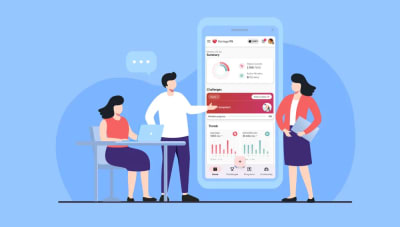
In Vantage Fit, HR admins launch a walkathon from the dashboard, either as a Race Challenge with a straight step leaderboard or as a Journey Challenge that moves teams across landmarks on a map. The only manual thing for you to do is decide when to run it.
POSOCO is a good illustration of what “easy to organize” buys you. Their two-week challenge, “Walking Miles, Losing Inches”, pulled in 72+ participants at around 97% participation.
Between them, they covered more than 11 million steps and burned 520,260+ Kcal, an average of 161 km per person. Everyone walked their own routes on their own schedule, so the whole event ran from the app.
If you want to compare it against other formats before committing, our guide to running a wellness challenge breaks down the options.
Benefit 4: Gamification
One reason people tend to avoid physical activity is that there is no instant gratification in it.
To lose weight or to see health benefits takes time. And by the time that it shows, people have already lost interest.
Gamification is the process of turning an everyday activity, such as exercising regularly, into a game of sorts. For “every level” cleared, there is some reward. It satisfies the need for instant appreciation that makes people stick to the very end.
Walkathons can be made very engaging through the use of gamification. For example, completing a set number of steps awards specific points or seeing one’s name on the company leaderboard.
Points and leaderboards are some of the features that Vantage Fit happens to offer to truly gamify the fitness process for the walkathon participants (your employees).
Vantage Fit also lets users share their badges or workout duration to the in-app social feed, much like other social media platforms.
Benefit 5: Form Habits
You will often hear that it takes 21 days to build a habit. That figure traces back to a 1960 self-help book about how long plastic-surgery patients took to adjust to their new look. Research since then points to considerably longer, and to wide variation between people.
What matters more for a walkathon is the direction of travel while it runs. In SRS Medical’s month-long Step It Up! challenge, average step count per employee rose 19.37% in the final two weeks.
People were walking more at the end than at the start. That is the pattern you want, because it shows the routine taking hold.
Once your employees see the benefits of walking by themselves, they will be further motivated to make a lifestyle change. With time, your employees will notice the improving physical health and mental clarity that regular exercising brings.
Benefit 6: Better Engagement

Walking is a physical activity that not only improves physical health but decreases stress as well.
A session of 30 minutes of walking every day can boost mood and disperse stress.
A happy mindset that regular exercise brings contributes to an employee feeling more energized and engaged. Not only will productivity rise but also control the feeling of burnout. All in all, hosting a walkathon benefits your employees’ holistic wellness.
DLA Plus saw 87% employee engagement in a three-week winter step challenge. Numbers like that hold better still when the walkathon is part of a series.
Pairing it with a rolling step challenge or tying completion to rewards for fitness gives people a reason to keep the habit past the finish line.
Benefit 7: Raise Awareness

To truly promote employee wellness, you must be able to advocate it properly. Hosting walk-a-thons are a perfect starting point to kickstart your corporate wellness program.
Walk-a-thons are more accessible for everyone to participate in and because people see walking as an achievable feat.
Your employees are more likely to start their health journey with an easy task than a gym challenge. It is the perfect medium to make employees more aware of their health and encourage them to upkeep it.
Awareness also works outward.
Because walkathons started as charity events, the fundraising mechanics are easy to bolt on: pick a cause, let participants collect pledges per kilometer or per 10,000 steps (the step challenge for charity guide covers the pledge structure), and publish the running total alongside the step leaderboard.
You get the wellness outcome and a visible community contribution from the same event, at close to no extra cost.
How to organize a walkathon
Knowing the benefits is the easy part. Actually running one comes down to five decisions.
1. Pick the tracking platform first
Everything else depends on this. At minimum the platform has to read real-time activity and reliably confirm whether someone logged their steps, plus pace and distance. Without trustworthy tracking you have no leaderboard, and without a leaderboard you have a mailing list, not a challenge.
It is worth choosing something broader than a pure step tracker. A platform that also logs yoga, meditation, water and meals lets you run the follow-up challenge on the same tool instead of onboarding everyone twice.
2. Set one concrete goal
A walkathon with no number attached goes stale in about a week. Make the target specific and finite: 6,000 steps a day for five working days, or 3 km a day for a fortnight.
Landmark Group escalated theirs week by week: 4,000, then 6,000, then 8,000, then 10,000 steps, which keeps the goal moving without ever feeling out of reach.
Decide up front whether you are ranking individuals or teams. Teams are more forgiving for the least active participants, since the group total absorbs a slow week.
3. Promote it before it starts, not on day one
Announce it with enough lead time for people to plan around it, and keep it visible while it runs. Internal channels do most of the work, but posting publicly has a second effect: it signals to candidates and peer companies that you fund this kind of thing.
4. Attach a real reward
Rewards are what move people who would not otherwise take part. Points redeemable against gift cards work well because they are tangible and don’t require a prize-giving ceremony.
Recognize more than the top step count. Most improved, most consistent, and best team all give people who will never win outright a reason to stay in.
5. Line up what comes next
The week after a walkathon ends is where the habit is won or lost. Have the next thing ready, whether that is a virtual run, a hydration challenge or a nutrition streak, so momentum transfers instead of evaporating. Variety is the point; the same challenge on repeat stops working.
If you need a number to anchor the goal, the 8,000-step mark from Benefit 1 is a sound one. Harvard Health adds that going up to 12,000 brings only a small further benefit, so a target in that range is defensible; anything higher is arbitrary.
Final Thoughts
Looking at all the fundraising pages, the thought of successfully hosting any wellness event, including a walkathon, may be intriguing. It can be just the perfect fundraiser event for your organization’s and employees’ well-being.
So, if you haven’t started planning a walkathon yet, then what’s stopping you? For a seamless experience, take the assistance of a corporate wellness application like Vantage Fit. In doing so, you can promote your event better and reap the benefits of a successful walkathon.
Frequently Asked Questions
How many minutes of walking is good for health?
Adults need at least 150 minutes of brisk walking a week, according to the Physical Activity Guidelines for Americans. Walks of any length count toward that total, so three short walks in a day add up.
Which is better - walking or going to the gym?
Walking suits more people, because it is low-impact, free and easy to start. A gym adds strength training, which the same guidelines recommend on two or more days a week. The two work best together.
What happens when you walk every day?
Walking every day strengthens the heart, lowers blood pressure, helps keep weight steady, and improves sleep and mood. Those gains build over months, so a daily habit matters more than any single long walk.
What is the difference between a walkathon and a step challenge?
A walkathon centres on one shared goal, such as a total distance or a charity cause, with set start and end dates. A step challenge is a competition on step counts, often repeated to build a habit. The same app can run both, so the goal decides which to run.