
What Are Corporate Wellness Programs?
Corporate wellness programs are employer-funded efforts that support employee health through fitness, mental health resources, health screenings, financial education, and work-life balance policies. Also called employee wellness programs or workplace wellness programs, they cut sick days, support retention, and build a healthier, more engaged workforce.
I learned what a workplace can do for your health before I ever built a wellness platform. Almost twenty years ago I was working at Friends Provident in Surrey. The office had an indoor sports hall and squash courts, and almost every other guy was a marathoner. When I admitted I could not swim, a colleague took me to the pool. Then he signed me up for the London Triathlon. I was 35, and that office turned me into an athlete. I have been one since.
That is the real job of a corporate wellness program. It builds an environment where healthy habits are caught, not taught. The business case sped up after the pandemic, when employers connected workforce health to retention, output, and insurance costs. But the mechanism has not changed since my Surrey days. Environment first. Numbers follow.
The benefits run both ways. Employees get more energy, lower stress, and help with money worries. Employers get retention, fewer sick days, and an easier recruiting story. The engagement effects show up within a quarter. The cost savings take longer, and I will be straight with you about that below.
Three numbers worth knowing before we go deeper:
- 4.1 fewer sick days: the CDC's employer guide notes that employees getting at least 75 minutes of vigorous activity a week miss an average of 4.1 fewer workdays a year (CDC Physical Activity Employer Guide). That is an association, not a program guarantee.
- Participation is the real fight: typical wellness-program participation runs 20 to 40%, and a 61-company German study found average participation even lower, at about 15%. Three of the four deployments in this guide reached 70 to 88% challenge engagement. The fourth tripled participation across three global challenges. Closing that gap is what this guide is about.
- The famous ROI numbers aged badly: Johnson & Johnson's widely quoted $250 million savings figure was the company's own estimate, relayed by Harvard Business Review in 2010. Newer randomized trials complicated it. The full ROI picture, with sources, is in the costs and ROI section below.
This guide covers 5 program types, 19 ideas you can act on, a 6-step launch framework, 4 real customer case studies with verified results, and an honest cost and ROI breakdown. For a balanced perspective, review the pros and cons of wellness programs alongside this framework.
5 Types of Corporate Wellness Programs
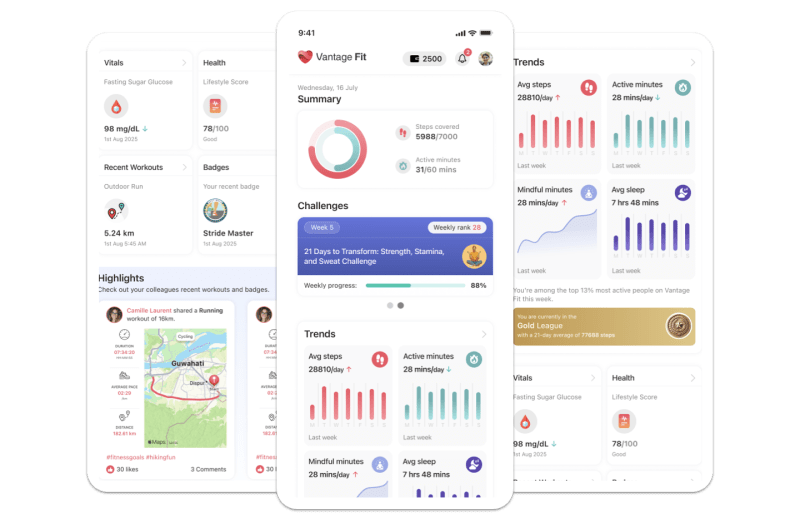
Good programs mix several types based on workforce groups, risk profiles, and business goals. The best platforms run on a cue-action-reward loop. Reminders prompt action, and rewards like points, badges, and gift cards reinforce the habit. That loop drives lasting change across all five types.
| Type | Focus Area | Example Activities | Key Metrics | Best For |
|---|---|---|---|---|
| Physical & Preventive | Movement, disease prevention | Step challenges, health screenings, smoking cessation | BMI trends, activity levels, avoidable claims | Sedentary workforces, desk-bound roles |
| Mental & Emotional | Stress, burnout, safety | Counseling, mindfulness, mood tracking | Absenteeism, burnout scores, EAP utilization | High-stress industries |
| Financial Wellness | Financial stress, retirement | Budgeting workshops, LSA benefits, debt counseling | Retention, financial stress surveys | Younger and mid-career employees |
| Work-Life Balance & Social | Flexibility, belonging | Flexible hours, team challenges, volunteering | Retention, team performance scores | Hybrid and remote teams |
| Data-Driven & High-Risk | Biomarker-based risk reduction | Targeted challenges by disease risk, condition-specific programs | Risk distribution shifts, claims trends | Mature programs, self-insured employers |
Physical & Preventive Health
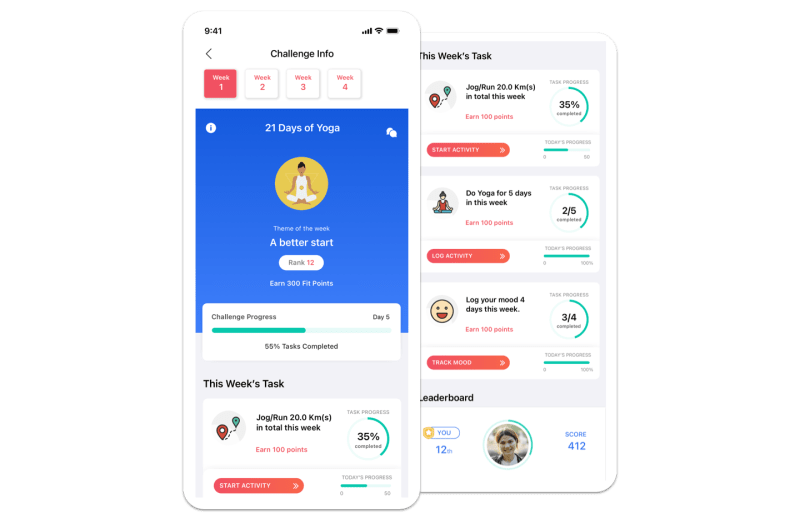
Step challenges, fitness tracking, health screenings, and preventive care. These are the easiest to launch and measure, and where most companies should start. Begin with a 30-day step challenge to build momentum, then add screenings, smoking cessation, and corporate fitness programs for deeper impact. The key is gradual ramp-up. Start desk-bound teams at 5,000 steps, not 10,000, because the on-ramp matters more than the target.
Mental & Emotional Wellbeing

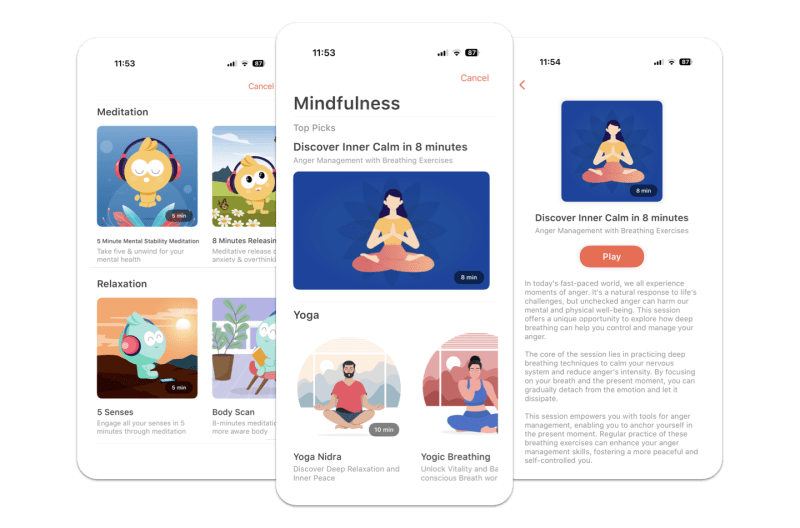
Counseling access, stress workshops, mindfulness programs, and daily mood tracking. A 2021 BMJ Open realist review found workplace mindfulness programs reduced perceived stress, anxiety, and burnout in most of the studies it examined, though results depended on a supportive work environment. Look for a wellness platform with a built-in meditation library so you do not need a separate third-party app.
Target high-stress teams first (IT, operations, leadership), then expand based on pulse survey data. Pair EAP access with confidential mood tracking so HR sees workforce trends without exposing individual data.
The most common mistake is offering a helpline nobody knows about. Promote it, and make clear that use is confidential. Then watch EAP use and pulse scores to see if it is working.
Generational note: Different age groups need different things. In our 2026 Global Workplace Well-being Industry Report, 74% of Gen Z and young millennial respondents put on-demand mental health support in their top two wellness priorities. Gen X employees prioritize financial and caregiving support. Baby Boomers lean toward chronic condition management and physical programs. A one-size-fits-all approach satisfies no single group completely.
Financial Wellness

Budgeting workshops, debt counseling, retirement planning, and Lifestyle Spending Accounts (LSAs). Financial stress quietly erodes focus. Employees distracted by money problems lose useful working time, and it is hidden from managers. LSAs are a growing benefit. In a 2023 Mercer survey, 13% of employers said they had an LSA or planned to add one, up from 9% a year earlier. They let employees choose how to spend wellness dollars across fitness, childcare, or home office gear. Younger employees gain most from debt help. Mid-career employees lean toward retirement planning.
Work-Life Balance & Social

Flexible hours, team challenges, volunteering, and community groups. These are the most powerful levers, and the least used. In hybrid and remote teams, they keep engagement from eroding.
But flexibility alone does not produce balance. The employees who protect their personal time put it on the calendar, the same way they put meetings there. Eleven marathons taught me that training does not happen in leftover time.
That is the shift wellness programs should enable. Not just permission to step away from work, but tools and norms that make personal time as visible as work time. Team challenges with leaderboards. Topic-based wellness communities. Clear, role-based flex policies. Vague promises do not work.
Habit coach Ashdin Doctor put it well on our podcast:
"Work-life balance is a lie. Sometimes you're working more, sometimes less. It's like cycling — sometimes more on the left, sometimes on the right, but overall you're going in one direction."
"Schedule not just work meetings but personal meetings and meetings with yourself — workout, meditation, reading time, education time. Put it on your Google Calendar."
— Ashdin Doctor, Habit Coach on Vantage Fit Corporate Wellness Podcast
Data-Driven & High-Risk Interventions
Targeted challenges based on private health marker data: fasting glucose, lipid panels, metabolic markers. This is where wellness shifts from programs to risk control. We built this into Vantage Fit, and I can tell you the design choices matter more than the AI. Lab reports are analyzed at group level only. HR never sees an individual's results. Participation is consent-based, and any platform doing this must be HIPAA-aligned and SOC 2 audited. The group trends then drive focused programs for high-risk segments: sugar-cut challenges where glucose runs high, movement programs where heart risk markers cluster.
We made one more deliberate choice. Our league tiers (Gold, Silver, Bronze) rank on 21-day rolling step averages, not single-day peaks. Spikes do not change health. Habits do. So the tiers reward the rolling average, and the focus stays on progress, not comparison.
19 Corporate Wellness Program Ideas That Work
Every idea here passes one test: could an HR leader act on it Monday morning?
Physical Wellness Ideas
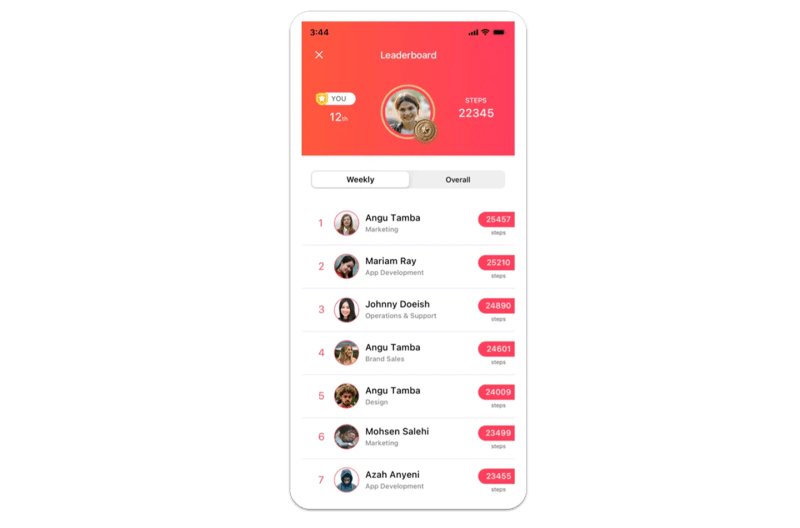
Virtual Marathon: Run a 5K/10K/21K event over a week with no fixed location. Employees rack up distance at their own pace, and global teams compete on the same leaderboard across time zones. Make sure the platform syncs with wearable devices employees already own (Apple Watch, Fitbit, Garmin) so tracking is hands-free.
Couch to 5K Program: Offer a multi-week running plan for beginners. A stepped plan helps even non-runners build a fitness habit. Works well as a team challenge with weekly check-ins.
Ergonomic Workspace Assessments: Partner with health providers for desk checks, standing desks, and posture training. Key for remote and hybrid workers who set up home offices without help.
Annual Health Screenings: Organize on-site or subsidized screenings covering blood pressure, cholesterol, BMI, and glucose. Link results to tailored wellness recommendations. Screenings create the baseline data that makes every other program smarter.
Smoking Cessation Programs: Offer quit-smoking support with counseling, nicotine patches, and tracked progress. Target groups with the highest smoking rates found through health surveys.
Nutrition Challenges: Run meal-logging challenges with calorie and macro tracking. Multi-activity challenges let you combine meal logging, steps, water intake, and mindfulness into a single program. Structured challenges make healthy eating trackable, not just a good idea.
Micro-Workouts for Desk Workers: I have shared my own 7-minute routine with our team: 12 exercises, no gym required. My physio calls squats the king of all exercises, and they cost nothing. Short, scheduled movement breaks beat the gym membership nobody uses.
Mental Health Ideas
Guided Meditation: Offer on-demand meditation libraries and structured mindfulness minutes as part of daily routines or challenges. Even 10 to 15 minutes daily helps in high-pressure roles.
Stress Management Workshops: Target high-stress teams with structured workshops on coping strategies, workload management, and resilience. Skip the generic "wellness webinar." Make sessions role-specific.
Mood Tracking: Enable daily mood logging with preset and custom emotions. Group-level data helps HR spot wellbeing trends across teams without exposing anyone's answers.
Digital Detox Challenges: Run time-limited challenges that push employees to reduce screen time outside work hours. Replace scrolling with tracked mindfulness minutes. Pair with walking or outdoor activity goals.
Remote & Hybrid Team Ideas
25% of fully remote workers experience daily loneliness versus 16% on-site (Gallup). An Integrated Benefits Institute analysis found 40% of fully remote workers reported anxiety or depression symptoms, versus 35% of in-person workers. Without a commute, sedentary habits build fast.
Virtual Challenges Across Time Zones: Async participation with global leaderboards. Wipro ran its 2025 wellness challenges this way across 30+ countries and grew participation 3X from the first challenge to the third.
Journey Challenges: Milestone-based virtual travel (walk through Europe, trek the Himalayas) gives distributed teams a shared goal without physical proximity.
Movement Breaks + Mindfulness: Step challenges that build up week by week, paired with short meditation sessions tracked as challenge activities. Fully remote workers report 45% daily stress versus 38 to 39% on-site, and hybrid workers run highest at about 46% (Gallup). Distributed work needs deliberate wellness support, mental as much as physical.
For more, see our guide to wellness activities for remote employees.
Financial & Social Ideas
Lifestyle Spending Account (LSA): Provide employer-funded flexible benefits employees use for fitness, childcare, home office equipment, or personal development. LSAs let each person define what "wellness" means for them.
Retirement Planning Sessions: Partner with financial advisors for group and 1-on-1 sessions. Mid-career and senior employees get the most value. Combine with debt management resources for early-career employees.
Volunteer Days: Organize company-sponsored volunteering tied to wellness themes like park cleanups, charity walks, and health drives. Combine with corporate wellness retreats for deeper team bonding.
Social Wellness Clubs: Create topic-based communities: hiking clubs, book clubs, cooking groups. Topic-based chat groups make this work for distributed teams without requiring everyone in the same office.
Wellness Rewards Program: Boost sign-ups with points employees can redeem for wellness actions. Offer gift cards across many types, from fitness gear to charity gifts. Rewards close the gap between good intent and real action.
How to Build a Corporate Wellness Program
Step 1: Assess Workforce Health Data
Start with data, not guesswork. Pull claims data, review sick-day patterns, and run a health risk assessment (HRA): a short questionnaire plus basic biometrics that scores health risks and gives you a group-level baseline. Our guide to health risk assessments covers how to run one. A dedicated wellness coordinator can own this process. They bridge the gap between HR strategy and day-to-day program work.
A quick story about why baselines beat formulas. My trainer once told me, "You have an unusually small heart." I asked how he knew. I was hitting a max heart rate of 200 where the standard formula predicted 175. The formula was generic. I was not. Your workforce is the same. Measure what is there before you design anything.
Key questions to answer:
- What are the top 3 health risks driving claims costs?
- Which departments or demographics show highest absenteeism?
- What does your workforce age and lifestyle profile look like?
- Where are the largest gaps between current programs and employee needs?
Step 2: Segment by Demographics and Risk
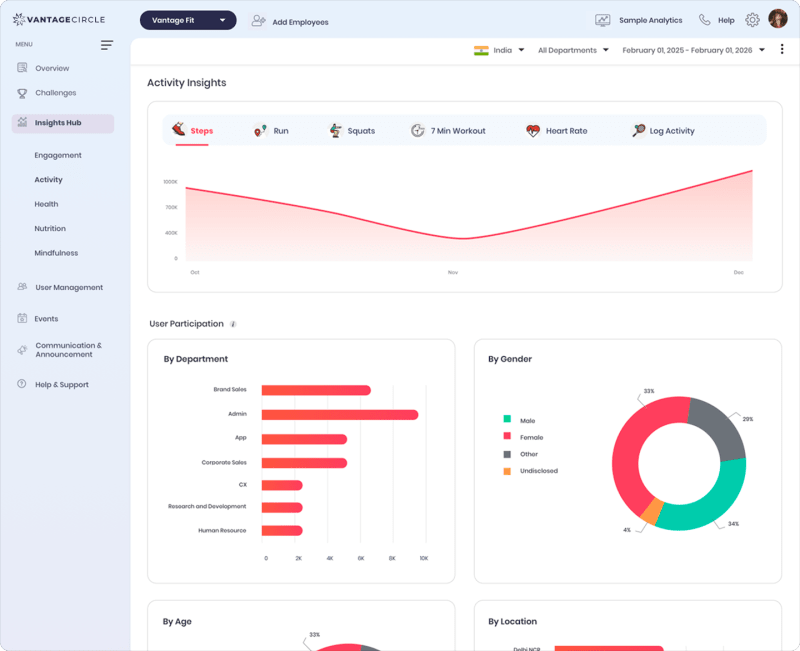
Your workforce is not one group. Split people by age, gender, department, location, chronic health flags, and activity levels.
Three segmentations from live programs on our platform:
- Women 35–45 in polluted metros: indoor mobility challenges
- Sales teams under 30 with sedentary workloads: cadence-based step goals
- Employees with elevated glucose biomarkers: sugar-restriction challenge programs
Splitting your workforce this way turns a generic program into a focused health strategy.
Step 3: Design Targeted Programs
Match program types to the risk groups you found. Use the 5-types framework above to build a mix of programs rather than a single one. Start with a wellness program proposal to lay out the business case, define expected results, and get leadership buy-in before spending.
Design principles:
- Focused challenges for private risk groups
- Gradual ramp-up (don't start at 10,000 steps for desk-bound teams)
- Mix individual and team-based activities
- Include mental, physical, and financial dimensions
Step 4: Choose a Wellness Platform
Your platform sets the ceiling on what you can run. Check vendors against these must-haves:
- Multi-activity tracking: steps, meals, mindfulness, and water rather than steps alone
- 10+ challenge types: step, team, journey, multi-activity, streak, custom. You need variety to keep programs fresh each quarter.
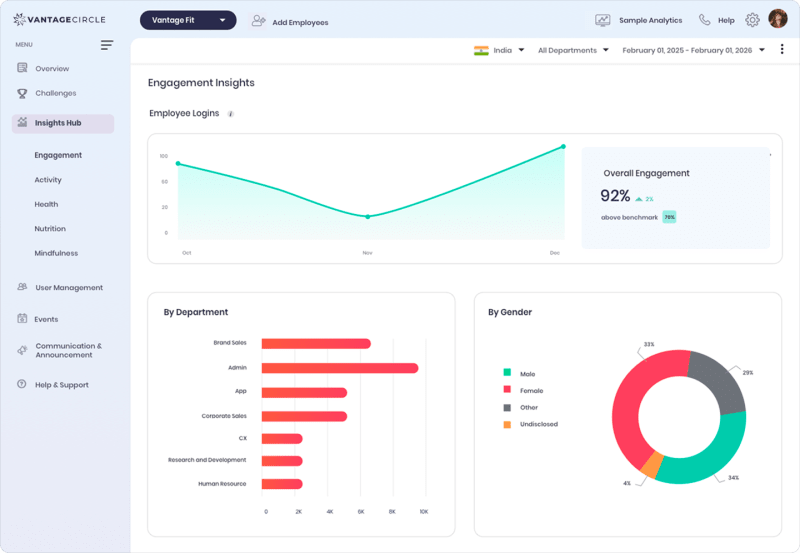
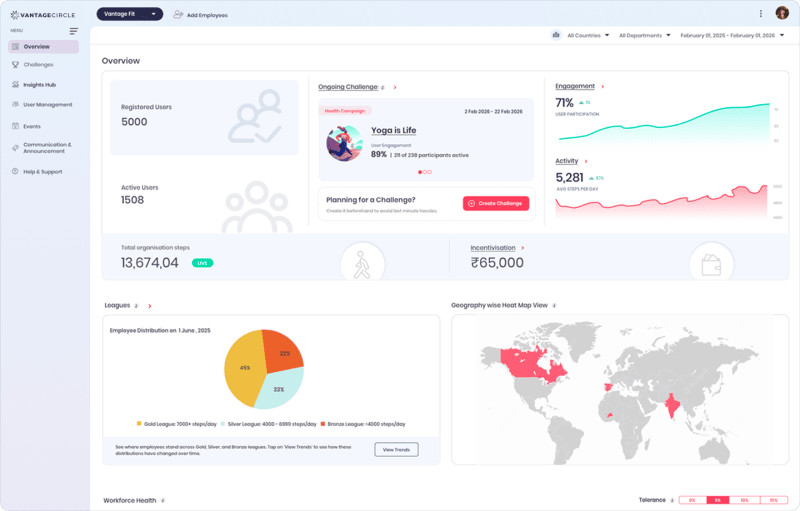
- Real-time admin dashboard: data filtered by team, location, and group
- Built-in rewards: points-based prizes with diverse gift card options
- Wearable sync: Apple Watch, Fitbit, Garmin so employees use devices they own
- HIPAA-aligned and SOC 2 audited. Non-negotiable for any platform handling health data.
Three questions to ask every vendor:
- How do you handle personal health data privacy at scale?
- Can we target challenges by group, risk profile, or health marker?
- What reports do you provide for C-suite ROI reviews?
A builder's note here. I am the CTO of a wellness platform, so read this checklist knowing where I sit.
I worked on our phone-camera squat detection feature myself, and I can tell you what breaks in wellness tech regardless of vendor: duplicate step counts when Apple Health and Fitbit both sync, timezone edge cases in global step-a-thons, and cheating in step challenges. We built Vantage Fit around the six criteria above, and every platform, ours included, fights those three problems daily. Ask any vendor how they handle them. For broader research, compare the best digital wellness platforms and employee wellness apps before you shortlist.
A Note on Privacy and the Law
If your program collects health data or ties rewards to health outcomes, US law has rules. The short version:
- HIPAA treats participatory programs (anyone can join, rewards not tied to outcomes) differently from health-contingent ones (rewards tied to a biometric or activity standard). Health-contingent programs carry extra requirements.
- ADA and GINA require that participation in any program collecting health information stays genuinely voluntary.
- ACA rules cap outcome-based incentives and require a reasonable alternative standard for employees who cannot meet a health target.
One plain-English rule covers most of it: if you collect health data, employees must be able to say no without penalty. Talk to counsel before tying rewards to health outcomes. The Department of Labor's EBSA resources and our guide to workplace wellness program regulations go deeper.
Step 5: Launch with Challenges
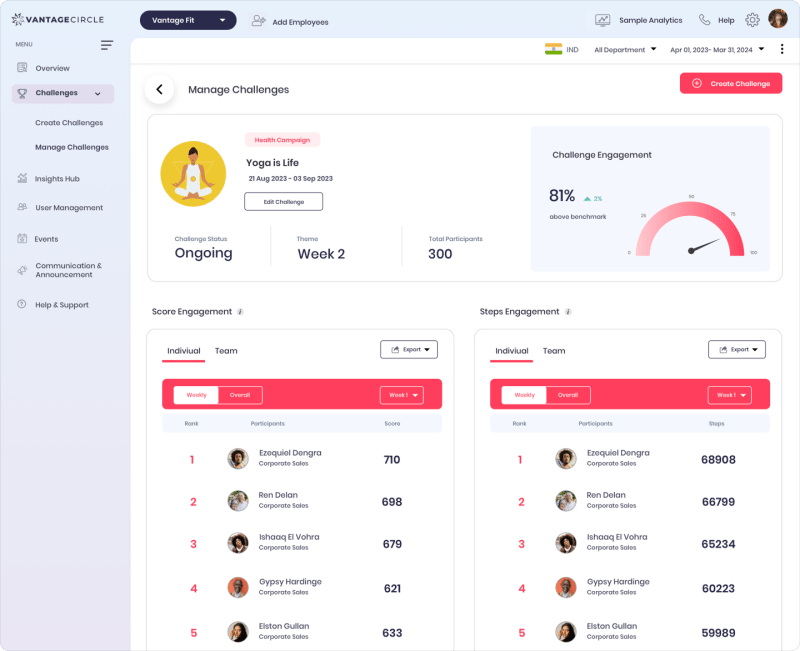
Start with a big, visible launch challenge to get people talking. Pre-built challenge templates (monthly themes like Stress-Free Month, Heart Health Month, or Nutrition Month) cut the need to design from scratch. A platform with 10+ challenge types lets you switch formats each quarter so sign-ups don't plateau.
We run a Global Virtual Walkathon at Vantage Circle every year, and I have learned one thing from announcing the results myself: name the winners, fast and publicly. Delayed recognition is as good as denied recognition.
Launch checklist:
- [ ] Communication plan ready (email, Slack/Teams, town halls)
- [ ] Challenge configured with realistic targets by segment
- [ ] Rewards and incentives set up
- [ ] Manager buy-in secured
- [ ] Success metrics defined before launch
Step 6: Measure and Iterate
Track sign-ups, but more importantly, track staying power and health results. Your admin dashboard should show uptake rates, activity trends, and health shifts in real time, filtered by team, location, and demographic group.
Key reports to generate:
- Monthly sign-up and uptake rates by group
- Quarterly health trend reports (group level)
- Risk shifts: share of employees in "Needs Attention" vs "Normal"
- Engagement and retention numbers for C-suite presentation
And be realistic about the timeline. I started my own fitness journey at 5km in 27 minutes, with my heart rate through the roof. Eleven marathons later, the lesson is that health results are a years-long trendline. I targeted a sub-4-hour marathon in 2023 and failed. I finally ran it in 2025. Workforce health behaves the same way. SHRM's employer toolkit suggests allowing three to five years to see true ROI, and that matches what I see. Budget for a two-year story, not a one-quarter story.
Corporate Wellness Program Examples: 4 Case Studies
See more companies at companies with wellness programs.
Wipro: A Global Multi-Country Rollout
Global IT company in 30+ countries. The core problem: no unified wellness platform across regions. Wipro's 2025 global wellbeing program on Vantage Fit ran as three challenges across the year: a wellbeing fest (163 users), a yoga-focused program (57 users), then the Spirit of Wipro Global Step-a-thon reaching 550 active users. Custom email campaigns and 15 to 20 live demos across regions drove sign-ups. The dip in the middle is worth noticing. Narrower themes draw fewer people, and the broad step-a-thon that followed more than tripled the original turnout. Each challenge built the audience for the next.
| Metric | Result |
|---|---|
| Participation growth | 3X increase (163 → 550 active users) |
| Monthly steps logged | +84% (41.45M → 76.12M, May–July) |
| Top countries | Philippines (111), UK (82), Canada (60) |
Read the full Wipro case study.
Tata Motors: 70% Engagement in Step Up & Elevate
India has a workforce health problem: 49.4% of Indian adults were insufficiently active in 2022, per a study in The Lancet Global Health. Tata Motors took it on with its Step Up & Elevate challenge, a roughly six-month team challenge across its plants in India. Employees tracked steps, meals, water intake, and mindfulness while competing on team boards. The program logged 3,300 meals, averaged 3L of water per day, and hit 9 minutes of daily mindfulness per active participant.
| Metric | Result |
|---|---|
| Employee engagement | 70% |
| Average daily steps | 7,600+ (6% increase from baseline) |
| Teams reducing average weight | 53% of 43 teams |
| Top team weight reduction | Sanand 2-Material: −12.36% |
Read the full Tata Motors Step Up & Elevate case study.
Brazosport ISD: 86% Engagement in 2 Weeks
Texas school district. The problem: getting teachers and staff involved in wellness when time is tight and the work is physical. Brazosport ran a 2-week "Fit Wars" challenge with rising targets: 40K steps in week one, 50K in week two, plus mindfulness 4 times a week and 8 glasses of water daily. Short timeframe and clear goals drove sign-ups. For context, typical wellness-program participation industry-wide is 20 to 40%.
| Metric | Result |
|---|---|
| Challenge engagement | 86% of challenge enrollees |
| Active participants | 132 |
| Average daily steps | 6,000+ |
| Average mood score | 4 out of 5 |
Read the full Brazosport ISD case study.
IBS Software: 88% Engagement in 28 Days
Software company headquartered in Kerala, India. IBS ran its March to Fitness challenge over 28 days with rising weekly targets. Week one started at 5,000+ daily steps, alongside squats, mindfulness, and hydration tracking. By the final week, targets escalated to 40,000 weekly steps and a 35 km run/walk. The staged weekly targets stopped early burnout while pushing steady effort.
| Metric | Result |
|---|---|
| Challenge engagement | 88% |
| Active participants | 500+ employees |
| Steps milestone | 236 employees hitting 30K+ steps per week by week 3 |
| Health tracking adoption | 118 tracking heart rate, 130 monitoring mood |
Read the full IBS Software case study.
Costs and ROI
For a detailed breakdown, see our guide to corporate wellness program costs.
What to Budget
| Tier | Annual Cost Per Employee | What's Included | Best For |
|---|---|---|---|
| Basic | $150–$400 | Activity tracking, basic challenges, step competitions | Smaller companies starting out |
| Mid-Range | $400–$800 | Multi-activity challenges, rewards, mental health resources | Mid-sized companies with established HR |
| Comprehensive | $800–$1,200+ | Biomarker tracking, tailored interventions, full analytics | Large enterprises, self-insured employers |
Many published estimates put typical US spend at $150 to $300 per person per year. Treat these tiers as planning ranges drawn from deployment experience and vendor-published pricing, not an official census. No such census exists. Companies with mature programs invest at the mid-range or higher once you add platform costs, prizes, and screening fees. The key is not how much you spend. It is whether your spend targets the right groups with the right programs.
What You Get Back
What you can credibly measure in year one: participation and engagement rates, activity levels, self-reported stress and behavior change, and early retention signals. The CDC association on absenteeism holds too: employees getting 75+ minutes of vigorous activity a week miss an average of 4.1 fewer workdays a year. Healthcare-cost savings are a multi-year story, and mostly a targeted one. Here is why.
What the Research Actually Says
I will tell you what most vendor pages will not.
The famous wellness ROI numbers came from observational studies. Johnson & Johnson's $250 million figure was the company's own estimate, relayed by HBR in 2010. The widely cited $3.27-per-dollar figure came from a 2010 meta-analysis by Katherine Baicker and colleagues.
Then researchers ran the gold-standard experiments. A 2019 randomized trial across 160 BJ's Wholesale Club worksites, co-authored by Baicker herself, found wellness programs improved self-reported health behaviors but had no significant effect on clinical measures, healthcare spending, or absenteeism at 18 months (Song & Baicker, JAMA 2019). The Illinois Workplace Wellness Study found the same null result in year one, and identified why the old numbers were inflated: employees who joined wellness programs were already about $115 a month cheaper in medical spend before the program started. The selection bias was the ROI.
RAND's seven-year PepsiCo study split the picture usefully: disease-management components returned about $3.80 per dollar, while lifestyle-management components returned about $0.50.
So I do not promise healthcare-cost ROI in year one. Nobody honestly can. What I see move first, across the companies on our platform, is engagement, retention, and culture. That is the case I make, and it is the honest one.
Debbie Bellenger, a health and wellness consultant we hosted on our podcast, frames the business case better than any ROI table:
"There's a direct correlation between employee health, employee happiness, employee engagement, and employee retention. Even if an unwell employee is at their desk eight hours, it might only be six hours of productive time — they're having doctor's appointments, having trouble focusing. Medical and pharmacy claims go up. The cost of sickness is not sustainable."
— Debbie Bellenger on the Vantage Fit Corporate Wellness Podcast
The CFO Test
Can you defend your wellness spend in 60 seconds? When we review our own wellness numbers at Vantage Circle, three things survive scrutiny: participation trends, sick-day trends, and retention in the teams that engage. If your metrics are "yoga classes offered" or "app downloads," you will lose the budget. Tie wellness data to numbers the C-suite already tracks.
Mind the Perception Gap
In survey after survey, leadership rates wellness program impact higher than employees do. The gap is the danger zone: programs that look successful in the boardroom and invisible on the floor. Measure what employees experience, not what leadership assumes.
Beyond ROI: Value on Investment (VOI). This is where the evidence leads. Track talent retention, employer brand, innovation rates, and employee satisfaction alongside any cost numbers. VOI treats wellness as a way to keep people, not just a way to cut claims. Unlike the old ROI math, it survives contact with the trials.
Frequently Asked Questions
What are corporate wellness programs?
They are employer-funded programs that support employee health across fitness, mental health, finances, and work-life balance. The label covers everything from a single annual step challenge to a year-round, data-driven health strategy with screenings, coaching, and rewards.
The distinguishing feature is structure: goals, tracking, and measurement, rather than a list of perks.
What are examples of wellness programs?
Common examples include step challenges, virtual marathons, guided meditation, smoking cessation programs, health screenings, budgeting workshops, Lifestyle Spending Accounts, team fitness contests, mood tracking, ergonomic assessments, and digital detox challenges.
The most effective programs combine several of these into a year-round calendar rather than running isolated events.
What are the 7 pillars of wellness?
There is no single canonical source for this framework. It is an informal model that circulates in HR practice. The version most teams use covers: (1) Physical: movement, nutrition, sleep. (2) Emotional: stress management, resilience. (3) Social: relationships, community, belonging. (4) Financial: budgeting, debt management, retirement readiness. (5) Occupational: job satisfaction, work-life balance. (6) Intellectual: learning, growth, mental stimulation. (7) Environmental: safe, healthy physical surroundings.
A complete corporate wellness program addresses all seven, though most companies start with physical and emotional wellness before expanding.
How do you build a corporate wellness program?
Build a program in six steps: (1) Assess workforce health data and risks. (2) Segment employees by demographics and risk profiles. (3) Design targeted programs matched to each segment. (4) Choose a wellness platform with multi-activity tracking, rewards, and analytics. (5) Launch with a high-visibility challenge. (6) Measure results and iterate quarterly.
The key factor is segmentation. Programs that treat every employee the same way fall behind those that target specific groups.
Do workplace wellness programs work?
They move behavior more reliably than they move costs. Two large randomized trials published in 2019 (a JAMA study across 160 worksites and the Illinois Workplace Wellness Study) found modest self-reported behavior changes at best, and no significant effect on healthcare spending or clinical measures within 18 months to 3 years.
What is measurable early: engagement, retention, and culture. Targeted disease-management programs are where healthcare-cost savings have shown up, returning roughly $3.80 per dollar in RAND's PepsiCo study versus $0.50 for lifestyle-only programs. Build for engagement first, and judge cost ROI on a multi-year horizon.
What is the average cost of a corporate wellness program?
Many published estimates put typical US spend at $150 to $300 per employee per year. Entry programs with activity tracking and challenges run $150 to $400 per employee annually. Mid-range programs with rewards and mental health resources run $400 to $800. Comprehensive programs with biomarker tracking and full analytics run $800 to $1,200 or more.
These are planning ranges drawn from deployment experience and vendor-published pricing. Spend follows program depth, not company size.
What happens to employee health data in a wellness program?
On a well-designed platform, individual health data stays private. HR and leadership see group-level trends only, never a single employee's numbers. Participation in anything that collects health information must be genuinely voluntary under US law (ADA and GINA), and platforms handling health data should be HIPAA-aligned and SOC 2 audited.
Ask any vendor to show you exactly what an admin can and cannot see before you sign.
What are the 5 pillars of employee wellbeing?
The five pillars of employee wellbeing (Gallup's wellbeing elements) are: (1) Career: satisfaction and growth in daily work. (2) Social: meaningful friendships and connections. (3) Financial: managing money and reducing stress. (4) Physical: health and energy to get things done. (5) Community: feeling of belonging and civic pride.
Use it as a map for program design: most corporate programs start with the physical pillar, then expand into the other four.
Next Steps
The engagement results in this guide are real and repeatable when programs are segmented and measured. The cost savings take years, not quarters, and anyone who promises otherwise has not read the trials.
You now have 5 program types, 19 ideas, 6 steps to launch, and 4 real deployments with their numbers. Marathons are not run on race day. They are run in the countless training hours before it. Workforce health works the same way. Start small, measure what matters, and stay in it for years.
Start here: Book a Vantage Fit Demo to see how the platform supports your program from launch through long-term measurement.
Plan ahead: Download the 2026 Wellness Calendar to map monthly themes and challenge ideas across the full year.
Share