A hybrid wellness program supports the physical, mental, and social health of employees across on-site and remote settings. It ensures every employee can participate in wellness activities regardless of location. According to Gallup’s State of the Global Workplace, hybrid workers now make up a significant population of the global workforce.
Programs built for this reality drive measurable results. Wipro, a global IT services firm with 200,000+ employees, grew active wellness participation from 163 to 550 employees across 30+ countries through three connected challenges with Vantage Fit in 2025. That is a 3X jump achieved through inclusive, location-agnostic program design.
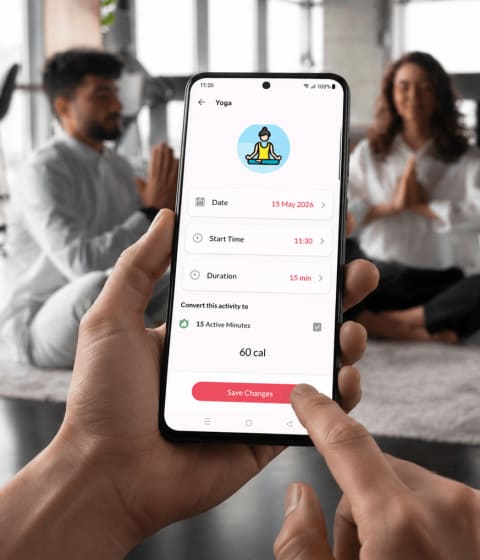
Vantage Fit covers physical, mental, and nutritional wellness through an app employees actually open every day, paired with the wearables they already own (Apple Watch, Fitbit, Garmin).
If you are someone who is looking for ways to build the perfect wellness program, then look no further. This blog walks you through building the ultimate hybrid wellness program, suiting all workforces.
Key Takeaways
- A hybrid wellness program supports employees belonging to both on-site and remote work settings. The usual one-size office-centric program design is no longer a go-to motto among business leaders.
- Hybrid work introduces three core wellness risks: disconnection, burnout behind flexibility, and unequal access to perks.
- Every hybrid-ready wellness program needs 6 must-have features, starting with mobile-first access and location-agnostic tracking.
- Start with an employee assessment, then plan and roll out in phases. Participation visibility from day one is what separates programs that last from those that don't.
Why Hybrid Work Demands a New Wellness Mindset
Hybrid work gives employees flexibility and employers productivity gains. But it also introduces wellness risks that traditional programs are not equipped to handle.
Remote and hybrid employees face three core challenges: social disconnection, burnout masked by flexible hours, and unequal access to wellness perks. A program that overlooks these risks will fail to engage the remote workforce.
Fewer Face-to-Face Connections, Greater Disconnection
Socializing is one of the biggest building blocks of employee well-being. When employees share a physical space, the chances of social connection are higher.
Remote and hybrid employees miss such an opportunity. They are bound to interact with their peers virtually. An alarming Gallup research suggests loneliness is a significant well-being risk for remote workers.
A wellness program that fails to actively foster social connections leaves remote employees with a gap that no step tracker alone can bridge.
Dr. David Lenihan, CEO of Ponce Health Sciences University, put a number to this on the Vantage Fit Podcast:
"About 40% of remote and 38% of hybrid workers had increased anxiety and depression compared with roughly 35% of in-office workers. I think the papers miss the point. The real reason is you lose the network — the interaction with your coworker and your boss. You don't know where you sit, whether you're getting a promotion or a bonus. That's what creates the anxiety."
— Dr. David Lenihan, CEO, Ponce Health Sciences University | Listen to the full episode
The Burnout Behind Flexibility
Flexible work hours is something that sounds like music to the ears of most overworked employees.
But, in reality, flexibility in work hours often makes burnout worse. Since there is no boundary between work and personal space, remote employees encounter a common yet unspoken problem.
The problem is, when do they wrap up their work and return to their personal space?
Even WHO suggests that longer hours, fragmented focus, and constant device availability contribute to occupational burnout. Unfortunately, this is a chronic condition that has not yet been successfully managed.
Work flexibility without any proper mental wellness support does not prevent burnout.
Unequal Access to Wellness Opportunities
On-site employees have access to wellness offerings such as on-site gyms, healthy catered lunches, and in-person yoga sessions. Remote employees get none of that.
When a wellness program is built around physical perks, it is inadvertently creating two tiers:
- well-supported in-office employees
- under-supported remote employees
This kind of bifurcation acts like a bulldozer, minimizing participation and morale across the whole team.
The truth is, traditional programs cannot meet hybrid needs. You need an inclusive program built for how people actually work today.
Must-Have Features of a Hybrid-Ready Wellness Program
Before you select or redesign your wellness program, make sure it covers these six features. Each one addresses a gap that office-centric programs leave open:
- mobile-first access
- location-agnostic activity tracking
- multi-dimensional wellness support
- cross-location team tools
- rewards redeemable from anywhere
- admin analytics that cover the full workforce
Here is a clear breakdown of the must-have features of a hybrid wellness program:
| Feature | What It Should Achieve | Why It Matters for Hybrid Teams |
|---|---|---|
| Mobile-first platform | Every employee can join from their phone, whether in the office or working remotely | Remote employees cannot rely on desktop-only tools or office intranet access |
| Location-agnostic activity tracking | Steps, workouts, and mindfulness logged from anywhere | Prevents an "office gym advantage" where on-site employees rack up passive activity credit |
| Multi-dimension wellness | Physical, mental, and nutritional support in one place | Hybrid stress shows up across all dimensions. Step-only programs miss the mental and nutritional gaps. |
| Team challenges and group tools | Cross-location team competition and social connection | Replaces spontaneous office connection with structured, remote-inclusive community |
| Accessible rewards | Gift cards and incentives redeemable from anywhere | On-site perks like catered meals or gym discounts exclude remote employees entirely |
| Admin analytics and reporting | A real-time dashboard to prove the program is working before the next budget review | HR needs visibility across a dispersed workforce, not just the office floor |
The notion of taking 10,000 steps daily is enough to stay healthy is increasingly challenged by research. Wellness programs that combine physical, mental, and nutritional challenges consistently outperform step-only programs. A multi-dimensional wellness program is the baseline for hybrid teams where isolation and burnout risk are higher.
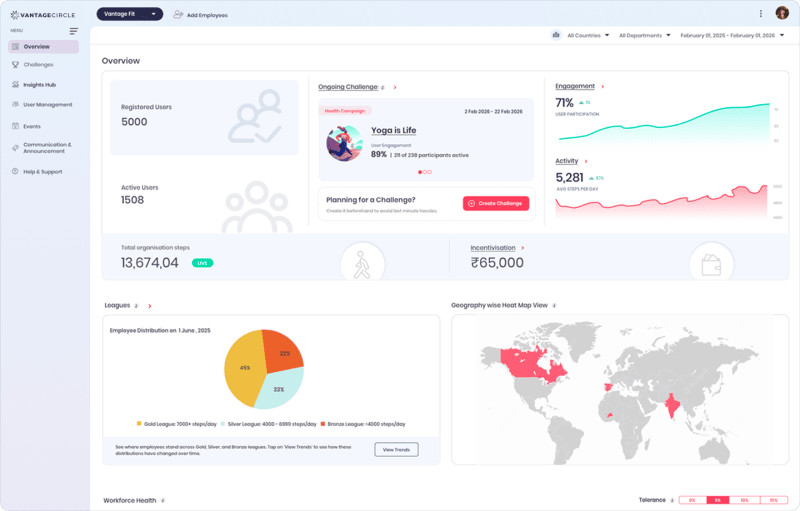
Vantage Fit’s admin dashboard gives you a real-time view of participation across every team and location. At a glance, you can see active users, engagement rate, total steps logged, and which challenges are driving the most activity, without chasing updates from each office.
10 Well-being Initiatives for Hybrid Workplaces
A strong hybrid wellness program goes beyond step challenge initiatives. It combines physical, mental, social, and even financial initiatives.
The following 10 are designed to work digitally, reach employees regardless of location, and address the full spectrum of wellness risks that hybrid work introduces.
- Virtual Step Challenge: A step challenge that runs on a mobile app gives every employee, be it on-site or remote, the same podium to start. Employees compete and track progress on shared leaderboards. And upon completing the challenge, they earn Vantage points.
Natalie Floyd, a former international figure skater and wellness advocate, described the reality of remote work movement on the Vantage Fit Podcast:
"When I spend a day at home, my step count is like a thousand steps. You have to build movement into your new lifestyle. That's where people struggle — all you want to do is get up, do your job, have your day, and that's it."
— Natalie Floyd, Director of Business Development, Rembrandt Awards | Listen to the full episode
- Mental Health Days: Designate days where no meetings are scheduled, and employees are encouraged to rest and recharge. Introduce mindfulness or meditation sessions to help employees feel relaxed.
- App-Based Mindfulness and Meditation Sessions: Guided meditation and breathing exercises that employees can practice on their own schedule. The goal is to make mindfulness sessions available during commutes, before calls, or between tasks. This is one of the most equitable wellness initiatives because it requires nothing more than a smartphone.
Suggested Read: Best Wellness Challenge Ideas for the Workplace
- Remote-Friendly Nutrition Challenges: Run a hydration challenge, a "eat a vegetable a day" challenge, or a meal-logging initiative. These are low-barrier, location-independent initiatives, and address a wellness dimension that step challenges do not cover.
- Cross-Location Team Challenges: Create teams that are a mix of on-site and remote employees. Give the team one shared goal that combines steps, mindfulness, and nutritional tracking. A shared fitness goal leads to a casual, ongoing interaction that remote employees do not get to be a part of.
- Online Fitness Classes: Introduce live or recorded fitness sessions for yoga, HIIT, stretching, or dance. Share via a company wellness platform or video link. Employees can join from any location, and on-demand recordings mean no one misses due to different time zones.
- Financial Wellness Webinars: Financial stress is a significant but often overlooked driver of employee well-being. Arrange monthly or quarterly webinars for budgeting and savings. Such initiatives address a wellness dimension that physical programs routinely ignore.
- Virtual Social Wellness Events: Online cooking classes, virtual trivia nights, or shared "lunch and learn" sessions rebuild the social fabric that vanishes in a remote working job. The goal is not productivity. The goal is to build and nurture connections, which directly support mental wellness.
- Manager-Led Wellness Check-Ins: Train managers to open meetings with a brief wellness check-in: "How are you doing this week?" "Any work-life boundary issues?" This is a zero-cost initiative but holds great emotional weight. Asking these simple questions showcases organizational care and surfaces burnout early. Research shows that workplace social support is a protective factor for occupational stress.
- Wellness Content Libraries: Offer employees a library of short-form health content on sleep, nutrition, and movement. This gives them self-directed wellness options that fit into small windows of time. Content libraries are valuable for employees in demanding roles or time zones where live programming is not accessible.
Where Should You Start When Building a Hybrid Wellness Program?
The biggest mistake you can make when building a hybrid wellness program is starting with the tool instead of the need.
Here is a three-phase action framework that moves you from idea to active program.
Phase 1: Assessment
Before selecting a platform or designing a challenge, survey your employees. You need to answer three questions:
- What are your biggest wellness challenges right now: physical health, mental health, or social connections?
- What does your current program offer, and who is it actually reaching?
- Are remote employees underserved compared to on-site employees?
Use a short pulse survey with 5–8 questions and segment the results by work location. The gaps you find will define your program’s priorities.
Invest in a platform with built-in survey tools. This makes it easier for you to execute and analyze.
Phase 2: Plan
After gathering the data, define the program’s goals.
An ideal wellness program should have specific and measurable goals. For instance, “Increase participation to 60% within 90 days” is more useful than “improve wellness engagement.”
After goal setting, select a platform that works across locations. Then set your budget and design your first campaign. Choose a wellness challenge that fits your goals.
Here are some ideas to try:
- a step challenge for broad participation
- a mindfulness initiative for mental wellness focus
- or a team-based challenge to rebuild social connection
The first challenge sets the tone for the entire program. It should be easy to join, fast to onboard, and genuinely rewarding. If the first experience is too complex, it will hamper the participation rate in the long run.
Phase 3: Roll Out
Communicate the program through every official channel your employees actually use, such as email, Slack, and Teams. Make the onboarding seamless. Share a QR code or a link to register, and a two-minute explainer video should be enough.
Track participation weekly, not monthly. Weekly check-ins let you course-correct early, before disengagement becomes a pattern.
After rolling out, admin analytics are what set strong programs apart from traditional ones.
When you can see which teams are active, which departments have low participation, or which challenges are driving the most engagement, you can make an informed investment decision.
Final Thoughts
Hybrid working jobs are here to stay. It is how a significant portion of the global workforce will operate for the foreseeable future.
Wellness programs that serve the wellness needs of a fully in-office team will not be valuable for a remote team. It is not because the goals have changed, but because the working conditions have changed.
The social disconnection, unequal access, and burnout associated with flexible work timings are real and measurable risks. With the right hybrid wellness program design and the right platform, these issues are solvable.
Employees who feel supported in their wellness are more engaged, more productive, and more likely to stay. That is the case for investing in a hybrid wellness program that actually works.
Frequently Asked Questions
How much does a wellness program cost?
The cost of an employee wellness program varies widely depending on the platform, program size, and features. Subscription-based wellness platforms typically charge per employee per month, while internally managed programs may only require time and communication costs. Also, I recently covered the total breakdown of corporate wellness program cost, which is worth a read.
Which wellness apps are best suited for a hybrid workplace wellness program?
The best wellness apps for hybrid teams are mobile-first, support multiple activity types (physical, mental, and nutritional), and include social features such as challenges and leaderboards. For a full comparison of the top options, see our roundup of the best employee wellness apps.
What are some good wellness challenges for hybrid teams?
The best hybrid wellness challenges work digitally and require no physical co-location. Step challenges, mindfulness streaks, hydration challenges, and team-based fitness competitions are all highly effective. For more ideas, explore our take on wellness challenges.
How do you measure the ROI of a wellness program?
Wellness ROI is typically measured by calculating participation rates, reductions in absenteeism, healthcare cost trends, and employee engagement scores. The best way is to integrate a platform with built-in analytics that lets you track these metrics from day one. For a step-by-step framework, read my coverage on the ROI of wellness programs.