You know what keeps people opening Duolingo every single day? The streak. It’s a powerful psychological hook, and it’s exactly what you need to keep your workforce moving.
A structured corporate streak challenge gets employees to hit a daily wellness goal on a set number of days each week. The programs that actually stay consistent past week three all lean on one specific design choice: a weekly frequency floor instead of an all-or-nothing daily rule.
Most HR teams borrow that logic wholesale: pick a daily goal, run it for a month, watch participation spike in week one. Then week three shows up. Someone misses two days, figures the whole thing’s blown, and quietly stops logging.
The pattern’s so predictable that behavioral psychologists gave it a name: the what-the-hell effect. And the daily-strict streak, the format almost everyone reaches for by default, is practically engineered to set it off.
The data backs that up. Every Vantage Fit challenge that cleared the 70% industry engagement average, including ones at Brazosport ISD (86%) and IBS Software (88%), was built on that frequency floor rather than a daily-strict rule.
That one tweak is the difference between a program that lasts and one that flares up and burns out fast. This guide covers the design, the psychology underneath it, and how to run it for your team.
Key Takeaways
- A streak challenge rewards consistency: hitting a goal on consecutive days, or a set number of days each week.
- Streaks work through loss aversion. Once people own a streak, breaking it feels like a loss, so they keep showing up.
- The most durable design pairs a daily target with a weekly frequency, like 5,000 steps on 4 days a week, so one missed day never ends the streak.
- For teams, streaks sustain engagement past the launch-week spike, which is exactly where most wellness programs fade.
What Is a Streak Challenge?
A streak challenge is a fitness challenge where participants hit a daily goal for as many consecutive days as possible, or a set number of days each week, over a fixed window. You’ll also hear it called a consistency challenge, a daily activity streak, or a workplace habit challenge. Whatever the name, it rewards regularity over peak performance. The unbroken streak is the thing that keeps people moving.
There are two flavors. The strict version wants the goal every single day, like a run streak where you log at least a mile, rain or shine. The flexible version asks for a frequency instead, like “active 5 days a week for a month.” Consumer versions you’ve probably bumped into include daily run streaks and 75 Hard.
75 Hard is a viral, 75-day zero-compromise challenge with no grace days, which makes it famous online but a guaranteed recipe for burnout in the workplace.
The best part is that you can plug almost any measurable goal into this format. Be it steps, active minutes, a walk, or a workout. The format stays put; the activity is yours to choose.
The Psychology Behind a Sticky Streak
Streak challenges work because of loss aversion. Once people build up an unbroken streak, they start to value it, and breaking it feels like losing something. Grace days keep one missed day from ending the whole run, which is what carries the habit over the long haul.
A visible streak turns a fuzzy goal into something you own, and people protect what they own. Repetition handles the rest. Research by Lally and colleagues in the European Journal of Social Psychology found a new behavior takes a median of 66 days to become automatic. A streak ferries people through those first rough weeks, quietly turning conscious effort into a healthy daily habit.
But here’s the trap most programs stumble into. Psychologists call it the “what-the-hell effect”: miss one day, decide the streak’s ruined, and bail. The fix isn’t more discipline; it’s designing for recovery.
James Clear’s rule from Atomic Habits nails it: never miss twice. A grace day or two builds that forgiveness right into the rules.
Rigid daily streaks can backfire. An all-or-nothing rule punishes one slip and invites burnout or injury, especially with running streaks. Build in rest days and grace days so consistency does not turn into pressure.
Types of Streak Challenges (and Which to Pick)
Streak challenges vary by how long they run and what they track. By length, you’ve got 7-day, 30-day, 8-week, and year-long formats. By activity, you can run step, walking, running, active-minute, or multi-habit streaks. Pick by goal: a short streak for a quick win, 30 days to build a habit, longer for a sustained program.
| Format | Duration | Activity | Best for |
|---|---|---|---|
| Kickoff streak | 7 days | Steps or active minutes | A quick win to launch a wider program |
| Habit-builder | 30 days | Walking or steps | Forming a routine (a workplace step challenge fits here) |
| Program streak | 8 weeks | Multi-activity | Sustained engagement across a quarter |
| Year-long streak | 365 days | Running or daily movement | Committed groups and run clubs |
One quick reframe on the daily target: skip the old 10,000-step rule. A 2025 systematic review in The Lancet Public Health, pooling 57 studies, found most health benefits land around 7,000 steps a day, a mark tied to up to a 47% lower risk of early death. And it’s not only about steps: the World Health Organization recommends at least 150 minutes of activity a week, which a daily streak quietly racks up without anyone keeping count.
Read more on: Wellness challenge ideas to build healthy habits
How to Design a Streak Challenge That Doesn’t Collapse at Week Three
Want a streak that lasts? Pair a daily target with a weekly minimum, like 5,000 steps on any 4 days. One missed day never resets the counter to zero, and that reset is exactly where most programs quietly bleed participants.
Set a daily goal plus a weekly minimum: for example, 5,000 steps on at least 4 days a week. This protects the streak from normal life like travel, sick days, and busy weeks.
This isn’t just theory. IBS Software’s 28-day “March to Fitness” challenge framed week one as “5,000 steps on five days,” a frequency requirement, not a daily rule. The payoff: 88% engagement, with 236 employees still hitting their weekly target in week three, right when most corporate wellness programs start shedding half their people.
Brazosport ISD ran the same structure across a two-week “Fit Wars” challenge and landed 86% engagement, sixteen points above the 70% industry average. In both cases, the frequency floor was the call that held participation together through the natural drop-off window.
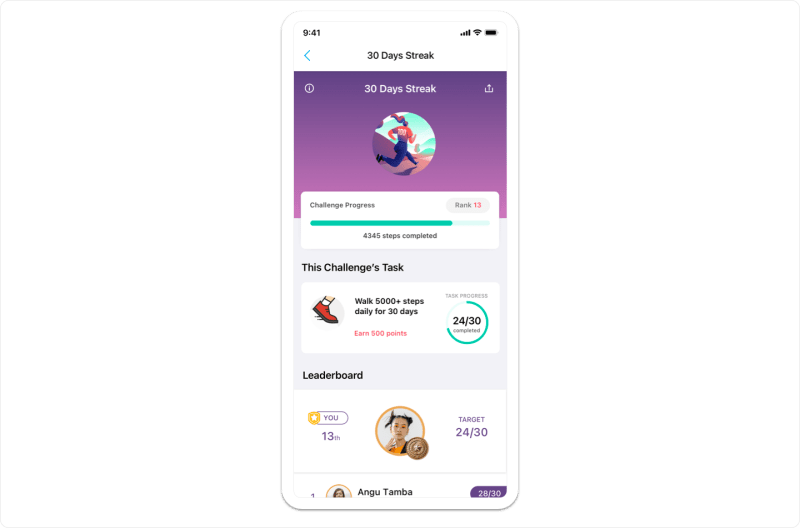
Some platforms bake this dual target right in. Vantage Fit’s Streak Challenge, for instance, lets an organizer set both a daily target and a weekly frequency, then tracks the daily achievement and the weekly streak count on its own, which means HR isn’t manually checking spreadsheets each week to see who’s still in.
How to Run a Streak Challenge: An Organizer’s Playbook
To run a streak challenge, pick a duration and weekly frequency, set the rule and grace days, decide how you’ll track it, attach rewards, and plan your launch comms. Then keep the streak visible, week to week. Get the run-of-show right and the payoff compounds: across Wipro’s 2025 wellness challenges, active participation more than tripled, from 163 to 550 employees.
- Pick the duration and weekly frequency to match your goal.
- Write one clear rule, with grace days, stating the daily goal, days per week, and allowed misses.
- Choose how employees track it, ideally with automatic syncing.
- Attach rewards to the streak itself, not just the finish line.
- Plan communications: a launch message, weekly nudges, a mid-point shout-out.
- Keep it visible with a live leaderboard or progress view.
Read more on: How to create an effective wellness challenge
Setting the Rules: Daily Target, Frequency, and Grace Days
Keep the rule to a single sentence: “Hit [goal] on [X] days per week for [duration], with [N] grace days.” Spell out what counts, how a missed day gets handled, and when a streak resets. And don’t treat grace days as a loophole; they’re the recovery design that keeps the what-the-hell effect from ending someone’s run.
Why Auto-Sync Beats Willpower
Tracking runs the gamut from manual logging to automatic syncing with wearables like Garmin, Fitbit, and Apple Watch.
Auto-sync matters more than it sounds. When logging takes zero effort, people forget less and streaks survive the busy days. A step tracker app that updates itself removes the single most common reason streaks break: simply forgetting to log the day.
Running a Streak Challenge for Your Team
Streak challenges are a natural fit for teams because they drive steady participation, not just a launch-week spike. A daily-habit streak keeps employees engaged for weeks, and weeks are when wellness programs actually move the needle on outcomes.
Most programs have the opposite problem. Industry data pegs sustained participation in one-off wellness events at 20 to 30 percent, because a single burst of enthusiasm rarely makes it to week three. Even structured challenges hover around a 70% engagement average, and slip below it when the design leaves no room for a missed day.
A streak built on a weekly frequency target fights both failure modes at once: daily accountability, minus the punishment for one slip. Brazosport ISD hit 86% engagement once wellness became a recurring habit rather than a calendar event, and the CDC’s workplace health resources tie consistent activity to lower absenteeism and healthcare costs.
Design for Consistency, Not Just Competition
Two design choices keep a team streak both inclusive and sticky. First, rank the leaderboard on consistency, not raw output. Vantage Fit’s gamified leaderboards make that easy, so the most dedicated person wins, not just the fittest, and anyone who’d rather not compete can quietly sit it out.
Second, reward the streak weekly, not only at the finish. Points earned each day, redeemable for wellness incentives like Amazon or Starbucks gift cards, keep people in it through the whole program.
"Vantage Fit has helped our employees stay active, track their progress, and get rewarded, turning wellness into a daily habit that drives both health and happiness across BISD."
Rachel Arthur / Director of Benefits & Wellness, Brazosport ISD
Read more on: How to increase employee participation in wellness programs
Frequently Asked Questions
How is a streak challenge different from a step challenge?
A step challenge rewards total volume, like who logged the most steps. A streak challenge rewards consistency, like who hit their goal the most days. You can run a step challenge as a streak by tracking daily targets met instead of cumulative steps.
Do streak challenges work for remote and hybrid teams?
Yes, and often better. A streak is location-independent, so a daily walk counts at the office, at home, or on the road. Automatic device syncing keeps remote employees on the same leaderboard as everyone else, so nobody gets sidelined for working a different time zone or a home office. Consistency, not commute, becomes the thing that counts.
Are streak challenges fair to less-active employees?
They can be, if you rank on consistency instead of raw performance. A frequency-based goal and a progress leaderboard let a new walker compete on equal footing with a marathon runner, because both are measured on showing up. That framing is what keeps less-active employees from quietly dropping out in the first week, when most fitness-first programs lose them.
How do you measure if a workplace streak challenge worked?
Look past sign-ups to sustained participation: the share of employees still active in week three or four. Pair that with average days-per-week hit and your post-challenge engagement score to see whether the habit stuck. If most of your starters are still logging by week four, the format is working; a sharp week-three drop usually means the rule was too strict.
What is a good daily target for a streak challenge?
For a step-based streak, 5,000–7,500 steps a day is a well-supported range, and most desk workers don't need to push past it. For non-step streaks, 20 minutes of activity makes a solid daily floor. The real trick is calibration: set the target high enough to build a habit, but low enough that a full day of back-to-back meetings doesn't guarantee a miss.
Bottom Line
A streak challenge isn’t about heroic effort. It’s about clearing away the reasons people quit. Set a daily target with a weekly frequency, write in grace days, rank on consistency, and reward the habit as it builds. Do that, and a two-week spike turns into a routine that outlasts the challenge itself.
Pick one team, set a 30-day streak with a 4-day-a-week floor, and launch it this month. Book a demo to see how the daily targets, leaderboards, and rewards basically run themselves.