Sugar-Free Challenge for Employees
A structured 30-day individual program that guides your workforce through a progressive reduction and elimination of added sugar — building lasting nutritional awareness through daily logging, weekly phases, and a competitive leaderboard that rewards consistency over restriction.
What Is the Sugar-Free Challenge?
The Sugar-Free Challenge is a 30-day individual program that guides your workforce through a structured, progressive reduction and elimination of added sugar from their daily diet. It begins with the most visible sources — sodas, candy, and desserts — then moves into reading complex food labels and cutting hidden sugars in condiments, sauces, flavored yogurts, and breakfast cereals. By the final week, employees are logging a fully sugar-free diet and building a personal plan for sustaining the habit after the challenge ends.
The emphasis is on progression, not perfection. Your team is not asked to eliminate sugar entirely on Day 1. They move through four phases with clear weekly tasks, daily logging, and milestone recognition at each stage.
Fully remote-friendly — every task is completed individually on each employee's own device at their own pace. No shared equipment, no group sessions, no coordination overhead. Perfect for in-office, hybrid, and remote teams.
Challenge Snapshot
Everything at a glance
Benefits of the Sugar-Free Challenge
The WHO recommends that free sugars make up less than 10% of total daily energy intake, with additional health benefits below 5%. Most working adults substantially exceed these thresholds without realizing it — a majority of added sugar in modern diets comes from processed foods where sugar is not visible as an ingredient.
The four-week progressive structure delivers real nutritional learning, not just a temporary dietary restriction. Those who complete the challenge leave with a working knowledge of where added sugar hides in their everyday food choices — more durable than any single nutrition seminar.
- Reducing sugar intake lowers blood sugar spikes and crashes that drive afternoon energy slumps and stress-driven snacking — employees commonly report more consistent daytime energy
- The four-week progressive structure builds real nutritional learning — participants finish with a working knowledge of where hidden sugar appears in everyday foods
- A label-reading habit built over 30 days is more durable than any one-time nutrition guidance or seminar
- Improved concentration and mood as sugar-driven energy crashes become less frequent over the course of the challenge
- Fully remote-friendly — every task is individual and doesn't require shared equipment, group sessions, or workplace coordination
- Poor nutrition drives measurable healthcare costs and absenteeism — structured wellness programs link to $250 in annual healthcare savings per person, with reduced sugar intake foundational to that improvement
- One of the few corporate wellness programs that actively builds health literacy — employees who can read a nutrition label are better equipped to make healthier choices for the rest of their working lives
- Generates a 30-day participation dataset: daily task completion rates broken down by week, showing whether the habit is building progressively
- Leaderboard ranks by task completion points, not dietary outcomes — widens participation and removes sensitivity around individual health metrics
- Individual food entries, calorie totals, and nutritional data are never visible to HR — only aggregate task-completion rates
- Accessible to in-office, hybrid, and remote teams with zero equipment overhead — no gym, no coordination, no shared workspace required
IBS Software achieved 88% employee engagement in a 28-day multi-activity wellness challenge on Vantage Fit — 17% above the 70% industry benchmark.
See it in actionHow the Sugar-Free Challenge Works
Set up the challenge
As an HR leader or wellness coordinator, you configure the challenge duration (30 days), the four weekly task phases, and the point values for each daily task. Scope it to specific departments or your entire workforce; enrollment can be open or invitation-based.
Employees log their meals each day
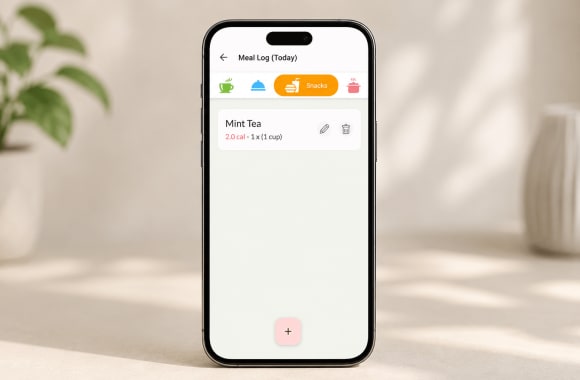
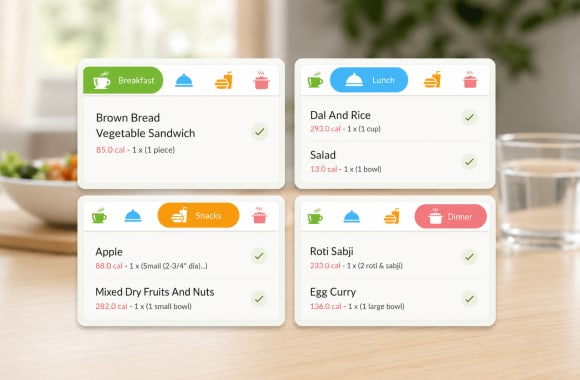
The core daily task is recording food and drink consumed across breakfast, lunch, snacks, and dinner. The week-specific task defines what counts as compliant for that phase — from eliminating obvious sugars in Week 1 to a fully sugar-free diet in Weeks 3 and 4.
Track task completion, not dietary metrics
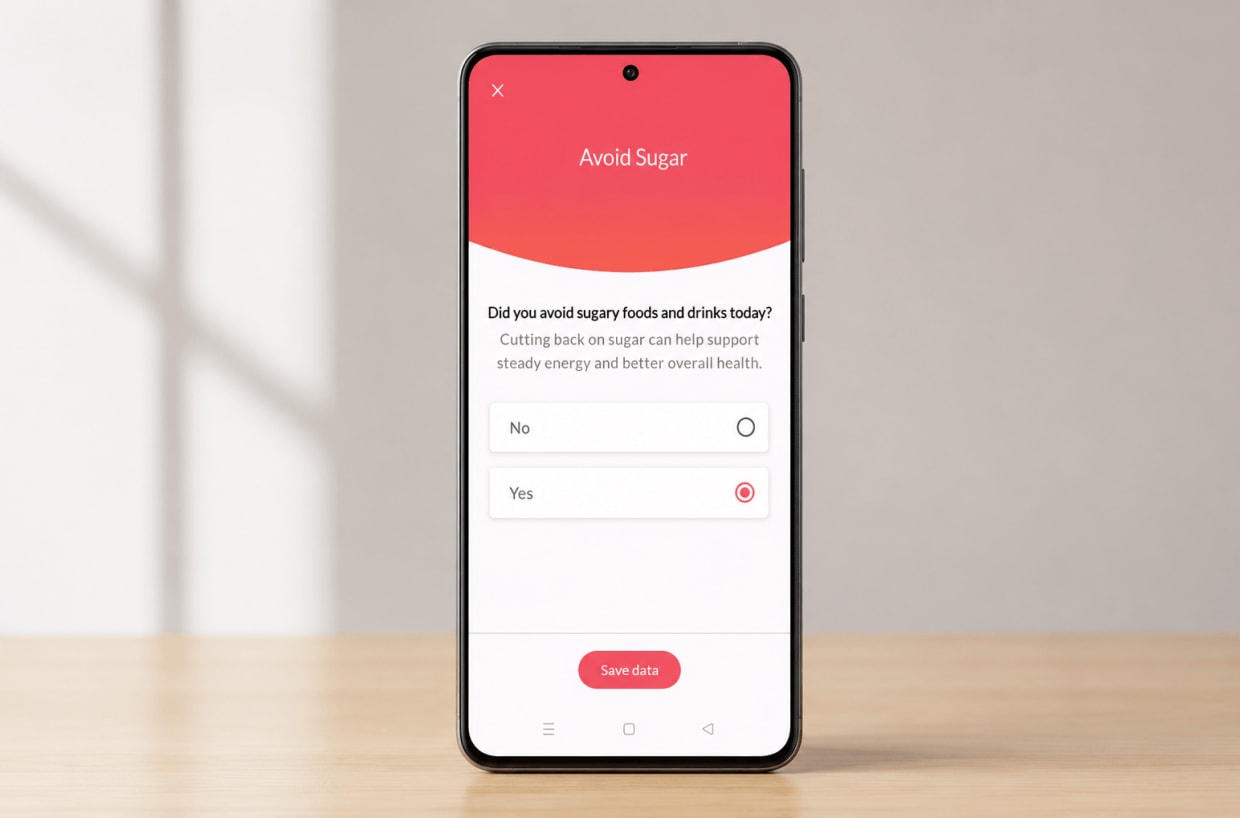
The daily task is complete once employees log their meals in accordance with that week's phase requirements. Points are earned per completed day. Employees self-report their task status — the logging record supports accountability by making the day's food intake visible in one view.
Participants track standing on the live leaderboard
Daily completion streaks, total points, and leaderboard position against colleagues — ranked by points, not by any dietary metric. The competitive element encourages consistency without surfacing any individual nutritional data.
Monitor participation through the dashboard
Throughout the 30 days, you track participation rates, daily task completion, and week-over-week trends through the admin dashboard. Individual food entries, calorie totals, and nutritional data are never visible — only aggregate task-completion rates. Final leaderboard positions lock at end of Day 30.
Ready to run this challenge for your team?
No equipment needed. Up and running in minutes — for remote, hybrid, and in-office teams.
Sample Sugar-Free Challenge Plan
This 4-week structure introduces one level of difficulty per week — from eliminating obvious sugars to reading food labels to a fully sugar-free diet — so the program stays manageable at every stage. As an HR leader, you configure the task list and point values to match your workforce's goals.
Week 1: Cut the Obvious (Days 1–7)
Daily task
"Log all meals. Mark complete if no obvious added sugars today (sodas, candy, desserts, sweetened beverages)"
The first week builds awareness of the most visible sources of added sugar and eliminates them. Focus on sodas, sweetened coffees and teas, candy, chocolate, desserts, pastries. The bar is achievable in Week 1 — the priority is building the daily logging habit before increasing difficulty in subsequent phases.
Milestone
Participants who complete the daily task on at least 5 of 7 days establish the consistency baseline for the remaining three weeks.
HR Action
Send a Day 1 welcome message explaining the 4-week progression. Include a simple list of what counts as "obvious added sugar" for Week 1. Frame the first week as the easiest stage — keep the tone encouraging.
Week 2: Read the Label (Days 8–14)
Daily task
"Log all meals. Mark complete if no added sugars today — obvious OR hidden. Check all food labels."
Week 2 raises difficulty from avoiding obvious sugars to identifying and eliminating hidden sugars in processed foods — tomato sauces, salad dressings, ketchup, flavored yogurts, granola, breakfast cereals, energy drinks. Team members learn to read ingredient lists and recognize sugar's many names: sucrose, high-fructose corn syrup, maltose, dextrose, cane juice, fruit juice concentrate.
Milestone
Those completing the daily task every day of Week 2 earn recognition for achieving back-to-back completion in the more demanding label-reading phase.
HR Action
Share a mid-Week 2 participation update. Consider sharing a "Hidden Sugar Guide" listing common foods with added sugar and their sugar-free alternatives to support the label-reading task.
Week 3: Go Sugar-Free (Days 15–21)
Daily task
"Log all meals. Mark complete if fully sugar-free AND sweet cravings met with whole foods (fruit, nuts, plain yogurt)"
Achieve full sugar elimination for seven consecutive days while actively replacing sweet cravings with whole food alternatives — fresh fruit, unsweetened nuts, plain full-fat dairy, whole grains. This week builds replacement habits that make sugar-free eating sustainable beyond the challenge. Share the leaderboard update at Week 3 start and acknowledge that cravings at this stage are a normal physiological response to sugar reduction.
Milestone
Those completing all seven days of Week 3 with completion throughout Weeks 2 and 3 earn additional recognition for back-to-back clean weeks.
HR Action
Share a leaderboard update at Week 3 start showing top 10 by points. Acknowledge that Week 3 is the hardest week and that cravings at this stage are a normal physiological response to sugar reduction.
Week 4: Make It Last (Days 22–30)
Daily task
"Log all meals. Mark complete if fully sugar-free. Complete your personal sustainability plan by end of week."
Maintain a fully sugar-free diet through the final nine days AND complete a personal sustainability plan: identify two or three foods and drinks containing added sugar in their daily routine, note the sugar-free alternative they'll use, and commit to maintaining that swap after Day 30. Employees who reach this stage finish with both a clean streak and an actionable plan for sustaining the habit.
Milestone
Challenge Completion Badge awarded to all who meet full 30-day completion criteria including the personal sustainability plan task. Leaderboard Rank Badge to top 10.
HR Action
Send a Day 30 wrap-up with final leaderboard, aggregate participation statistics by week, and recognition for all completers.
Rewards and Points
You configure the point value for each daily task during setup. Because the leaderboard ranks by points accumulated across 30 days rather than any dietary metric, the challenge rewards consistency and daily effort rather than outcomes that vary by individual physiology or starting habits.
Challenge Completion Badge
Awarded to every employee who completes the full 30-day sugar-free challenge — meeting completion criteria across all four weekly phases including the personal sustainability plan.
Leaderboard Rank Badge
Awarded to the top 10 participants on the final leaderboard — ranked by total points accumulated across 30 days, not by any dietary or nutritional metric.
Consistency Badge
Awarded to employees who maintain a sustained daily task completion streak across all four weeks — demonstrating the habit-building the challenge is designed to create.
Points earned through the challenge are added to the employee's Vantage Points balance. Employees can redeem these points for gift cards from Amazon, Starbucks, Nike, and hundreds of other options through the Vantage Fit rewards marketplace. Points carry over and combine with earnings from other active challenges.
Running the Sugar-Free Challenge on Vantage Fit
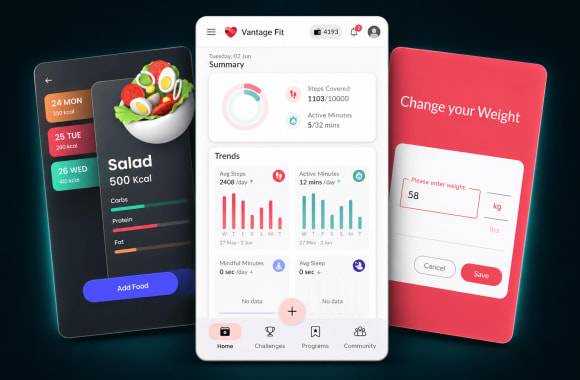
The Sugar-Free Challenge runs on Vantage Fit's food tracking and self-reported task completion features — combined into a single 30-day custom challenge structure with four progressive weekly phases.
Food search and logging
Powered by an Algolia food database, region-specific by country and locale. Employees search, select the matching item, enter serving size and quantity, and assign it to the appropriate meal type. Manual entry available for items not in the database. Daily totals update as entries are added.
GreenScore nutrition quality signal
Each food item carries a GreenScore (0–100 nutrition quality metric). Higher score equals more nutritionally balanced. During the Sugar-Free Challenge, employees can use GreenScore as a simple quality signal when evaluating food swaps in Week 3 — foods with high GreenScores tend to be lower in added sugar.
Quick Tray for repeat logging
Re-log frequently eaten foods with a single tap. Once logged once, items appear in Quick Tray. Reduces logging friction and keeps daily task completion rates high during habit-building weeks — particularly useful in the high-volume logging phases of Weeks 2 and 3.
HR dashboard and participation insights
The admin dashboard shows overall participation rates, percentage completing daily tasks each day, and week-by-week completion trends. Individual food entries, calorie totals, and macro data are never visible — only aggregate task-completion rates. You see who is participating consistently without seeing any individual nutritional data.
Automated reminders
The platform sends daily meal logging reminders and weekly phase-transition prompts at the start of each new week. A Day 30 wrap-up notification is automatically sent with final leaderboard standings and completion certificate links.
Frequently Asked Questions
Can remote employees participate in the Sugar-Free Challenge?
Yes. Every task can be completed individually on each participant's own device. No workspace, group session, or physical workplace required. Remote, hybrid, and in-office staff participate on exactly equal terms.
How is food logged during the challenge?
Participants search the Vantage Fit food database, select the matching item, enter serving size and quantity, and assign it to the appropriate meal type. For foods not in the database, participants add a custom manual entry. Quick Tray is available for frequently eaten items to reduce logging friction across the 30 days.
How does the challenge track whether an employee is eating sugar-free?
The daily task is self-reported. Once employees have gone through the day in line with that week's phase requirement, they record their task as complete. The logging record supports self-reporting by making the day's food intake visible in one view. Leaderboard ranking is based on task completion, not automated dietary verification.
How long should a Sugar-Free Challenge run?
30 days. The four-phase structure requires at least one week per phase for the habit to take hold before difficulty increases. Extensions to 60 days are possible for longer-form nutrition programs.
What if an employee slips and consumes sugar?
A single slip doesn't disqualify a participant. Points accumulate across the full 30 days, and the completion criteria are configured by you. A team member who has a difficult day and records their task as incomplete still accumulates all points from completed days.
Is individual food data visible to HR?
No. Individual food logs, calorie totals, macro data, and nutritional quality scores are visible only to the team member who logged them. HR admins see only aggregate task completion rates. No individual nutritional data is surfaced in the admin dashboard.
Related Challenges
Launch the Sugar-Free Challenge on Vantage Fit
Decision Foundry reported 89% employee participation in their Vantage Fit wellness program.