












Fitness Loyalty Programs: A Smarter Way to Drive Consistent Employee Wellness

Every January, gyms fill up with people scanning in and riding that fresh-start momentum. But the gyms that retain members in March, July, and October are not relying on motivation alone—they rely on systems: streak counters, tiered status levels, and subtle milestone cues that reinforce continued engagement.
Contrast this with what typically happens inside companies. HR launches a step challenge, enthusiasm spikes briefly, Slack channels fill with screenshots, and participation quickly tapers off. By week 3, the leaderboard is dominated by the same ultra-active employees, while most others disengage. No behavioral patterns are analyzed; no habits are reinforced, and the initiative is ultimately categorized as “engagement” and closed out.
When you put these two worlds side by side, the contrast is striking. The systems that actually work in fitness environments are simple, predictable, and rooted in behavioral science (habit loops, consistency bias, and progressive reinforcement). The environments differ, but the behavioral mechanics do not. And yet most workplaces never adopt them.
What Fitness Loyalty Programs Actually Are?
A fitness loyalty program is a structured system that rewards people for sustained, repeatable activity rather than sporadic peaks. Its purpose is to drive consistency, not competition.
You’ve seen versions of this everywhere:
-
Apps rewarding streaks.
-
Membership programs with bronze, silver, and gold levels.
-
Progress badges for hitting weekly or monthly activity goals.
-
Perks unlocked through regular participation.
Across these formats, the underlying mechanics are consistent:
-
They track behavior over time —not simply “Did you show up today?”, but “What does your pattern look like across weeks and months?”
-
They reward that pattern—not the peak.
-
They organize people into tiers(Bronze, Silver, Gold)that signal status and progress.
The objective is straightforward: make habits visible, measurable, and worth sustaining.The surprising part isn’t that loyalty programs exist. It’s that corporate wellness still isn’t borrowing their logic.
What Most Corporate Wellness Programs Get Wrong?
When loyalty-based systems are compared with typical workplace wellness initiatives, the gap becomes clear and significant.
Here’s the pattern most companies follow:
-
Launch an 8-week step challenge.
-
Blast internal communications.
-
Watch Week 1 spike with enthusiasm.
-
By Week 3, half the participants quietly drop out.
-
A few ultra-active people dominate the leaderboard.
-
HR announces winners and moves on.
On paper, metrics such as “70+ percent participation” appear positive. In practice, they reveal very little about actual habit formation or long-term behavior change.
From a behavior-change perspective, the mechanics are almost perfectly misaligned:
-
Total volume is celebrated, while consistency is largely invisible.
One person can rack up 15,000 steps twice and look more “successful” than someone walking 7,000 steps every day. -
Competition is structured as winner-takes-all, discouraging most participants.A handful of ultra-active employees live on top of the leaderboard. Everyone else eventually realizes they can’t catch up, so they stop trying.
-
Measurement is binary, with little insight into progression or dropout timing.“Joined / didn’t join.” There’s no nuance about when people dropped off, whether they ever came back, or whether their baseline changed.
-
Continuity is missing; once the challenge ends, so does the behavioral structure. When the challenge ends, so does the structure that supports the behavior. The whole thing is treated like a campaign, not a system.
If a gym tried to run retention this way:- one noisy campaign, no focus on continuity, no structural loyalty logic, it wouldn’t last long. But that’s still how a lot of corporate wellness works.
What a Loyalty-Based Approach Would Look Like?
Now imagine if workplace wellness adopted loyalty logic instead of competitive logic. The questions HR asks would immediately shift:
From:
“Who walked the most this month?”
To:
“How many employees are maintaining a healthy baseline most days?”
From:
“How many people participated?”
To:
“What does our consistency distribution look like across the workforce?”
From:
“Who won the challenge?”
To:
“Who improved their baseline over the last quarter?”
Instead of a single leaderboard that rewards only top performers, a tiered model would reflect true habit strength across the workforce:
-
Lower tiers = irregular or low baseline activity
-
Middle tiers = stable, moderate movement
-
Higher tiers = strong, sustained routines
This tells you far more about your workforce than a single challenge ever could.
And instead of restarting from zero every time, you track how those tiers shift over a period of time (months, quaterly, yearly or custom):
-
Are more employees moving from low-tier to mid-tier consistency?
-
Are high-tier employees maintaining their routines or slipping?
-
What happens when incentives change?
This is the kind of behavioral insight HR leaders should be working with, not step totals that disappear once the challenge ends.
How Vantage Fit’s “Wellness Leagues” Uses Fitness Loyalty Logic?

This philosophy directly informs the design of Wellness Leagues in Vantage Fit.
Wellness League is, in practice, a fitness loyalty program for employees, built specifically around step data and consistency.
Here’s how the logic shows up inside the product.
A Rolling 21-day Average Instead of Daily Step Chasing
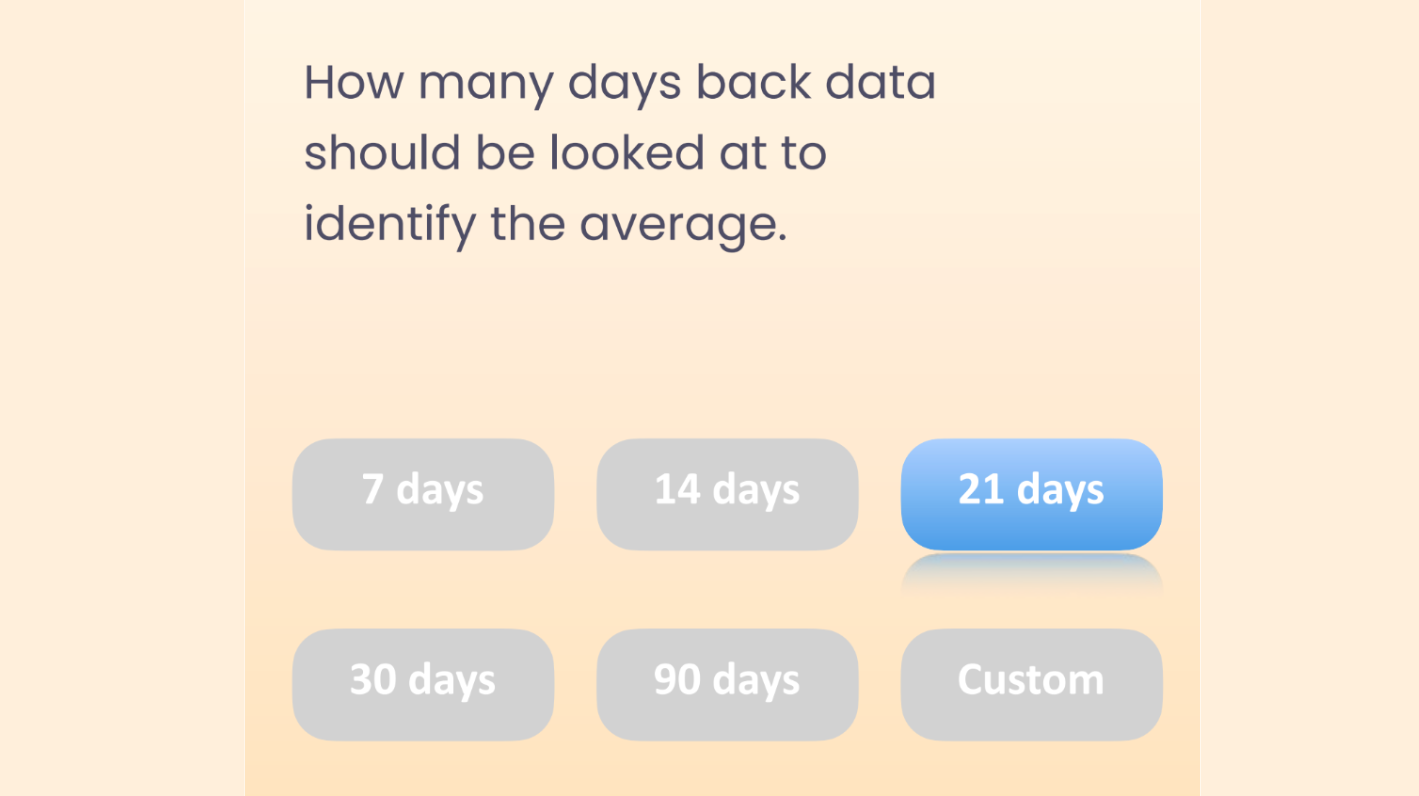
League placement is determined not by daily or weekly spikes but by a 21-day rolling average of daily steps. Other time windows (7, 14, 30, 90 days, or custom) are available, but 21 days is the default.
That means:
-
You can’t “hack” your way to the top with one or two extreme days.
-
Small improvements in your daily routine matter a lot.
-
Falling back into sedentary patterns shows up quickly in your league.
The system evaluates your pattern, not your isolated performances.
Bronze, Silver, Gold: Tiers That Reflect Real Behavior

Wellness League uses a simple three-tier structure:
-
Bronze represents a basic activity baseline (e.g., roughly 3,000 steps/day).
-
Silver reflects stronger, more regular activity (around 5,000 steps/day).
-
Gold is reserved for employees maintaining higher levels (around 8,000+ steps/day).
The system is fully transparent. Users can view:
-
Their current 21-day average,
-
Their current league tier, and
-
The average required (and duration needed) to progress to the next tier.
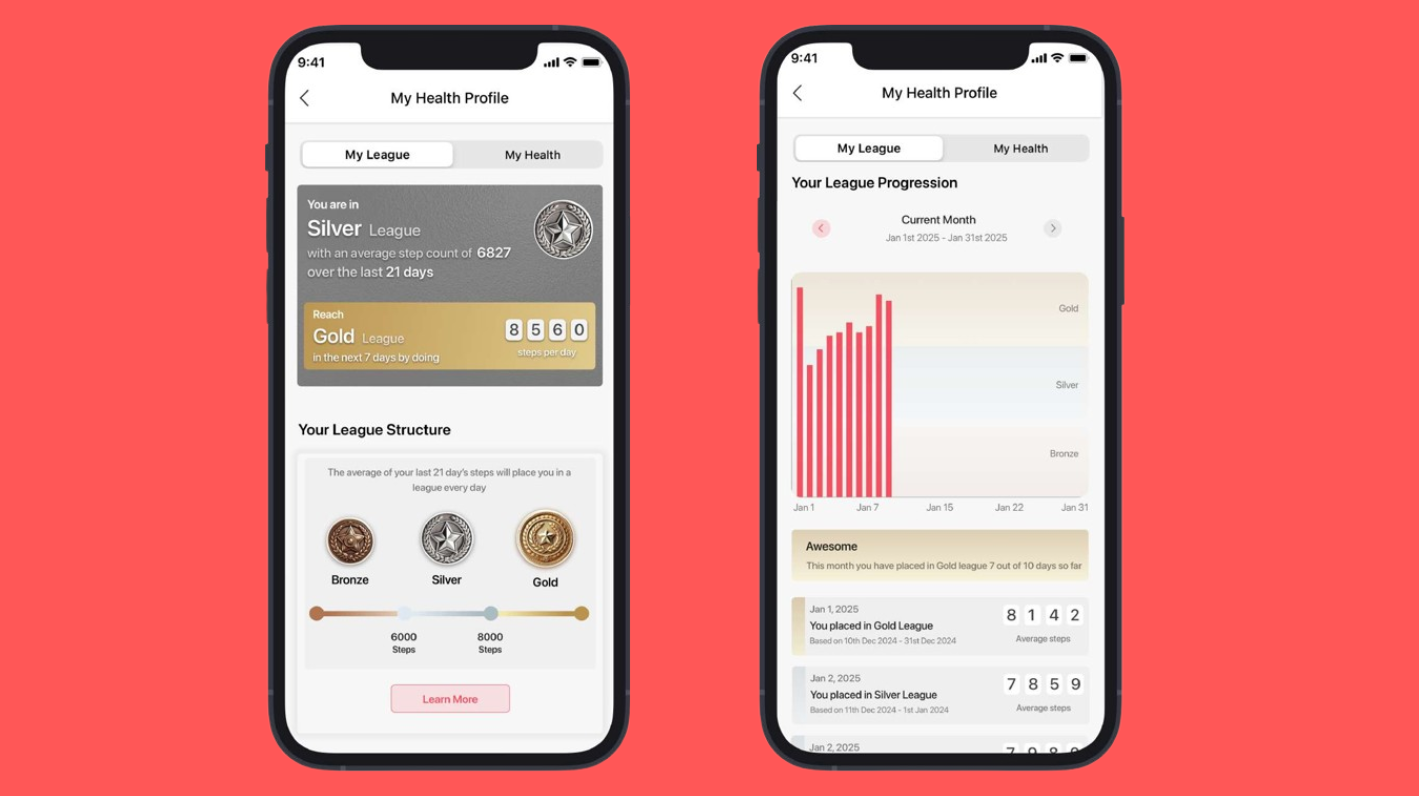
That’s exactly the kind of transparency good loyalty systems use to keep people engaged.
Stability is Rewarded, Peaks Are Not
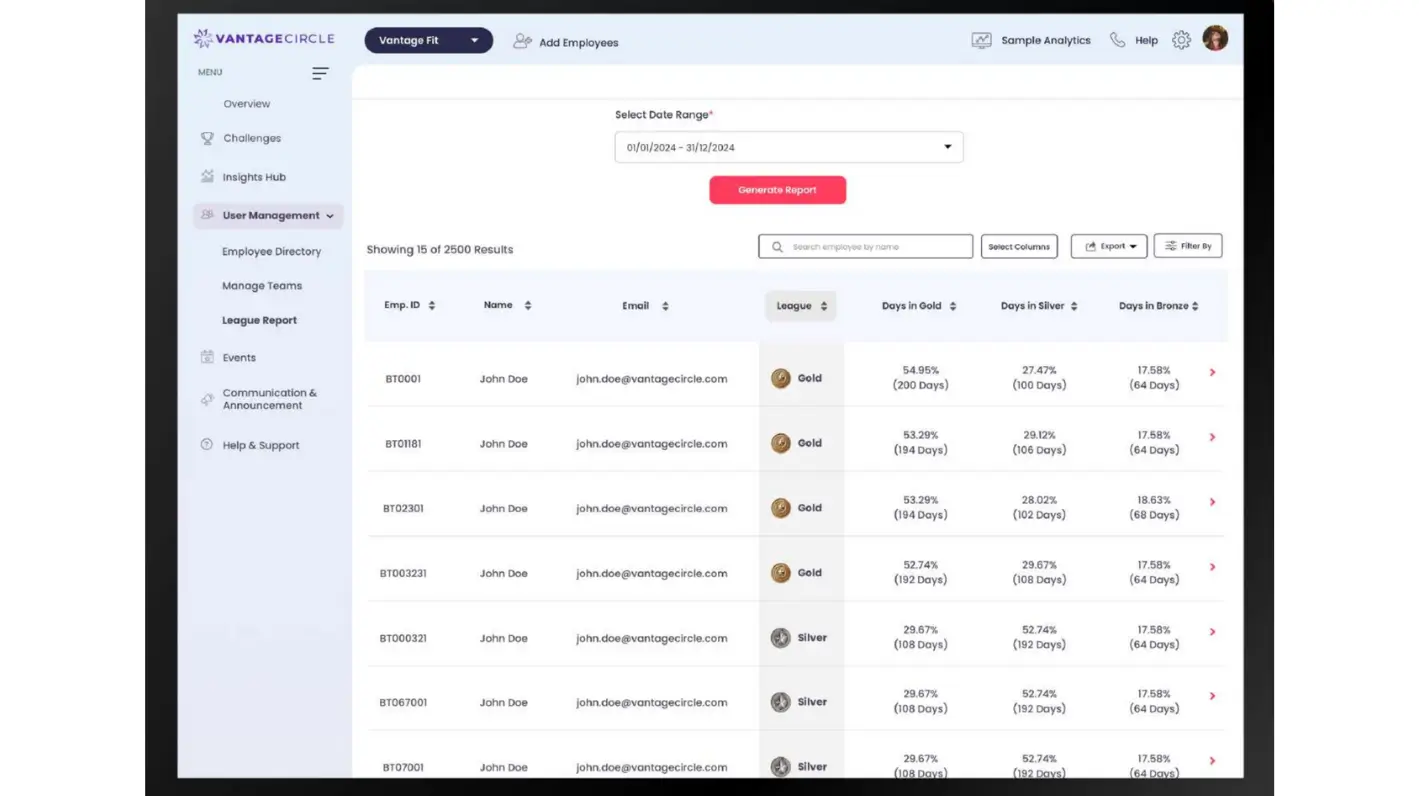
Because everything runs on a rolling average, the system naturally favors stability:
-
Moderate but consistent movers get recognized and hold their position.
-
Sporadic, high-volume days with long gaps in between don’t translate to sustained status.
In other words, the logic aligns with health reality: habit strength beats occasional intensity.
HR Gets a Real Behavioral View, Not Just a Challenge Report
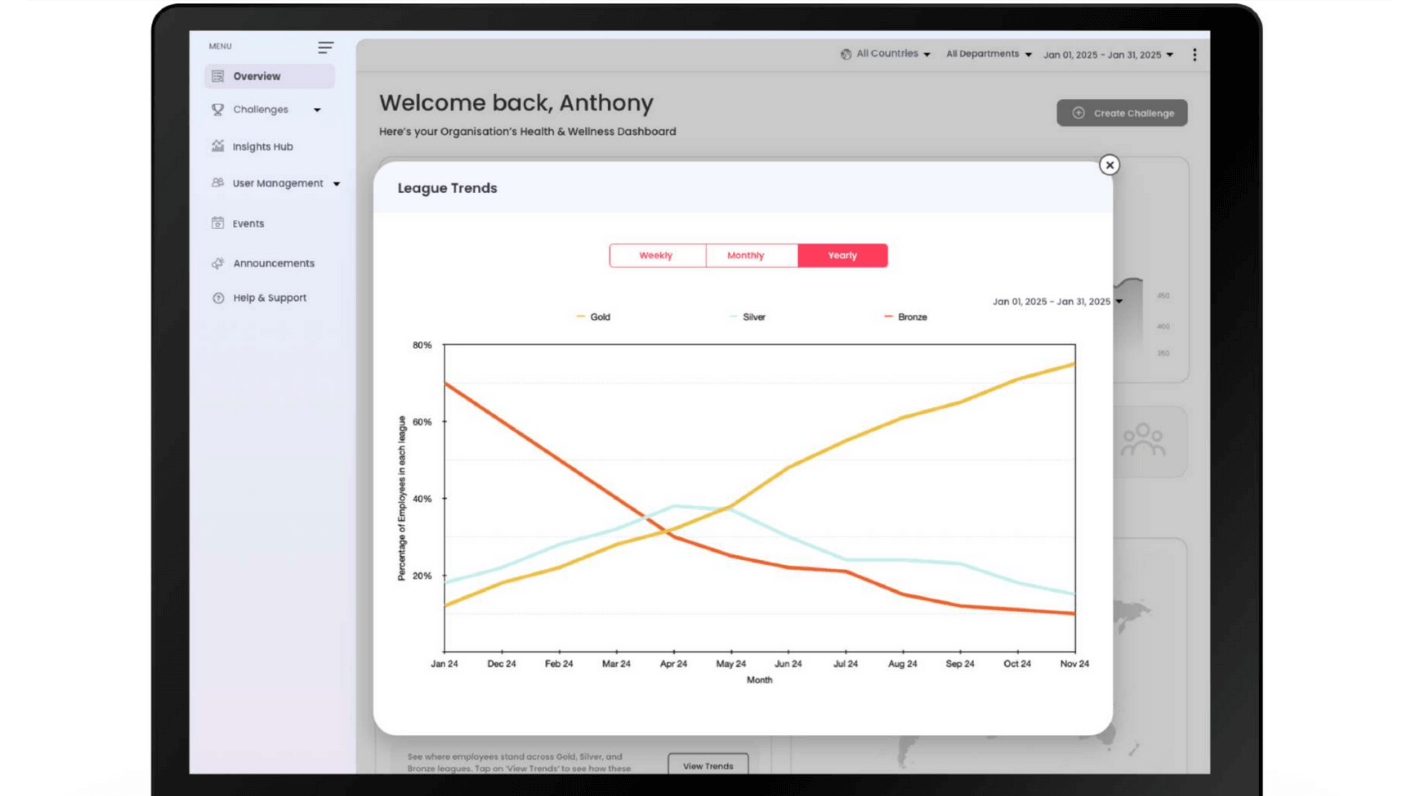
For HRs, Wellness League turns all of this into a new level of visibility:
-
You can see the distribution of employees across Bronze, Silver, and Gold—which doubles as a rough map of movement behavior in your workforce.
-
You can track how that distribution shifts over months and quarters, not just during a single event.
-
You can see if higher leagues are holding steady or collapsing as soon as a campaign ends.
At that point, you’re not just saying “We had 70+ percent participation.” You’re asking far more honest questions:
-
“Are we gradually moving people out of the lowest activity bands?”
-
“Are we keeping people in healthier patterns over time?”
-
“What happens to our leagues when incentives change?”
This is the difference between running wellness events and managing wellness behavior.
Final Thoughts
A fitness loyalty approach won’t solve every organizational wellness challenge, but it accomplishes something most traditional programs do not: it makes consistency both visible and valuable.
Employees finally see that sustained, everyday movement, not occasional peak performance, is what earns recognition. It also gives HR a true behavioral baseline, offering a clearer picture of how active the workforce actually is and whether those patterns are improving over time.
Most importantly, it creates a structure that outlives any single challenge; wellness stops being episodic and becomes a year-round system built on tiers, patterns, and progression. Fitness loyalty programs work because they’re designed around behavior rather than hype.
The real question is when workplaces will stop treating wellness like a series of disconnected events and start building loyalty systems where healthy habits can actually grow.