
The purpose of wellness programs is to encourage employees to adopt a holistic approach to health and well-being. It is a very thoughtful approach for employees to take wellness seriously in an age when people get consumed by work and forget even to move around. However, even well-intentioned initiatives can produce unintended consequences.
In the case of wellness programs, HR is witnessing a phenomenon known as "Wellness Fatigue." Ironically, something designed to support well-being can lead to exhaustion.
Yes, wellness fatigue is real, and the term has been around for quite some time.
What Is Wellness Fatigue?

Wellness fatigue results from an overload of poorly executed wellness initiatives.
Simply put, wellness fatigue is a state in which the task of leading a healthy lifestyle becomes exhausting and unfulfilling. Or when wellness activities feel like obligations on a to-do list rather than meaningful lifestyle enablers.
Why Wellness Programs Lose Momentum
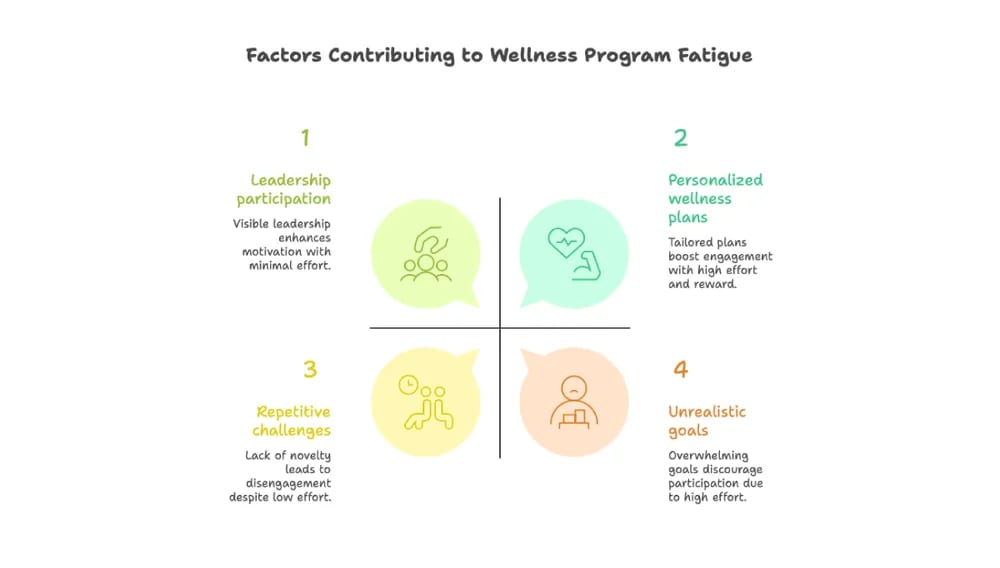
When employees are repeatedly exposed to the same old wellness programs, they lose interest in them. Instead, they feel pressured to take part in initiatives that do them no real good.
The usual scene when it comes to a wellness program looks something like this:
Repetitive step challenges
Infrequent or generic webinars or workshops
More emphasis on physical health and less on mental/emotional health
Lack of personalization
At first glance, hosting wellness programs may appear supportive and effective. However, if HR teams don't get creative over time and just repeat the same initiatives, employees will get bored and start to question the need for these programs.
Let's look into why wellness programs lose their appeal over time.
Firstly, novelty wears off. The first challenge feels fresh and exciting; by the fourth, it's déjà vu. When the initiative format repeats, motivation naturally drops.
Secondly, most programs demand too much effort. Long, unrealistic challenges or manual reporting become just another task to finish. Many employees simply opt out at this point.
Thirdly, when the perceived reward does not justify the effort required. Giving a small reward for a significant effort is one of the biggest reasons for low participation. When employees feel the payoff isn't worth the effort, engagement drops.
Finally, the absence of visible leadership participation quietly erodes program momentum. When managers don't participate or acknowledge wellness initiatives, employees read the sign clearly as "This isn't truly important."
Related read: 13 Reasons Why Corporate Wellness Programs Fail & Ways to Avoid Them
Signs Your Workplace Is Experiencing Wellness Fatigue
Wellness fatigue is a byproduct or a symptom of many poorly designed or failed wellness programs. HR needs to be aware of subtle signs of wellness fatigue before it is too late.
Below are some common signs:
Participation spikes at launch, followed by a sharp decline as the challenge progresses.
The same small group of employees participates every time. And even they start skipping the initiatives.
Employees join challenges but don't complete the tasks.
Engagement is driven only by rewards, not intrinsic motivation.
Feedback includes phrases like "preoccupied with urgent work," "not for me," or "again?"
Managers rarely mention or model wellness behaviors.
Employees engage passively, completing only the minimum activity required to qualify.
How Wellness Fatigue Shows Up for Different Types of Employees
Wellness fatigue can manifest differently among various employee groups.
Working parents:
Working parents juggle heavy home responsibilities with work. Adding an 8k-steps-per-day challenge on top of that can feel impossible. The struggle is not due to lack of interest, but lack of time. Many won't participate, or if they do, they can't complete it. In short, they're already at capacity.
When organizations enroll these employees in an 8,000-steps-per-day challenge as part of a wellness program, most of them will most likely not take part.
The common reason is that they don't have time for it. And even if they do participate, there are slim chances they will finish the task due to time constraints.
Gen Z & early-career employees
Gen Z grew up in a fast-paced, tech-driven world. They expect quick wins and instant results, even in wellness. They're also digitally saturated; after long hours on screens, joining another online wellness webinar feels like more work, not a break.
Mid-level managers
These individuals are caught between team pressure and top leadership expectations. Wellness only feels like a distraction from meeting deadlines.
This turns out to be the case, especially when performance metrics don't generously reward well-being. Without explicit reinforcement from leadership, this group quietly deprioritizes wellness initiatives.
As a result, participation and engagement in wellness programs decline, leading to wellness fatigue over time.
Suggested read: Want Better Employee Engagement in Wellness Programs? Start Here!
Senior leaders
Senior leaders are time-strapped and laser-focused on ROI. If a wellness program appears to be 'fluff' with no clear impact, they'll fund it but often won't personally engage with it. They view it as nice-to-have, not a necessity.
Remote & hybrid employees
Remote and hybrid employees face blurred work-life boundaries and significant digital fatigue. If wellness initiatives rely heavily on live in-office sessions, these employees feel excluded. Conversely, if it's all app-based or virtual, it might just feel more screen time. A balance is needed to engage them truly.
High-burnout teams (sales, support, operations)
In high-pressure teams (sales, support, operations), every minute is tied to targets or tickets. In these environments, optional wellness goals feel burdensome. Unless well-being is built into the workday, these programs won't survive. Instead, wellness just becomes another stressor.
How to Re-Energize Your Wellness Program

Wellness fatigue does not signal failure; it provides valuable feedback on program design. This phenomenon serves as feedback on whether a wellness program is genuinely improving employee health. So, if there are clear signs of wellness fatigue in the organization, it is time for the program to reset or evolve.
Here are some practical and sure-shot ways to bring life to a wellness program:
1. Wellness programs must align with employees’ actual health needs
Here is one way Vantage Fit addresses this is through its Health Report feature:

With Vantage Fit's health report update feature, employees can voluntarily update key health markers, helping identify broader health trends such as vitamin D deficiency, diabetes risk, and cholesterol concerns without revealing individual data. HR teams only see aggregated percentages, never names or personal records.
These insights enable organizations to move away from one-size-fits-all initiatives and create targeted, need-based wellness challenges for specific groups. This way, they maintain participants' complete privacy.
Focusing on real health trends rather than blanket activities makes wellness programs feel purposeful rather than repetitive. In the long run, this approach reduces wellness fatigue and rebuilds engagement.
2. The initiative should offer realistic and somewhat generous incentives
HR often looks away from the power of incentives. They focus on cutting costs and reducing the incentives attached to wellness programs. For them, offering a standardized wellness program is an incentive for employees.
It's human nature to respond to gratification. If a wellness program offers only minimal rewards, it loses its charm. Employees simply won't invest if the payoff isn't worth it.
In short, meaningful incentives are essential to keep a wellness program engaging and effective.
3. HR should tackle the real wellness issues instead of just hosting another step challenge
Physical wellness is essential but so are mental and emotional health. Many mental health issues (like chronic stress or mild depression) can fly under the radar until they become severe.
By the time obvious symptoms appear, the problem is deeply rooted. This is similar to how early warning signs of serious health conditions often go unnoticed until they become severe. HR should proactively address mental health and offer a holistic wellness program, rather than just another step challenge.
Similarly, HR teams should proactively address a broader range of mental and emotional health concerns.
The Role of Company Culture in Preventing Wellness Fatigue
Wellness fatigue is not only caused by weak programs. It is also a repercussion of a weak work culture.
High-profile business leaders have publicly advocated extreme work hours in pursuit of outsized outcomes. When leaders normalize burnout, reward constant availability, or treat wellness as a mere checkbox, employees take the cue that well-being isn't truly valued.
As discussed in my earlier thought leadership blog, 'Workplace Wellness Is a Lie', wellness initiatives will fail if they're merely band-aids for poor job design or unhealthy workplace expectations.
Culture and program design are root causes of wellness fatigue. Organizations can prevent this state if they focus less on optics and more on everyday behaviors like:
How managers support boundaries
How workloads are designed
Whether people feel psychologically safe enough to prioritize their well-being.
When company culture does the heavy lifting, wellness stops feeling forced upon and starts working.
Why Addressing Wellness Fatigue Matters
Wellness fatigue is not something HR should take lightly. It is a compounding business risk. And the longer it goes unaddressed, the more expensive it becomes for the organization.
| Impact Area | What the Data Shows | Why It Matters |
|---|---|---|
| Burnout cost | Burnout costs organizations $4,000–$21,000 per employee per year. | Fatigue quietly drains productivity long before attrition shows up. |
| Productivity loss | Disengaged employees are ~18% less productive. | Wellness fatigue directly affects output, not just morale. |
| Attrition cost | Replacing an employee costs 0.5–2 times the employee's annual salary. | Burned-out employees are far more likely to leave. |
| Budget waste | Low-participation wellness programs still consume full budgets. | Money is spent without meaningful returns in health or engagement. |
| Trust erosion | Poor programs reduce future adoption rates. | Once credibility is lost, even better programs struggle to gain traction. |
Wellness fatigue does not indicate apathy toward well-being. It signals a disconnect between wellness design and how employees actually live and work.
When programs feel generic or performative, participation drops, trust erodes, and budgets lose impact.
The real cost is not just low engagement or participation rate. It is the missed opportunities that could have prevented burnout and turned well-being into a driver of performance.
Sustainable wellness starts with culture, not challenges. Here are the top 3 drivers to practice it:
Managers who model healthy behaviors
Programs rooted in real employee needs
Data that enables more innovative interventions.
This is where a platform like Vantage Fit can make a difference – by helping organizations move from one-size-fits-all wellness to targeted, privacy-first, data-driven programs that deliver measurable ROI.
Because wellness that works doesn't drain employees; it supports them and strengthens the business.
Frequently Asked Questions About Wellness Fatigue
1. Can wellness fatigue happen even if participation numbers look good?
Yes. Participation can be driven by incentives or pressure, not genuine engagement. Wellness fatigue reflects when repeat participation drops, or employees disengage once rewards are removed.
2. How does remote or hybrid work increase the risk of wellness fatigue?
Remote and hybrid work blur boundaries and increase digital fatigue. Wellness programs that rely on fixed schedules or more app-based activities often feel like extra work, accelerating disengagement instead of improving well-being.
3. What's the ideal length for wellness challenges to prevent fatigue?
The ideal length of wellness challenges is 2 to 4 weeks.
4. How does reward timing influence wellness fatigue?
Delayed rewards weaken motivation and make efforts feel unnoticed.
Share