











15 Inclusive Employee Wellness Challenge Ideas That Don’t Exclude Anyone

Most wellness programs serve a narrow ideal: they center the able-bodied, using routines and metrics that exclude anyone who doesn't fit the mold. These standards have become so ingrained that they go unquestioned, rendering exclusion invisible.
The impact of such exclusion is profound. Employees with neurodiversity or social anxiety often avoid public performance metrics. Cultural differences such as dietary restrictions, modesty concerns, language barriers further limit participation.
Inclusive wellness challenges recognize this and choose to welcome everyone with open arms. They emphasize hybrid-friendly, low-pressure, and accessible formats that honor individual journeys.
Companies with robust DEI programs report 41% higher employee engagement, 22% lower voluntary turnover, 37% fewer discrimination incidents, and 28% higher psychological safety scores.
On that note, this guide aims to help HR teams rethink inclusivity in wellness challenges and embed it into every design decision. Better experiences foster better outcomes for people and organizations alike. Here's how to design challenges that work for everyone — and why it matters.
The 5 Principles of Inclusive Wellness Challenge Design
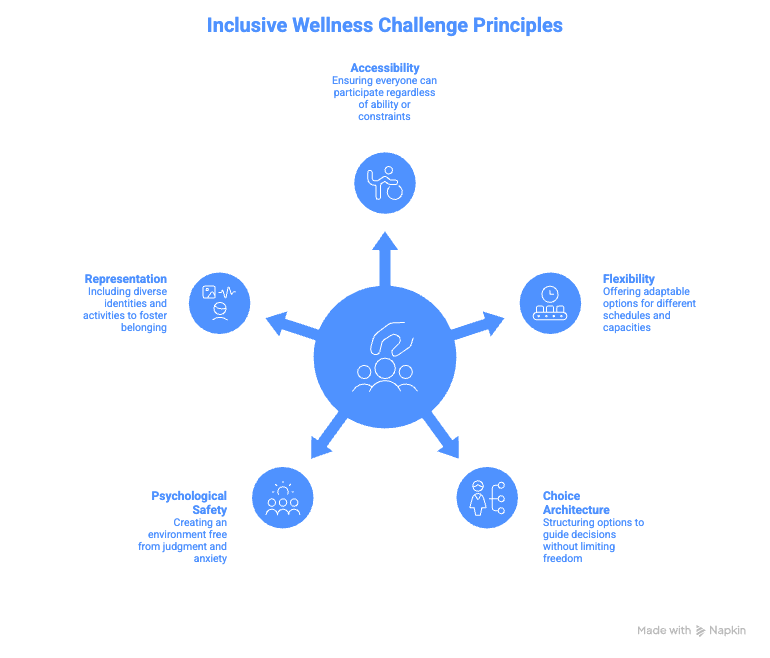
True inclusivity starts with one question: 'Who did we exclude?' Instead of building a standard program and adding accommodations later, design outward from the answer. The five principles that follow ensure that physical ability, background, or circumstance never determine who belongs in your wellness challenge.
The first principle is-
1. Accessibility
Accessibility means designing challenges that everyone can engage with, regardless of factors such as physical/cognitive ability, digital literacy, work pattern, or resource constraints.
Research from a fitness center serving people with disabilities reveals how accessibility is key. A progressive exercise program initially used a clinical approach focused on diagnosis and treatment. When staff shifted focus to emphasize independence and routine, offering both seated and standing exercises, minimal prerequisites, and community-building alongside fitness, participation expanded dramatically.
Companies usually get things wrong by locking the challenges into a single format and then adding exceptions around the edges.
An inclusive challenge reverses that order. It begins by asking: Is everyone on board?
Facilitate your employees' wellness journeys without restrictive constraints
2. Flexibility (Pace, Intensity, Timing)
The second principle, flexibility, recognizes that shift workers, caregivers, and employees juggling multiple responsibilities need adaptable options.
Companies often enforce strict weekly deadlines, fixed intensity levels, and synchronized activities that favor staff with predictable schedules. An inclusive challenge, however, offers multiple difficulty levels and flexible timing, allowing employees to choose what suits their capacity and schedule.
A manufacturing facility allowing asynchronous logging saw shift worker participation jump from 18 to 54 percent in six months. Workers logged whenever their shifts allowed.
3. Choice Architecture (“Multiple Equivalent Paths”)
Choice architecture refers to the intentional way choices are structured and presented to guide how people make decisions. It is done without limiting their freedom to choose.
Popularized by Thaler and Sunstein, the concept is built on the idea that the way options are arranged, framed, or set as defaults can significantly influence behavior.
In the context of wellness challenge, choice architecture entails structuring wellness options so employees can pursue health in their own way.
For instance, most companies build step challenges as "primary," then add meditation as "alternative." Such an approach can prove to be faulty. Instead, activities such as walking, swimming, strength training, yoga, dancing, and martial arts must all earn the same points.
This shift matters because choice eliminates ranking.
4. Psychological Safety
Psychological safety refers to employees participating without the fear that their body, performance, or choices would be judged, ranked, or made visible without consent.
Most organizations weaponize comparisons. Public rankings force participants into unwanted measurements. Besides, visible metrics trigger anxiety for participants already managing disability, body image concerns, or health stigma.
Inclusive challenges help dissolve judgment. Workers of any ability level, any health status, or any demographic background can participate without fear of exposure or comparison.
If people don't feel comfortable participating, the challenge has already failed its purpose.
5. Representation (Activities for Diverse Identities)
Most corporate wellness programs feature narrow imagery. Young and able-bodied figures, white faces, and sculpted structures take the main stage. Larger bodies disappear entirely.
Moreover, older, disabled, women of color, and LGBTQ+ employees feel alienated if not represented equally.
The cumulative effect teaches that certain bodies, abilities, and backgrounds are the standard for wellness. People read the imagery and sadly conclude the program wasn't built for them.
Inclusive challenges embed representations structurally. Imagery features people across ages, body types, abilities, races, genders, and contexts.
Activities expand beyond traditional fitness to include yoga from multiple cultural traditions, tai chi, qigong, dance, martial arts, and culturally specific wellness practices. Communications appear in multiple languages matching workforce demographics.
These structural choices ensure no one feels like an afterthought.
Build a wellness culture with our science-backed ready-to-use bingo template with seven card variations
With these five principles as your foundation, here are 15 challenges you can host for your diverse workforce:
15 Inclusive Employee Wellness Challenge Ideas
We have divided the challenges into 5 major categories and have taken into account the many factors that define the nature of inclusivity. Let's check them one by one:
Low Impact & Accessible Movement Challenges
1. Active Minutes Challenge (any movement counts, including seated)
Why it’s inclusive
An active minutes challenge counts all forms of movement, making it accessible for participants with mobility limitations, chronic pain, or varied fitness levels. Inclusivity is absolute because effort and participation are preferred over intensity.
How to host it
Have your team members log any movement throughout their day and keep these factors under consideration:
- For mobility issues: Count wheelchair pushes, seated resistance‑band work, upper‑body stretches, or even supported standing for a few seconds as valid active minutes.
- For chronic pain: Participants can choose gentle activities that don’t exacerbate pain, such as chair yoga or slow walking.
- For different fitness levels: Employees can set personal goals (e.g., 5 minutes of movement per day) and track progress at their own pace.
- For remote/hybrid workers: Use an app or simple form where employees log “active minutes” in open text (what they did + how long), so that untrackable activities like stretching in the kitchen or pool exercises still count.
Penalize no one for their physical capacity.
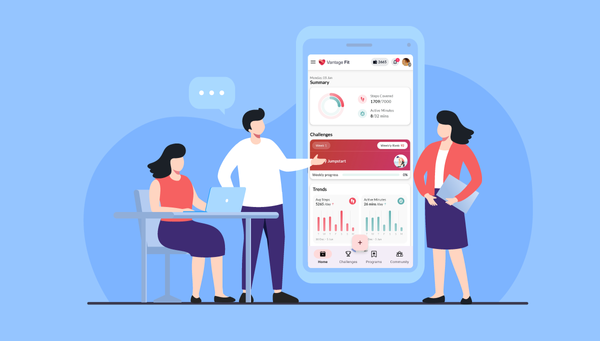
You can also level up this challenge with Vantage Fit’s new Active Minutes metric, which captures how many minutes someone has been physically active above a baseline heart rate. It then surfaces that as a clean, time-based number instead of calories burned.
2. Gentle Yoga / Mobility Challenge (with on-demand videos)
Why it’s inclusive
Stiffness, balance, and breath regulation are some of the common barriers for older, neurodivergent employees, and those returning from injury. A gentle yoga and mobility challenge helps tackle these issues by offering flexibility in how participants move their bodies.
How to host it
These are some things you can facilitate:
- Curate a library of on-demand videos so workers participate whenever it fits their day and energy level.
- Include seated yoga for participants with mobility limitations, chair-based routines for those who can't stand for long, and restorative poses for employees managing chronic pain.
- Offer beginner, intermediate, and advanced options, so fitness level doesn't dictate participation.
- Include video lengths from 5 to 30 minutes, so energy and time constraints don't block participation.
Hire or feature instructors from diverse body types, ages, and abilities. Show modifications for every pose; lay less emphasis on the "advanced" version. Avoid language like "no excuses" that shame people whose bodies have legitimate limits.
3. Chair Movement or Stretch Break Challenge
Why it’s inclusive
The chair is the default setup here. It serves as a common base between wheelchair users, people with balance issues, and fully mobile employees. By focusing on upper-body mobility and spinal alignment, the challenge becomes safe and approachable, especially for those living with chronic pain or fatigue.
How to host it
- Design simple routines centered on upper-body mobility and spinal alignment, using the chair for stability throughout.
- For chronic pain sufferers, offer two tracks:
“Relief” for slow, small ranges of motion and longer breath-holds.
“Activation” with slightly larger ranges for better-pain days.
- For different fitness levels, keep the base challenge simple, then add optional progressions like light dumbbells or resistance bands.
- Schedule two or three short live video breaks weekly and keep recordings on demand for shift workers and remote employees.
Mental & Emotional Wellness Challenge Ideas
4. Emotional Check-In & Naming Challenge
Why it’s inclusive
Most often, challenges demand positivity, erasing the experiences of people experiencing loss or life transitions. This challenge normalizes the full spectrum of emotional wellbeing and asks people to notice what emotion is present without judgment.
How to host it
- Invite employees to do a brief emotional check‑in at a frequency that works for them (daily or weekly).
- For neurodivergent individuals: provide emotion wheels, word banks, or visual scales to support identification and expression.
- For anxiety or burnout sufferers: explicitly normalize all emotions as valid and avoid labeling feelings as “good” or “bad.”
Offer optional weekly pulse check-ins or 1‑on‑1 debriefs with a manager, coach, or peer supporter for those wanting extra support.
5. 5-Minute Mindfulness Challenge
Why it’s inclusive
Traditional mindfulness programs often insist on 20‑minute meditations or silent retreats, which can exclude staff with ADHD, anxiety, busy schedules, or sensory sensitivities.
A five‑minute mindfulness exercise is short enough to feel achievable, helping neurodivergent employees and overwhelmed workers build a real habit without pressure.
How to host it
Below are certain considerations you can think of:
- Invite employees to practice mindfulness for just 5 literal minutes per day.
- For employees with ADHD: emphasize that short bursts are often more effective than longer sessions that trigger restlessness.
- For neurodivergent employees who struggle with sustained attention, position the challenge as “micro‑practice” that can be repeated, not a test of focus.
- For people from diverse cultural backgrounds: offer a menu of practices such as pranayama, sini-mas breathing, simple grounding exercises, or walking meditation instead of only Western “mindfulness.”
Track participation through simple check-ins. Let staff choose their mindfulness style: apps like Insight Timer or Calm, YouTube guided meditations, their own silent practice, or walking meditation.
Offer recorded snippets which are accessible anytime for remote workers.
6. Cultural & Spiritual Wellness Practice Challenge
Why it’s inclusive
This challenge works across belief systems, ability levels, and schedules, centering people’s own cultural and spiritual traditions instead of sidelining them. Cultural minorities can finally see their wellness practices recognized as valid and meaningful, not treated as optional “extras.”
How to host it
- Invite employees to engage in one spiritual wellness activity rooted in their own culture or spirituality, such as prayer, meditation, journaling, yoga, tai chi, qigong, breathwork, reading sacred texts, or community rituals.
- Spotlight different traditions in internal communications over the course of the challenge: Islamic prayer routines, Hindu mantras, Indigenous grounding practices, Jewish meditation, Christian contemplation, and others.
Keep participation completely private. Never ask team members to explain or justify their spiritual practices. Respect that some workers prefer solitude for this work. Provide quiet spaces in offices if possible.
Social & Connection-Based Wellness Challenges
7. Peer Gratitude Challenge
Why it’s inclusive
Connection drives belonging, yet forced group activities exclude introverts, remote workers, neurodivergent employees, and people with social anxiety. A peer gratitude challenge allows people to connect in ways that feel safe — written, private, or asynchronous — and ensures quieter contributors are also recognized.
How to host it
- Have workers express gratitude toward one peer each week in whatever way feels comfortable: a private message, an email, a note on a shared board, or a brief conversation.
- Encourage gratitude messages that highlight how someone helped, welcomed, mentored, or brightened a tough day.
- For neurodivergent people who struggle with small talk, emphasize that written appreciation is equally valid and gives space to be thoughtful and authentic.
- Intentionally highlight and reward gratitude directed toward quieter participants and behind‑the‑scenes contributors so recognition is not limited to visible roles.
Motivate healthy behaviors through our innovative incentives and rewards system
8. "Inclusive Coffee Chats" Challenge
Why it’s inclusive
Most team bonding happens through office spontaneity or large group events. This in turn might make remote workers, introverts, and socially anxious employees feel left out. Structured, one‑to‑one coffee chats with choice over format give everyone a manageable, low‑pressure way to connect.
How to host it
- Pair participants for one 15‑minute conversation with someone they don't normally talk to — across departments, locations, or seniority.
- Offer flexible formats: video, phone, walking call, or even asynchronous chat for those who find real‑time conversation draining.
- For introverts and anxious workers: match them with genuinely calm people, share conversation prompts a week in advance, and reassure them that small talk is not required.
- Ensure remote and hybrid workers can join equally via digital channels and are not treated as an “add‑on” to office-based pairs.
A Deloitte analysis found organizations with inclusive cultures are 2× as likely to exceed financial targets, 3× as likely to be high‑performing, 6× more likely to be innovative and agile, and 8× more likely to achieve better business outcomes overall.
9. "Reach Out & Check In" Challenge
Why it’s inclusive
People often feel isolated at work, especially remote workers, new joiners, and those going through stress or life changes.
One‑to‑one check‑ins give space to voice what is not openly discussed and can be especially powerful for employees navigating identity invisibility (e.g., LGBTQ+ workers, immigrants, people with invisible disabilities).
How to host it
- Invite staff members to reach out to one colleague each week, not for work purposes, but to genuinely check in.
- Provide simple prompts like:
- “How are you really doing?”
- “Haven’t connected in a while and wanted to touch base.”
- Normalize brief, low‑effort outreach so the challenge doesn’t become another heavy to‑do.
- Highlight how this is especially supportive for remote workers who have limited informal interaction.
- Train managers on how to respond when concerns emerge and when to escalate to HR or wellbeing resources.
- Emphasize consent: employees are free to decline or set boundaries if they don’t want to share details.
Employees going through rough patches feel genuinely seen when someone notices. Train your managers to escalate when concerns emerge.
Healthy Routine & Daily Habit Challenges
10. Notification & Digital Boundaries Challenge
Why it’s inclusive
Notifications fracture focus and keep people in a constant state of alert. Employees with ADHD lose executive function with each ping; anxious workers stay hypervigilant; remote employees blur work-life boundaries by checking emails outside hours.
A digital boundary challenge acknowledges these realities and empowers everyone to reclaim attention, regardless of role or schedule.
How to host it
- Invite employees to silence non‑essential alerts, batch emails to two or three set times, and block 90 minutes of uninterrupted work daily.
- Announce clear team norms like “9–11 AM focus blocks, no meetings,” so leadership visibly supports it and workers feel safe stepping away from inboxes.
- Provide short how‑to guides on using do‑not‑disturb modes, priority notifications, and calendar blocking across devices.
Let people choose their window based on their timezone or shifts.
11. Healthy Lunch & Snack Swap Challenge
Why it’s inclusive
Nutrition challenges often fail because they impose one “healthy” standard on employees with different budgets, cultural practices, allergies, and health conditions.
A snack swap challenge puts agency back in employees’ hands and honors diverse definitions of “better” aligned with personal goals and restrictions.
How to host it
- Have your team members choose one snack they currently eat and replace it with a better option aligned with their specific goals.
- Provide examples across diverse cuisines, not just Western health food culture, so everyone sees themselves represented.
- For employees managing diabetes: suggest swaps like sugary snacks to nuts, yogurt, or high‑fiber options.
- For remote workers: frame the challenge around home snacking patterns, not just office pantries.
- For shift workers: share shelf-stable, grab‑and‑go ideas that work with limited break-room access.
Honor dietary restrictions from religion, allergies, and chronic illness without questioning. Provide examples across diverse cuisines, not just Western health food culture. Provide budget-conscious participants with affordable swap suggestions, not premium options they can't access.
12. Posture & Ergonomic Micro-Habits
Why it’s inclusive
Most employees with chronic pain or mobility differences skip traditional fitness challenges entirely. A workplace ergonomics challenge changes this by making a few bodily tweaks in how people go about their day.
Such a challenge is accessible to those who can’t or don’t want to exercise in conventional ways, including neurodivergent workers who constantly fidget or shift.
How to host it
- Have employees pick one posture or ergonomic habit they can adjust throughout their workday, such as:
- adjusting chair or screen height,
- taking position breaks every hour,
- using lumbar support or footrests,
- alternating between sitting and standing, if possible.
- Provide ergonomic assessments or personalized guidance for people with documented pain conditions instead of generic tips only.
- Celebrate micro-wins — like fewer headaches or reduced stiffness — rather than dramatic before‑and‑after stories.
- Include remote workers by sharing simple home office hacks using everyday items (pillows, books, boxes) rather than expensive equipment.
Purpose, Culture & Community-Oriented Challenges
13. Volunteer Hours Challenge (Digital & Low-Energy Options)
Why it’s inclusive
Research proves that purpose-driven work tackles burnout better than any fitness app. Yet traditional volunteer opportunities exclude workers who can't travel, have mobility limitations, have a chronic illness, or have caregiving responsibilities.
A flexible volunteer hours challenge meets people where they are.
How to host it
- Invite employees to contribute volunteer hours in any way that fits their life, such as:
- in-person service,
- virtual mentoring,
- skill-sharing with nonprofits (e.g., data analysis, social media, writing),
- fundraising from home,
- advocacy or community organizing online.
- Frame it as “contribute your time in a way that works for you,” and make it genuinely optional for those who are exhausted and need rest.
- Ensure virtual and low‑energy options are easy to access and valued equally to in‑person volunteering.
- Where possible, provide paid volunteer time off so employees don’t feel guilty stepping away from work.
14. Sustainability Challenge (Small, Realistic Actions)
Why it’s inclusive
Employees want to contribute to environmental causes, but big sustainability goals can feel overwhelming, expensive, and unreachable.
A realistic sustainability challenge builds inclusion by focusing on tiny, no‑cost actions that require no particular physical ability or financial privilege.
How to host it
- Offer a menu of small, achievable actions such as:
- bring a reusable water bottle to work,
- skip single-use coffee cups for one week,
- use digital documents instead of printing,
- carpool or use public transit one day weekly,
- reduce meeting time by 15 minutes.
- Emphasize that even one or two chosen actions “count” — this is not about perfection or zero‑waste lifestyles.
Avoid shaming workers for their current habits. Offer realistic, affordable options. Don't force employees to spend extra money on "eco-friendly" products. Make digital participation equal to physical action, so remote workers aren't left out.
15. Gratitude to Community Challenge
Why it’s inclusive
Gratitude practices are known to reduce anxiety and build psychological safety. A community gratitude challenge shifts the spotlight from individual achievement to relational support, helping introverts, remote workers, and anxious employees participate in ways that feel authentic rather than performative.
How to host it
- Run a challenge where people acknowledge one person in their workplace community each week: someone who helped them navigate a problem, supported their growth, or made their day easier.
- Give multiple expression options: public recognition, a private message, or an anonymous note.
- Explicitly state that quiet, written, or anonymous appreciation is as valuable as public shout‑outs.
- Encourage teams to reflect on how these micro‑moments of recognition gradually shift culture from transactional to relational.
Final Thoughts
A world shaped for able-bodied convenience requires intentional effort to dismantle. These 15 inclusive wellness challenges offer a mini alternative. They prioritize accessibility over metrics, flexibility over rigid structure, and choice over prescription. These might not be perfect solutions, but they are honest attempts to honor how people actually live.
They acknowledge that wellness looks different to everyone. A parent managing caregiving needs flexibility differently from a shift worker. That a woman of color needs representation differently than someone who already sees themselves reflected everywhere.
Platforms like Vantage Fit make this practical with customizable tracking, Active Minutes for all movement types, and backend options to fit diverse needs without extra work.
It's an ongoing commitment to listening, adapting, and genuinely believing that every employee deserves wellness on their own terms.
Ready to launch your next inclusive wellness challenge with ease? Schedule a Vantage Fit demo today and take the first step toward improving your team's health.
FAQS
How to set up a wellness challenge at work?
Listen to those who aren't participating and why. Build accessibility into the foundation. Offer multiple equivalent pathways. Test with disabled employees and shift workers before launch.
What are wellness challenge ideas for different seasons?
- Spring: nature walks, gardening.
- Summer: swimming, water activities.
- Fall: hiking, outdoor movement.
- Winter: dance, yoga, cooking, volunteer work.
- Year-round: sleep tracking, meditation, journaling, strength training.
What are some wellness challenge team name ideas?
Some wellness challenge team name ideas could be:
Connection Collective, Wellness Explorers, Health Allies, Intention Squad, Mindful Movers, Vitality Crew, Movement Makers, Thriving Together, Balance Builders, Joy Seekers, Strength in Stillness, Community Roots.
What are the top apps to run wellness challenges?
Some top wellness challenge apps include Vantage Fit, Wellable, Limeade, BetterUp, and YuMuuv. Always prioritize platforms that support multiple tracking methods, offer private progress options, and allow customizable pathways over feature-heavy systems.